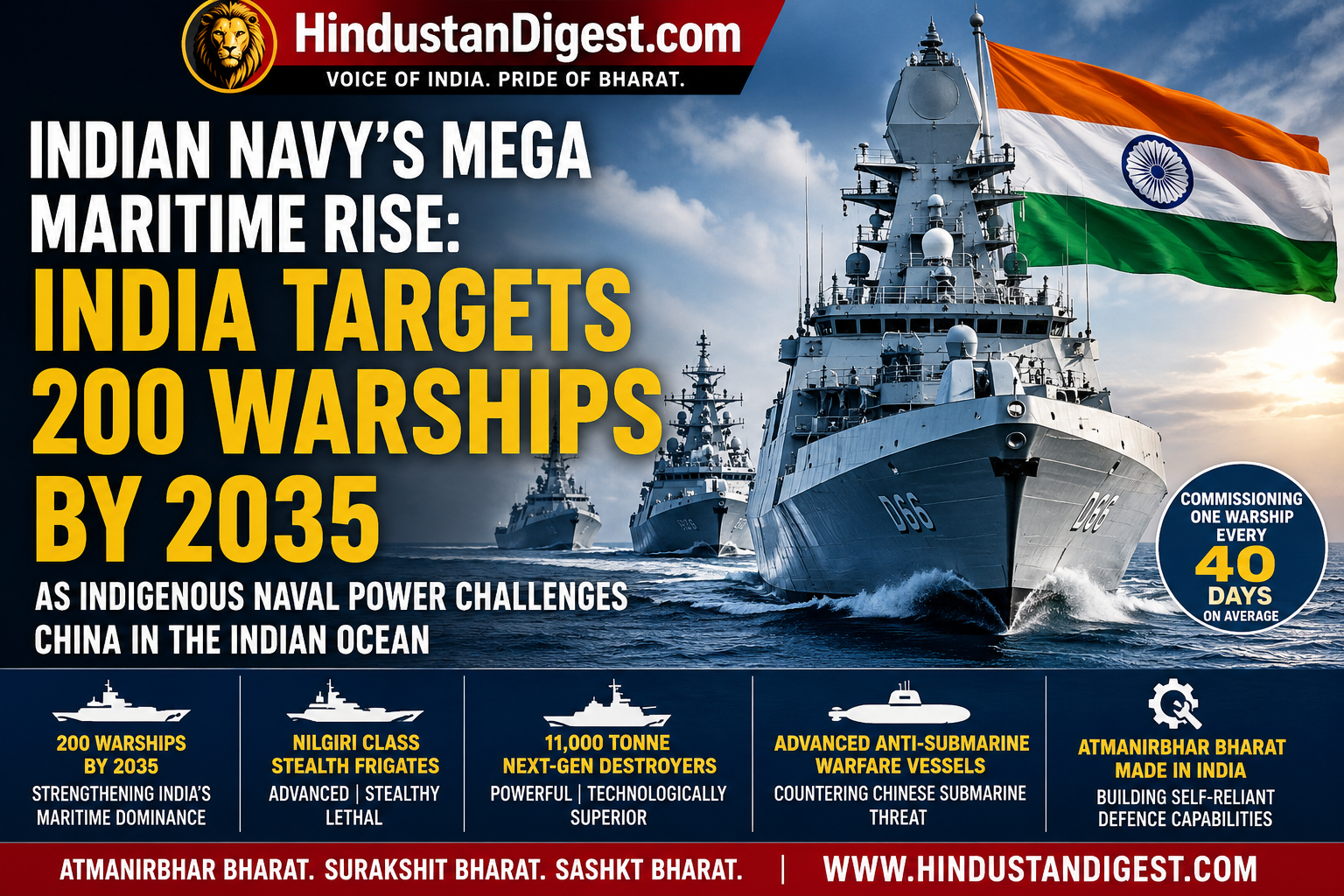
Indian Navy’s Mega Maritime Rise: India Targets 200 Warships By 2035 As Indigenous Naval Power Challenges China In The Indian Ocean.
India’s indigenous naval shipbuilding programme is transforming the Indian Navy into a 200-warship maritime force by 2035. From stealth frigates and destroyers to anti-submarine warfare vessels, India is rapidly expanding its naval dominance under Atmanirbhar Bharat.
Indian Navy’s Maritime Revolution Signals India’s Emergence As A Global Naval Power
India is witnessing one of the most ambitious military modernisation programmes in its post-independence history. The Indian Navy, once heavily dependent on imported platforms from Russia and Western nations, is now rapidly transforming into a powerful indigenous maritime force under the Government of India’s “Atmanirbhar Bharat” vision.
With plans to operate nearly 200 warships by 2035, India is sending a strong strategic message to adversaries and competitors alike — particularly Communist China, whose aggressive expansion in the Indian Ocean Region (IOR) has become a major security concern for New Delhi.
The Indian Navy’s indigenous shipbuilding programme is now progressing at an unprecedented speed, with warships being commissioned approximately every 40 days – a historic production pace unmatched in Indian naval history.
This transformation is not merely about increasing fleet size. It represents India’s larger geopolitical ambition to become the dominant maritime power in the Indian Ocean and a decisive player in Indo-Pacific security architecture.
The Rise Of India’s Indigenous Naval Manufacturing Ecosystem
For decades, India depended heavily on foreign suppliers for major naval platforms. Soviet and later Russian warships formed the backbone of India’s fleet, while critical systems came from Europe and Israel.
However, strategic realities changed dramatically after:
- China’s naval expansion in the Indian Ocean
- Beijing’s “String of Pearls” strategy
- Growing Chinese presence in Pakistan, Sri Lanka and the Maldives
- Frequent submarine deployments by the PLA Navy in the Indian Ocean
- Supply-chain vulnerabilities exposed during global conflicts
In response, India accelerated indigenous defence manufacturing under the Make in India initiative.
Today, over 95% of the Indian Navy’s new warship orders are being built in Indian shipyards.
Major Indian shipbuilding hubs now include:
- Mazagon Dock Shipbuilders Limited (MDL), Mumbai
- Garden Reach Shipbuilders & Engineers (GRSE), Kolkata
- Cochin Shipyard Limited (CSL), Kochi
- Goa Shipyard Limited (GSL)
- Hindustan Shipyard Limited (HSL), Visakhapatnam
These shipyards are creating thousands of skilled jobs while significantly reducing India’s strategic dependence on foreign defence suppliers.
INS Tamal Marks The End Of An Era
A symbolic milestone in India’s naval journey came in July 2025 with the commissioning of INS Tamal from Russia.
INS Tamal is widely regarded as the last major foreign-origin warship to enter Indian Navy service.
Its induction effectively marked the closing chapter of India’s dependence on imported frontline warships.
Going forward, virtually all major naval combatants including destroyers, frigates, corvettes, offshore patrol vessels and anti-submarine warfare platforms will be built domestically.
This shift is strategically significant because indigenous production ensures:
- Faster fleet expansion
- Better maintenance capability
- Lower long-term operational costs
- Technology absorption
- Strategic autonomy during wartime
- Reduced vulnerability to foreign sanctions
India’s defence planners increasingly believe that self-reliance in naval capability is essential for national security in an era of rapidly shifting global alliances.
Nilgiri-Class Stealth Frigates To Strengthen India’s Blue-Water Capability
Among the most important additions to the Navy’s future fleet are the advanced Nilgiri-class stealth frigates.
These next-generation frigates are designed with sophisticated stealth features to reduce radar visibility and improve survivability during combat operations.
Key capabilities include:
- Advanced anti-air warfare systems
- Long-range surface strike capability
- Anti-submarine warfare technology
- Integrated electronic warfare systems
- State-of-the-art combat management platforms
The Nilgiri-class warships are expected to become the backbone of India’s future blue-water naval operations.
Importantly, these ships also demonstrate India’s growing mastery over complex warship design and integration technologies previously dominated by advanced Western powers.
India’s Massive 11,000-Tonne Destroyers Could Become Regional Game Changers
India is also developing next-generation destroyers displacing nearly 11,000 tonnes among the largest and most heavily armed warships ever designed by the country.
These destroyers are expected to possess:
- Advanced missile defence systems
- Long-range cruise missiles
- Enhanced anti-submarine capabilities
- Integrated electric propulsion systems
- Network-centric warfare capability
- Multi-domain operational integration
Defence analysts believe these destroyers will significantly improve India’s ability to project power deep into the Indo-Pacific region.
Such vessels are particularly important in countering China’s rapidly growing naval presence, including aircraft carrier strike groups and nuclear submarines operating in the Indian Ocean.
Anti-Submarine Warfare Vessels Become Critical Amid Chinese Submarine Expansion
One of the biggest threats India faces today is the increasing deployment of Chinese submarines in the Indian Ocean.
China has systematically expanded its underwater warfare footprint through:
- Frequent submarine patrols
- Dual-use port access agreements
- Military cooperation with Pakistan
- Strategic maritime infrastructure projects
To counter this threat, India is investing heavily in specialised anti-submarine warfare (ASW) vessels.
These platforms are equipped with:
- Hull-mounted sonar systems
- Towed array sonar
- Anti-submarine rockets
- Torpedoes
- Maritime helicopters
- Underwater surveillance systems
The Indian Navy’s growing ASW fleet is expected to play a decisive role in protecting critical sea lanes and safeguarding India’s maritime trade routes.
Why The Indian Ocean Matters To India’s National Security
Nearly 95% of India’s trade by volume and a majority of its energy imports travel through the Indian Ocean.
This makes maritime security absolutely critical for India’s economic stability.
Strategically important choke points include:
- Strait of Hormuz
- Malacca Strait
- Bab-el-Mandeb
- Mozambique Channel
Any hostile disruption in these sea lanes could severely impact India’s economy.
China’s growing naval ambitions have therefore forced India to rethink its maritime doctrine and adopt a far more assertive naval posture.
India is now increasingly focused on becoming the primary “net security provider” in the Indian Ocean Region.
India’s Naval Expansion Is Closely Linked To The Quad And Indo-Pacific Strategy
India’s naval modernisation also aligns with broader geopolitical developments in the Indo-Pacific.
New Delhi has deepened strategic cooperation with:
- The United States
- Japan
- Australia
- France
Joint naval exercises such as Malabar have become increasingly sophisticated and signal India’s expanding role in regional security.
India’s naval growth is viewed globally as a crucial balancing force against China’s military expansionism.
Western powers increasingly see India as an indispensable maritime partner capable of maintaining stability in the Indo-Pacific.
Indigenous Defence Manufacturing Is Becoming A Strategic Economic Engine
India’s indigenous naval programme is not only a military success story but also a major economic opportunity.
The defence manufacturing ecosystem is generating:
- High-skilled employment
- Technology transfers
- MSME participation
- Export opportunities
- Research and development growth
India is now actively pursuing defence exports to friendly countries in Southeast Asia, Africa and the Middle East.
Several Indian-built patrol vessels and naval systems are already attracting international interest.
This positions India as a rising global defence manufacturing hub.
Challenges Still Remain
Despite remarkable progress, India still faces several critical challenges:
Engine Dependency
India continues to rely on foreign suppliers for certain marine propulsion systems and advanced engines.
Delays In Indigenous Jet Engine Technology
Domestic development of high-performance military engines remains limited.
Budgetary Constraints
Large naval expansion plans require sustained long-term funding.
Chinese Naval Advantage
China still possesses a numerically larger navy with faster shipbuilding capability.
However, Indian defence planners believe the current trajectory represents irreversible strategic progress.
India’s Maritime Century Has Begun
India’s ambitious plan to build a 200-warship navy by 2035 reflects far more than military expansion.
It signals the arrival of a confident, self-reliant and strategically assertive India prepared to defend its national interests across the Indian Ocean and the Indo-Pacific.
The rapid pace of indigenous warship construction demonstrates that India is no longer content being a regional observer while China expands aggressively across Asia’s maritime domain.
From stealth frigates and advanced destroyers to anti-submarine warfare platforms, the Indian Navy is steadily evolving into a formidable blue-water force capable of safeguarding India’s sovereignty, trade routes and strategic interests.
As the world enters a new era of geopolitical competition, India’s naval rise may well become one of the defining strategic transformations of the 21st century.
For more strategic defence analysis, national security updates, and geopolitical coverage, follow HindustanDigest.com – India’s voice for national interest and strategic awareness.
HindustanDigest.com
More Featured Articles:
Venture Debt in India: The Complete 2026 Guide for Startups, Founders, CFOs & Growth Companies.
Unlock Growth: How to Secure ₹1 Cr – ₹15 Cr Unsecured Funding for Your Business :
Strategic Finance Options for Medical and Hospital Businesses in India (2026)


3 thoughts on “Indian Navy’s Mega Maritime Rise: India Targets 200 Warships By 2035 As Indigenous Naval Power Challenges China In The Indian Ocean.”