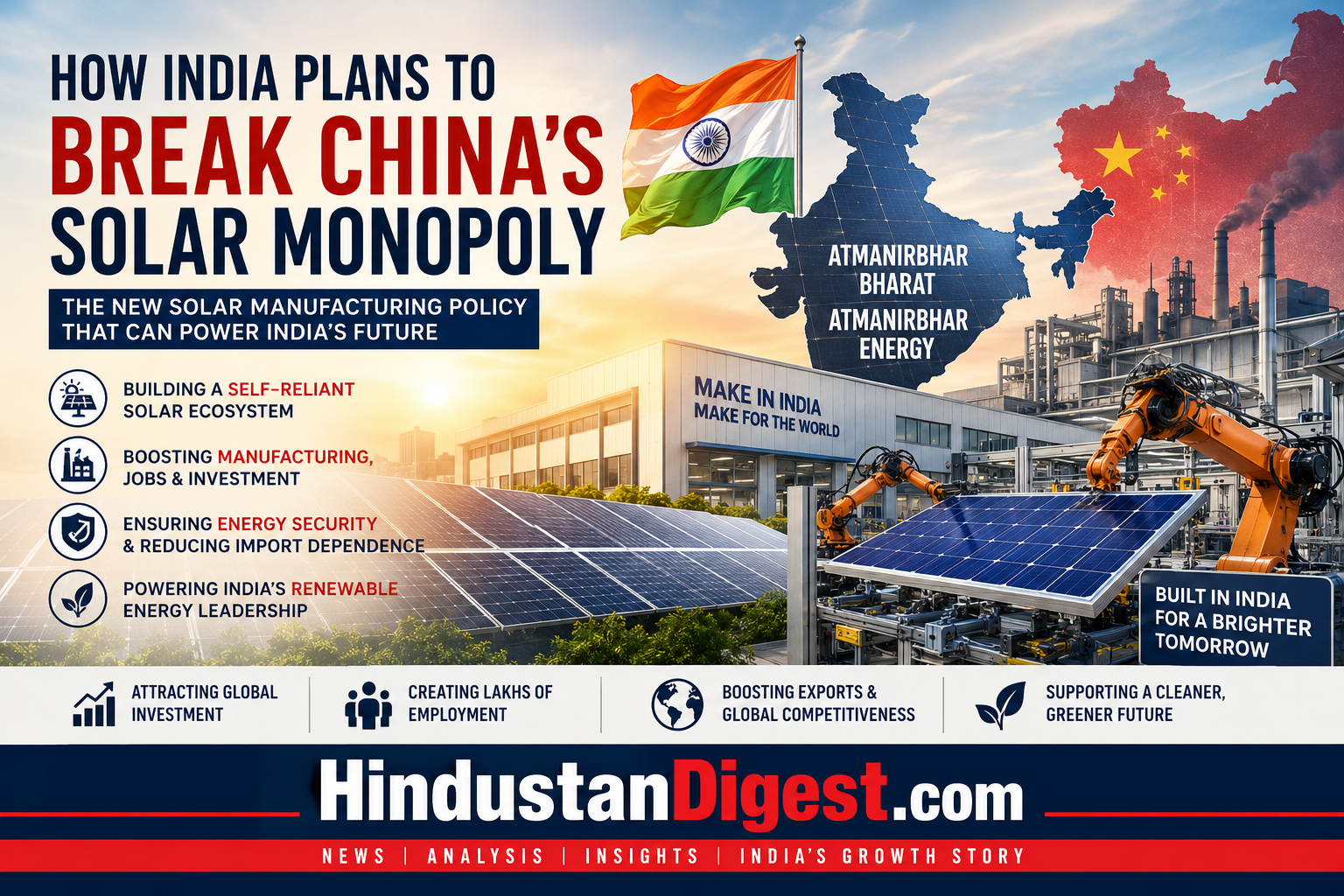
How India Plans to Break China’s Solar Monopoly: The New Solar Manufacturing Policy That Could Transform India into a Global Renewable Energy Powerhouse.
India is taking bold steps to reduce dependence on China in the solar industry through new manufacturing policies, incentives, and investments. Explore how India’s solar strategy can boost economic growth, energy security, jobs, exports, and renewable energy leadership.
As the world accelerates its transition toward clean energy, solar power has emerged as the most important pillar of the global renewable energy revolution. However, one country currently dominates this critical industry—China.
Today, China controls more than 80% of global solar manufacturing capacity across key stages of the solar value chain, including polysilicon production, wafer manufacturing, solar cells, and solar modules. This overwhelming dominance has made many countries dependent on Chinese imports for their renewable energy ambitions.
India, one of the world’s fastest-growing economies and energy consumers, is now taking decisive steps to reduce this dependence. Through a series of strategic policies, incentives, and investments, India aims to build a self-reliant solar ecosystem capable of competing with China and emerging as a major global manufacturing hub.
The government’s new solar manufacturing initiatives represent not just an industrial policy but a broader economic, geopolitical, and energy security strategy that could reshape India’s future.
Understanding China’s Dominance in the Solar Industry
Over the last two decades, China systematically built its solar manufacturing ecosystem through:
- Massive government subsidies
- Low-cost financing
- Integrated supply chains
- Large-scale manufacturing facilities
- Strong export-oriented policies
As a result:
- China produces over 80% of the world’s solar panels.
- More than 90% of solar wafers come from China.
- A significant share of global solar-grade polysilicon is manufactured there.
- Chinese firms enjoy economies of scale unmatched by most competitors.
This dominance has helped lower solar energy costs globally but has also created vulnerabilities in global supply chains.
Countries around the world increasingly recognize the risks of relying too heavily on a single nation for a critical component of their energy infrastructure.
Why India Wants to Reduce Dependence on China
India’s solar energy ambitions are enormous.
The country aims to achieve ambitious renewable energy targets while meeting rapidly rising electricity demand driven by:
- Industrial growth
- Urbanization
- Electric vehicle adoption
- Digital infrastructure expansion
- Population growth
However, a large portion of India’s solar equipment requirements has traditionally been imported, especially from China.
This creates several challenges:
1. Energy Security Risks
Dependence on imported solar equipment exposes India to:
- Supply disruptions
- Geopolitical tensions
- Price volatility
- Trade restrictions
A domestic manufacturing ecosystem can significantly reduce these risks.
2. Trade Deficit Concerns
Large-scale imports contribute to India’s trade imbalance.
By producing solar equipment domestically, India can reduce import dependence and strengthen its manufacturing sector.
3. Employment Generation
Solar manufacturing creates jobs across:
- Engineering
- Production
- Logistics
- Research and Development
- Installation and maintenance
A robust solar ecosystem could generate hundreds of thousands of skilled and semi-skilled jobs.
4. Strategic Independence
Renewable energy infrastructure is becoming as strategically important as oil and gas.
Domestic production ensures long-term strategic autonomy.
Key Features of India’s New Solar Manufacturing Push
India’s strategy focuses on creating an end-to-end solar manufacturing ecosystem rather than merely assembling imported components.
1. Production Linked Incentive (PLI) Scheme
The PLI scheme has become one of the government’s most powerful tools for encouraging domestic manufacturing.
Under this initiative:
- Companies receive financial incentives based on production output.
- Investments are encouraged across the entire solar value chain.
- Manufacturers are motivated to scale operations and improve efficiency.
The scheme has already attracted billions of dollars in investment commitments.
2. Integrated Manufacturing Facilities
India aims to develop integrated manufacturing capabilities covering:
- Polysilicon
- Ingots
- Wafers
- Solar cells
- Solar modules
This approach reduces dependence on imported intermediate products and strengthens supply chain resilience.
3. Domestic Content Requirements
Government-backed projects increasingly prioritize locally manufactured solar equipment.
This creates guaranteed demand for domestic producers and encourages further investments.
4. Import Duties and Trade Protection
India has implemented tariff measures to support local manufacturing.
These policies help:
- Protect domestic producers
- Encourage local investment
- Reduce reliance on imported products
While such measures may temporarily increase costs, they support long-term industrial development.
5. Infrastructure Development
Special industrial zones, logistics support, and manufacturing clusters are being developed to:
- Lower production costs
- Improve efficiency
- Attract global investors
These industrial ecosystems are critical for competing internationally.
Economic Benefits for India
If successful, India’s solar manufacturing strategy could generate significant economic benefits.
Increased Foreign Investment
Global companies seeking alternatives to China are increasingly exploring India.
This could lead to:
- Technology transfers
- Capital inflows
- Manufacturing partnerships
- Export-oriented investments
Job Creation
A complete solar value chain could generate employment opportunities in:
- Manufacturing
- Engineering
- Construction
- Supply chain management
- Research and innovation
Millions of indirect jobs may also be created.
Export Opportunities
As global demand for solar equipment continues to surge, India has an opportunity to become a major exporter.
Potential export markets include:
- Europe
- Africa
- Southeast Asia
- Middle East
- Latin America
This could significantly boost India’s manufacturing exports.
Strengthening the Make in India Mission
The solar sector aligns perfectly with India’s broader manufacturing ambitions.
Success in solar manufacturing could serve as a model for other strategic industries, including:
- Semiconductors
- Electric vehicles
- Battery manufacturing
- Electronics
Environmental and Climate Benefits
India’s solar strategy is not only about economics.
It also supports the country’s climate objectives.
Accelerated Renewable Energy Adoption
Domestic manufacturing can:
- Reduce project delays
- Improve supply chain reliability
- Lower long-term costs
This enables faster deployment of solar projects.
Reduced Carbon Emissions
Greater solar power adoption helps reduce dependence on fossil fuels, lowering greenhouse gas emissions and improving air quality.
Sustainable Economic Growth
Renewable energy investments support long-term sustainable development while reducing environmental impact.
Challenges India Must Overcome
Despite strong policy support, several challenges remain.
Scale and Cost Competitiveness
Chinese manufacturers benefit from decades of investment and scale.
Indian firms must rapidly expand production to compete globally.
Technology Gap
Advanced solar technologies continue to evolve.
India must invest heavily in:
- Research and Development
- Innovation
- High-efficiency solar cells
- Next-generation manufacturing technologies
Supply Chain Development
Building a complete domestic ecosystem requires substantial investment across multiple stages of production.
Developing upstream capabilities remains crucial.
Access to Capital
Large-scale solar manufacturing facilities require billions of dollars in investment.
Affordable financing will be essential for sustained growth.
The Global Opportunity for India
Global governments are actively seeking alternatives to concentrated supply chains.
Countries including:
- United States
- European Union nations
- Japan
- Australia
are encouraging supply chain diversification.
India is uniquely positioned to benefit because of:
- Large domestic market
- Competitive labor force
- Strong policy support
- Growing manufacturing ecosystem
- Strategic geopolitical position
If execution matches ambition, India could emerge as one of the world’s leading solar manufacturing hubs within the next decade.
What This Means for Businesses and Investors
The solar manufacturing transformation presents opportunities across multiple sectors:
Manufacturers
Can benefit from incentives and growing domestic demand.
Investors
May find opportunities in renewable energy infrastructure and manufacturing companies.
Technology Providers
Can partner with Indian firms to accelerate innovation.
Exporters
Can leverage India’s expanding production capacity to access international markets.
Financial Institutions
Can support large-scale projects through financing and green investment products.
Conclusion
India’s effort to break China’s dominance in solar manufacturing represents one of the most significant industrial and energy policy initiatives in recent years. By promoting domestic production, attracting investment, strengthening supply chains, and supporting renewable energy growth, India is laying the foundation for a self-reliant solar ecosystem.
The journey will not be easy. Competing with China’s scale, efficiency, and established infrastructure requires sustained policy support, technological innovation, and substantial investment. However, the rewards are enormous: stronger energy security, millions of jobs, increased exports, reduced import dependence, and a leadership position in the global clean energy economy.
As the world races toward a greener future, India’s solar manufacturing strategy could become a defining chapter in the country’s economic transformation and its rise as a global renewable energy powerhouse.
Published by HindustanDigest.com
Bringing insightful analysis on business, economy, policy, technology, and India’s growth story.
More Featured Articles:
SME IPO in India: A Comprehensive Guide for Growing Businesses Looking to Go Public.
Unlock Growth: How to Secure ₹1 Cr – ₹15 Cr Unsecured Funding for Your Business :
Funding and Investment Options to Grow India’s Real Estate and Allied Businesses
SIDBI – Powering India’s MSME Growth: Funding, Schemes & Business Support.
CFO Services for Startups: Why Virtual CFOs Are Transforming Business Scalability in India


One thought on “How India Plans to Break China’s Solar Monopoly: The New Solar Manufacturing Policy That Could Transform India into a Global Renewable Energy Powerhouse.”