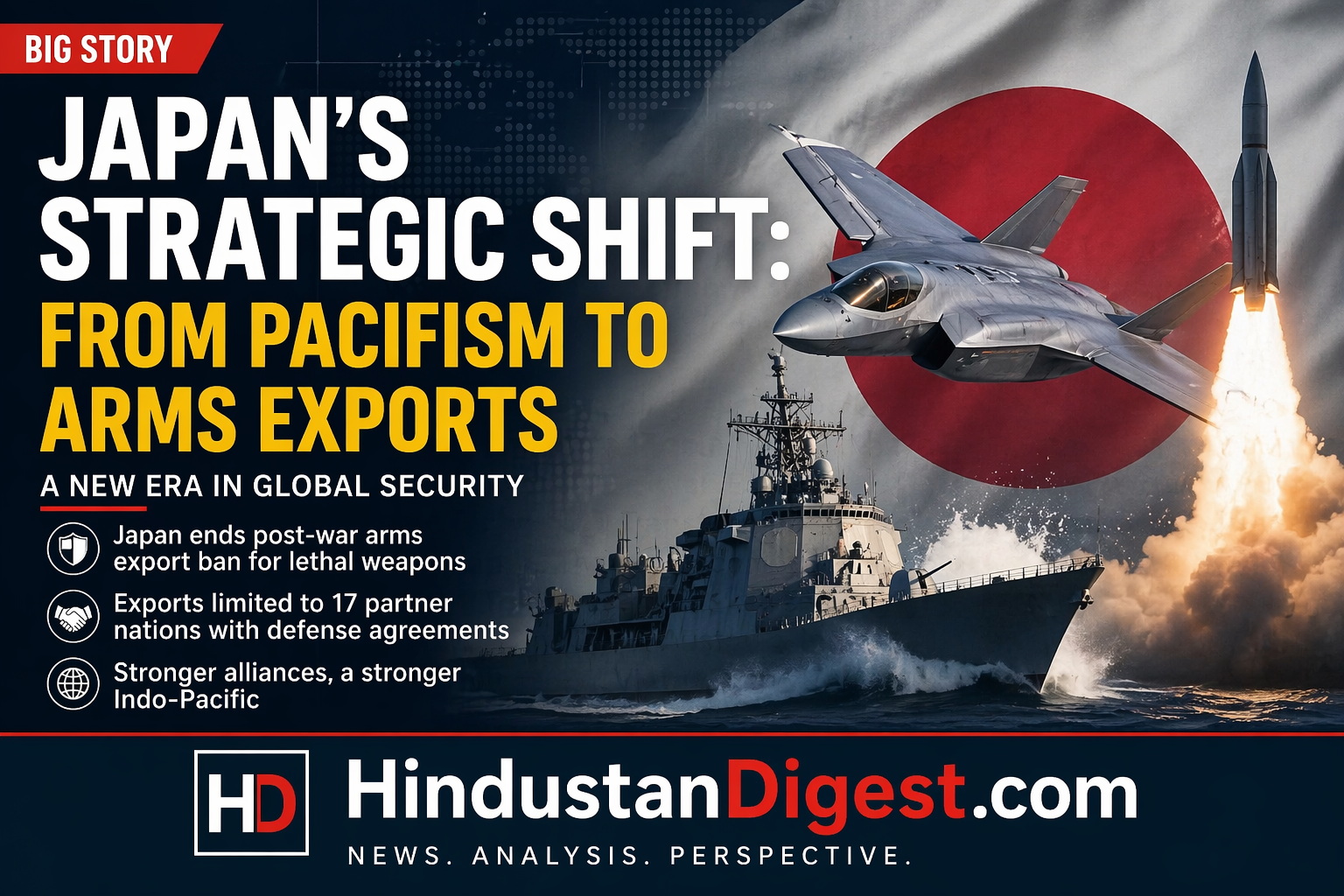
Japan’s Strategic Shift in Defense Policy: From Pacifism to Arms Exports – Implications for Global Security and India
Japan marks a historic shift from its post-war pacifist stance by allowing lethal weapons exports to select partner nations. Explore the policy change, geopolitical implications, and impact on India and global defense dynamics.
Japan’s Strategic Shift: A Turning Point in Global Security Architecture
In a landmark policy decision, Japan has formally moved away from the constraints of its post-World War II pacifist doctrine by permitting the export of lethal military equipment. This development signals not just a domestic policy evolution but a profound shift in the geopolitical landscape of the Indo-Pacific and beyond.
For decades, Japan adhered to a strictly defensive security posture under Article 9 of its Constitution, which renounced war and prohibited the maintenance of offensive military capabilities. While reinterpretations over the years allowed incremental expansions, the latest move represents a structural transformation in Japan’s strategic identity.
Understanding the Policy Shift
The newly endorsed framework allows Japan to export lethal weapons such as missiles, destroyers, and fighter jets. However, these exports are not unrestricted. They are confined to a group of 17 countries that have signed formal “Defense Equipment and Technology Transfer Agreements” with Japan.
This carefully curated list includes strategic partners such as India, Australia, Philippines, Vietnam, United Arab Emirates, and Norway. Recently, Bangladesh became the 17th member, highlighting Japan’s expanding strategic outreach.
The selective nature of these partnerships underscores Japan’s intent to strengthen alliances with like-minded nations while maintaining control over the end-use of its defense exports.
Drivers Behind Japan’s Policy Transformation
1. Rising Regional Security Threats
Japan’s strategic recalibration is largely influenced by evolving security challenges in the Indo-Pacific region. Increasing assertiveness from China, particularly in the East and South China Seas, alongside ongoing tensions involving North Korea, has necessitated a stronger and more proactive defense posture.
2. Strengthening the Defense Industrial Base
By entering the global arms market, Japan aims to revitalize its domestic defense manufacturing sector. Historically constrained by export restrictions, Japanese defense firms struggled to achieve economies of scale. The new policy opens up international markets, fostering innovation, competitiveness, and sustainability within the sector.
3. Strategic Alignment with Allies
Japan’s decision aligns closely with its broader strategic partnerships, particularly within frameworks like the Quad (involving India, the United States, Australia, and Japan). Enhanced defense cooperation through equipment transfers strengthens interoperability and collective security mechanisms.
Implications for the Indo-Pacific Region
A New Security Dynamic
Japan’s emergence as an arms exporter introduces a new dimension to regional security. It enables partner nations to access high-quality defense technology, thereby enhancing their deterrence capabilities.
For countries like India, this could translate into deeper defense collaboration, joint production opportunities, and access to advanced technologies.
Balancing Regional Power Equations
The move is widely interpreted as part of a broader effort to counterbalance China’s growing influence. By empowering its allies, Japan contributes to a more distributed and resilient security architecture in the Indo-Pacific.
Potential Risks of Militarization
While the policy aims to strengthen security, it also raises concerns about an arms race in the region. Increased availability of advanced weaponry could escalate tensions if not managed carefully through diplomatic channels.
Impact on India–Japan Relations
The inclusion of India among the approved partner nations holds significant strategic importance. India and Japan have already been strengthening ties through defense exercises, technology cooperation, and infrastructure partnerships.
This policy shift could lead to:
- Joint development of defense technologies
- Increased defense trade and investment
- Enhanced maritime security collaboration
Given India’s focus on indigenization and self-reliance in defense (Atmanirbhar Bharat), collaboration with Japan presents a mutually beneficial opportunity.
Global Implications
Japan’s entry into the global arms export market alters the competitive landscape. Traditionally dominated by countries like the United States, Russia, and European nations, the inclusion of Japan introduces a technologically advanced and politically stable supplier.
This could:
- Increase competition in defense exports
- Provide alternative sourcing options for countries
- Promote higher standards in defense technology and compliance
Challenges and Criticism
Despite its strategic rationale, the policy has sparked debate within Japan and internationally. Critics argue that:
- It may dilute Japan’s long-standing pacifist identity
- It could entangle Japan in external conflicts indirectly
- Oversight mechanisms must be robust to prevent misuse
Balancing economic, strategic, and ethical considerations will be crucial for the success of this policy.
Conclusion
Japan’s decision to allow lethal arms exports marks a defining moment in its post-war history. It reflects a pragmatic response to evolving security challenges while signaling a willingness to take on a more active role in global defense dynamics.
For the Indo-Pacific region, and particularly for partners like India, this shift opens new avenues for collaboration, capability building, and strategic alignment. However, the long-term impact will depend on how responsibly and transparently Japan implements this policy.
The world is witnessing not just a policy change, but the re-emergence of Japan as a proactive strategic actor in shaping global security.
HindustanDigest.com
More Featured Articles:
The Rise of Sanaenomics: Japan’s New Era of Resilience and Global Alliances.
Trump’s Alienation of India: Why Distancing New Delhi Could Be a Strategic Blunder for the West.
Why Kjøller Is an Important Venture Capital Investor for Startups Globally.
BSE Main Board Listed Company (Mumbai) Available for Strategic Acquisition.
5 thoughts on “Japan’s Strategic Shift in Defense Policy: From Pacifism to Arms Exports – Implications for Global Security and India”