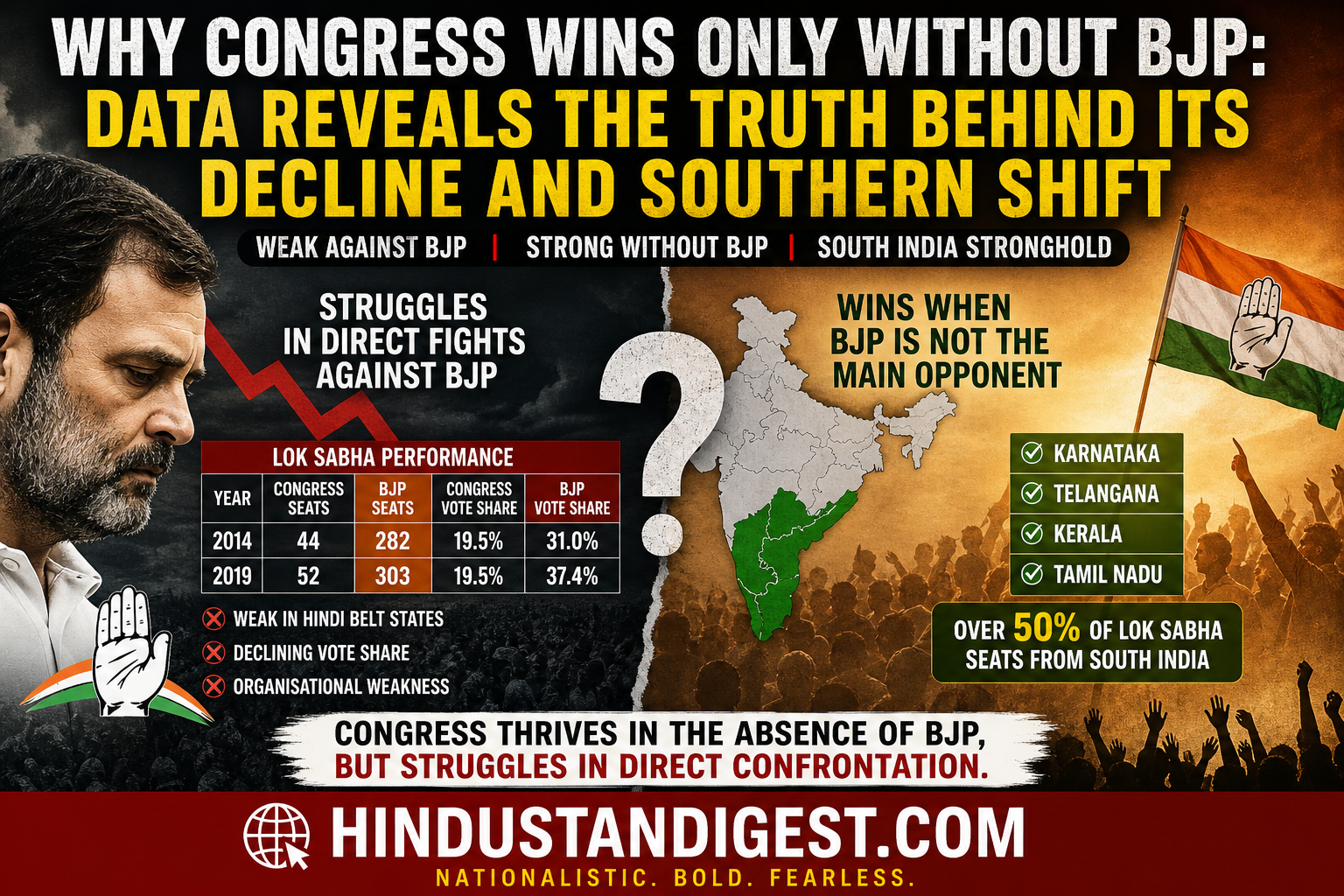
Why Congress Wins Only when its fight is with a non-BJP party: Data Reveals the Truth Behind Its Decline and Southern Shift.
A deep analysis of why Congress struggles against BJP, its shrinking national footprint, and the rise of its southern stronghold. Is Congress becoming a regional party?
The Political Paradox of Congress
The Indian National Congress, once the undisputed political force that shaped modern India, now finds itself trapped in a paradox. It continues to win elections once a while but only under specific conditions. Increasingly, one pattern stands out clearly:
Congress performs only when the Bharatiya Janata Party (BJP) is not its primary opponent.
This raises uncomfortable but necessary questions:
- Has Congress lost its ability to directly challenge BJP?
- Is its political base shrinking geographically?
- Is it slowly transforming into a regional party centered in South India?
This article breaks down the structural, ideological, and electoral realities shaping Congress’ current trajectory.
1. The Core Pattern: Congress vs BJP , A Losing Battle
Over the past decade, electoral data across Lok Sabha and Assembly elections shows a consistent trend:
👉 When Congress directly faces BJP, it struggles to win.
👉 When BJP is absent or weak, Congress performs significantly better.
Examples That Reinforce This Pattern
- Hindi Heartland (UP, MP, Rajasthan, Gujarat):
Congress has repeatedly failed to sustain victories against BJP. - Gujarat:
Despite occasional vote share improvements, Congress has failed to convert momentum into power against BJP’s organizational strength. - Uttar Pradesh:
Congress has been reduced to the margins, unable to compete with BJP’s mass mobilization and narrative control.
Why This Happens
- Narrative Dominance of BJP
BJP has successfully built a strong ideological and national narrative that Congress has struggled to counter effectively. - Organizational Strength
BJP’s cadre-based structure and booth-level management far exceed Congress’ current capabilities. - Leadership Perception Gap
BJP’s centralized leadership contrasts with Congress’ perceived lack of decisive leadership.
2. Congress Performs Better in Multi-Cornered or Regional Contests
Interestingly, Congress still wins elections—but mostly in scenarios where:
- BJP is not the primary challenger
- Regional dynamics dominate
- Anti-incumbency works in its favor
Key Examples
- Karnataka: Congress wins when contest is largely bipolar but BJP loses ground due to local issues.
- Telangana (before regime change): Congress re-emerged primarily against a regional party.
- Himachal Pradesh & Chhattisgarh: Alternating power often driven by anti-incumbency rather than ideological dominance.
👉 Conclusion: Congress wins not because it defeats BJP but because BJP is weakened or absent.
3. The Southern Shift: Congress’ New Political Geography
One of the most significant transformations is geographical:
👉 Congress is increasingly dependent on South India.
Strongholds in the South
- Karnataka
- Telangana
- Kerala (alternating with Left)
- Tamil Nadu (through alliances)
Weakness in the North and West
- Uttar Pradesh – Nearly irrelevant
- Bihar – Dependent on alliances
- Gujarat – Persistent failure
- Delhi – Marginal presence
What This Means
Congress’ electoral map is becoming skewed:
- North & West: BJP dominance
- East: BJP dominates
- South: Congress retains some relevance in a couple of states
👉 This creates a serious identity crisis for a party that once claimed pan-India dominance.
4. Is Congress Becoming a Regional Party?
This is the most debated—and controversial question.
Indicators Suggesting a Regional Shift
- Seat Concentration
A significant share of Congress’ seats now comes from southern states. - Alliance Dependency in North India
Congress often plays a junior role in alliances (e.g., with regional parties). - Cultural & Political Disconnect
Messaging that resonates in South India does not always translate in the Hindi belt.
But Is It Fully a Regional Party Yet?
Not entirely.
Congress still has:
- National presence
- Historical legacy
- Recognizable leadership
- Vote share across multiple states
👉 However, the trend line is clear—without structural reform, it risks becoming regionally confined.
5. The BJP Factor: More Than Just an Opponent
To understand Congress’ decline, one must understand BJP’s rise.
BJP’s Strategic Advantages
- Strong ideological positioning
- Consistent messaging
- Deep grassroots network
- Effective use of technology and media
- Centralized and decisive leadership
👉 Congress is not just losing elections—it is losing the political narrative battle.
6. Structural Issues Within Congress
Congress’ challenges are not only external but deeply internal.
Key Weaknesses
- Leadership Ambiguity
Lack of clear, authoritative leadership hurts decision-making. - Organizational Weakness
Weak booth-level presence compared to BJP. - Reactive Strategy
Congress often reacts to BJP instead of setting the agenda. - Alliance Dependence
Increasing reliance on regional players reduces its national stature.
7. What Needs to Change for a Revival?
If Congress wants to re-emerge as a national challenger, it must:
1. Rebuild Grassroots Organization
Without a strong cadre, electoral revival is impossible.
2. Develop a Clear Ideological Narrative
Voters need clarity—not ambiguity.
3. Empower State Leadership
Localized leadership is crucial in India’s diverse political landscape.
4. Compete Directly with BJP
Avoiding BJP is not a long-term strategy.
The Indian National Congress, once the dominant political force of India, now operates under a striking limitation:
👉 It wins—but mostly when the BJP is not its primary opponent.
This is not merely a political opinion—it is increasingly backed by electoral data across Lok Sabha and Assembly elections.
A deeper look reveals three critical trends:
- Congress struggles in direct contests with BJP
- It performs better in multi-cornered or regional contests
- Its geographical strength is shifting toward South India
Let’s break this down with hard data.
📊 The National Reality: Congress vs BJP in Lok Sabha
| Election Year | Congress Seats | BJP Seats | Congress Vote Share | BJP Vote Share |
|---|---|---|---|---|
| 2014 | 44 | 282 | 19.5% | 31.0% |
| 2019 | 52 | 303 | 19.5% | 37.4% |
What This Data Shows
- Congress vote share has remained stagnant (~19–20%)
- BJP has significantly expanded its vote base
- In direct national contests, BJP has clear structural dominance
👉 Conclusion: Congress is not closing the gap—it is stuck.
📊 Direct Battles: Congress vs BJP in Key States
Madhya Pradesh
| Year | Congress Seats | BJP Seats | Result |
|---|---|---|---|
| 2013 | 58 | 165 | BJP Win |
| 2018 | 114 | 109 | Congress Narrow Win |
| 2023 | 66 | 163 | BJP Landslide |
👉 Congress win in 2018 was short-lived and reversed decisively
Rajasthan
| Year | Congress Seats | BJP Seats | Result |
|---|---|---|---|
| 2013 | 21 | 163 | BJP Win |
| 2018 | 100 | 73 | Congress Win |
| 2023 | 69 | 115 | BJP Win |
👉 Pattern: Congress wins temporarily, BJP regains quickly
Gujarat
| Year | Congress Seats | BJP Seats | Result |
|---|---|---|---|
| 2017 | 77 | 99 | BJP Win |
| 2022 | 17 | 156 | BJP Landslide |
👉 One of the sharpest declines for Congress
📊 Where Congress Wins: BJP Not the Main Factor
Telangana
| Year | Congress Seats | Main Opponent | Result |
|---|---|---|---|
| 2018 | 19 | BRS | Loss |
| 2023 | 64 | BRS | Congress Win |
👉 BJP not central → Congress resurgence
Karnataka
| Year | Congress Seats | BJP Seats | Result |
|---|---|---|---|
| 2018 | 80 | 104 | Hung |
| 2023 | 135 | 66 | Congress Landslide |
👉 Victory driven by local factors + anti-incumbency
Chhattisgarh
| Year | Congress Seats | BJP Seats | Result |
|---|---|---|---|
| 2013 | 39 | 49 | BJP Win |
| 2018 | 68 | 15 | Congress Landslide |
| 2023 | 35 | 54 | BJP Comeback |
👉 Not ideological dominance—cyclical voting behavior
📊 The Geographic Shift: Congress’ Southern Dependence
Lok Sabha Seat Distribution (2019 Approx.)
| Region | Congress Seats | Observation |
|---|---|---|
| South India | ~28 | Stronghold |
| North India | ~6 | Weak |
| West India | ~2 | Minimal |
| East India | ~6 | Alliance-dependent |
Key Takeaway
👉 More than 50% of Congress’ strength now comes from South India
📊 State-Wise Relevance Snapshot
| State | Congress Position |
|---|---|
| Uttar Pradesh | Marginal |
| Bihar | Alliance-dependent |
| Gujarat | Declining |
| Delhi | Negligible |
| Karnataka | Strong |
| Telangana | Strong |
| Kerala | Competitive |
| Tamil Nadu | Alliance-supported |
📊 The Core Pattern (Simplified)
| Scenario | Outcome |
|---|---|
| Direct Congress vs BJP fight | BJP dominates |
| BJP weak or absent | Congress performs well |
| Regional party dominant state | Congress gains opportunity |
👉 The Numbers Don’t Lie:
Congress thrives in BJP’s absence—not in direct confrontation.
Why Is This Happing? Structural Reasons
1. BJP’s Strategic Edge
- Strong cadre network
- Clear ideological messaging
- Superior election machinery
- Leadership clarity
2. Congress’ Internal Weaknesses
- Leadership ambiguity
- Weak grassroots structure
- Reactive politics instead of agenda-setting
- Dependence on alliances
Is Congress Becoming a South Indian Party?
The data strongly suggests a geographical contraction:
- North India → Collapse or marginalization
- West India → Severe decline
- East India → Dependency
- South India → Core strength
👉 While Congress is still a national party on paper,
its electoral reality is increasingly regional.
The Bigger Question: Can Congress Compete with BJP Again?
For revival, Congress must:
- Build a strong grassroots organization
- Develop a clear ideological narrative
- Empower state leadership
- Compete directly with BJP—not avoid it
Conclusion: A Party at a Crossroads
Congress today is not irrelevant but it is structurally constrained.
- It wins but selectively
- It competes but unevenly
- It survives but not dominates
👉 The central reality is undeniable:
Congress performs best when BJP is weak and struggles when BJP is strong.
Final Takeaway
🔥 Congress doesn’t defeat BJP—it benefits only when BJP isn’t the main fight.
📊 Its national vote share is stagnant.
🌏 Its strength is only inSouth India.
👉 Unless this changes,
India’s oldest political party risks becoming a regional force in a national arena.
HindustanDigest.com
More Featured Articles:
China+1 Strategy: Is India Truly Gaining Ground or Missing a Historic Opportunity?
From the Indus Valley to a Global Power: India’s 5000-Year Civilizational Journey to the Future.
India Halts Water Flow of Ravi River to Pakistan: Understanding the Shahpur Kandi Project.
The Ultimate Guide to Burger Singh Franchise: How to Partner with India’s Fastest-Growing QSR Brand.