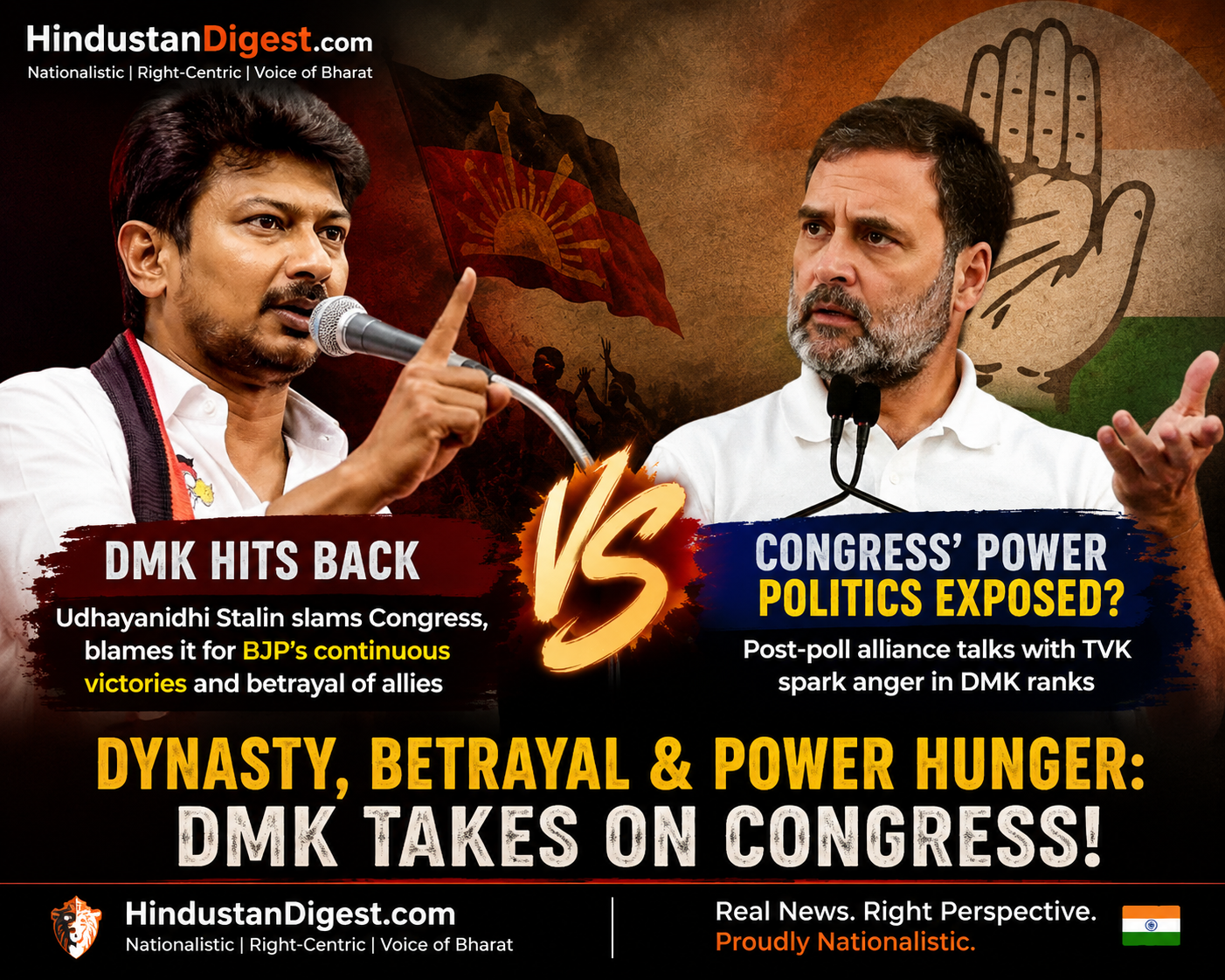
DMK Hits Back at Congress Opportunism: Udhayanidhi Stalin’s Sharp Attack Exposes Congress’ Power Politics and Dynasty Culture.
DMK leader Udhayanidhi Stalin launches a strong attack on Congress over its alleged post-poll understanding with TVK, accusing the party of betrayal, dynasty politics, and opportunism. Read the full political analysis on Tamil Nadu’s changing power equations.
DMK’s Angry Rebuke to Congress Signals Cracks in INDIA Bloc Politics
Tamil Nadu politics witnessed another dramatic turn after senior DMK leader and Leader of the Opposition Udhayanidhi Stalin launched a fierce political attack against the Congress party during a DMK youth wing meeting. His remarks have once again exposed the deep-rooted tensions between regional parties and the Congress high command, particularly over allegations of political opportunism and post-poll power games involving TVK.
The strong words from the DMK camp are not merely emotional outbursts. They reflect years of frustration among regional allies who believe Congress has repeatedly weakened alliance partners while prioritising the interests of the Gandhi family and its shrinking political empire.
For many political observers, the latest confrontation highlights a larger national reality: Congress continues to lose credibility among regional allies because of its inability to evolve beyond dynasty-centric politics and its obsession with retaining control despite repeated electoral failures.
What Triggered the Latest DMK-Congress Clash?
Speaking before party workers, Udhayanidhi Stalin sharply criticised Congress and reportedly blamed the national party for the BJP’s uninterrupted rise across India. According to him, Congress’ political miscalculations, weak leadership, and inconsistent alliance strategies have repeatedly damaged opposition unity.
His remarks came amid reports and political chatter regarding Congress allegedly exploring equations with Vijay-led TVK after elections, despite long-standing cooperation with the DMK.
For DMK cadres, this was viewed as a betrayal.
The sentiment inside the DMK appears straightforward: while the DMK stood shoulder-to-shoulder with Congress during Lok Sabha elections and Assembly battles, Congress allegedly continued searching for alternative political arrangements to secure its own survival.
This has reinforced the perception that Congress treats alliances merely as temporary arrangements for power rather than ideological partnerships built on trust and respect.
Congress and the Politics of Convenience
The criticism against Congress is not new. Across India, several regional parties have accused the Congress leadership of arrogance and political double standards.
From West Bengal to Punjab, from Maharashtra to Delhi, Congress has often been accused of weakening alliance partners while simultaneously demanding loyalty from them.
Political analysts argue that Congress suffers from a deep contradiction:
- It seeks support from strong regional parties.
- Yet it remains uncomfortable with regional leadership becoming dominant.
- It continues to project the Gandhi family as the central power structure despite declining electoral relevance.
This contradiction has repeatedly damaged opposition unity.
In Tamil Nadu, the DMK has remained one of Congress’ strongest allies for decades. Yet many DMK supporters now openly question what Congress actually contributes electorally in return.
Several party workers believe the DMK’s organisational strength, cadre base, governance model, and leadership appeal are the real reasons behind alliance victories in the state – not Congress.
Dynasty Politics: Congress Cannot Escape the Criticism
One of the biggest criticisms against Congress remains its dynastic culture centred around the Gandhi family.
Whether it is Rahul Gandhi or Sonia Gandhi, critics argue that Congress has failed to create a modern democratic leadership structure based on merit and accountability.
Ironically, Congress frequently attacks regional parties over dynasty politics while remaining entirely dependent on one political family for national relevance.
This hypocrisy has increasingly frustrated allies.
Many regional parties now believe Congress expects unconditional support while refusing to introspect on why voters across India continue rejecting its leadership model.
The BJP’s repeated victories at the national level are often attributed not only to the ruling party’s political machinery, but also to Congress’ inability to inspire confidence among voters.
Udhayanidhi Stalin’s remarks indirectly echoed this growing frustration.
DMK’s Position: Regional Strength Over Delhi-Centric Politics
The DMK today sees itself as a strong regional force capable of defending Tamil Nadu’s interests without depending entirely on Delhi’s political calculations.
Under M. K. Stalin, the DMK has projected itself as a governance-focused party that combines welfare politics, state rights advocacy, and organisational discipline.
Many within the DMK believe Congress has survived politically in Tamil Nadu primarily because of the DMK’s support base.
This explains the anger over any possible Congress-TVK understanding.
To DMK loyalists, such political manoeuvring appears less like alliance management and more like opportunistic power bargaining.
Congress’ National Decline and Regional Distrust
The Congress party once dominated Indian politics. However, over the past decade, its decline has accelerated because of:
- Leadership confusion
- Weak grassroots organisation
- Internal factionalism
- Dependence on dynasty politics
- Failure to present a strong ideological alternative
- Repeated electoral setbacks
As a result, regional parties increasingly view Congress as unreliable.
In several states, Congress has either lost allies or weakened them politically through internal power struggles and conflicting ambitions.
This latest controversy in Tamil Nadu could further deepen mistrust between Congress and regional partners within the broader opposition ecosystem.
The TVK Factor and Changing Tamil Nadu Politics
The rise of TVK under actor-turned-politician Vijay has already altered Tamil Nadu’s political landscape.
While TVK is still building its electoral structure, mainstream parties are carefully watching its growth trajectory.
Any attempt by Congress to maintain informal channels with TVK while remaining allied with DMK naturally creates suspicion.
For DMK supporters, such behaviour confirms their belief that Congress prioritises survival and bargaining power over political loyalty.
A Bigger Message Emerging From Tamil Nadu
Beyond immediate alliance tensions, the DMK-Congress confrontation reflects a broader national trend.
Regional parties no longer wish to be treated as junior partners by a declining Congress leadership. They want political respect, autonomy, and transparent alliances.
The age of unquestioned Congress dominance is over.
If Congress continues relying solely on dynasty-driven politics and backroom power calculations, it risks alienating even its strongest remaining allies.
Udhayanidhi Stalin’s remarks therefore carry significance beyond Tamil Nadu politics. They represent growing impatience among regional forces with what many describe as Congress’ outdated and power-centric political culture.
Conclusion
The latest war of words between DMK and Congress has once again exposed the fragile nature of opposition alliances in India.
While the DMK appears determined to protect its political space and regional identity, Congress continues facing criticism for opportunism, dynastic leadership, and inconsistent alliance behaviour.
For many observers, the message from Tamil Nadu is clear: regional parties are no longer willing to silently carry the political burden of Congress while receiving uncertainty and political manoeuvring in return.
As Indian politics evolves, parties that remain rooted in grassroots realities and regional aspirations may ultimately prove stronger than those still dependent on legacy surnames and Delhi-centric power politics.
HindustanDigest.com
More Featured Articles:
Venture Debt in India: The Complete 2026 Guide for Startups, Founders, CFOs & Growth Companies.
China+1 Strategy: Is India Truly Gaining Ground or Missing a Historic Opportunity?
From the Indus Valley to a Global Power: India’s 5000-Year Civilizational Journey to the Future.

