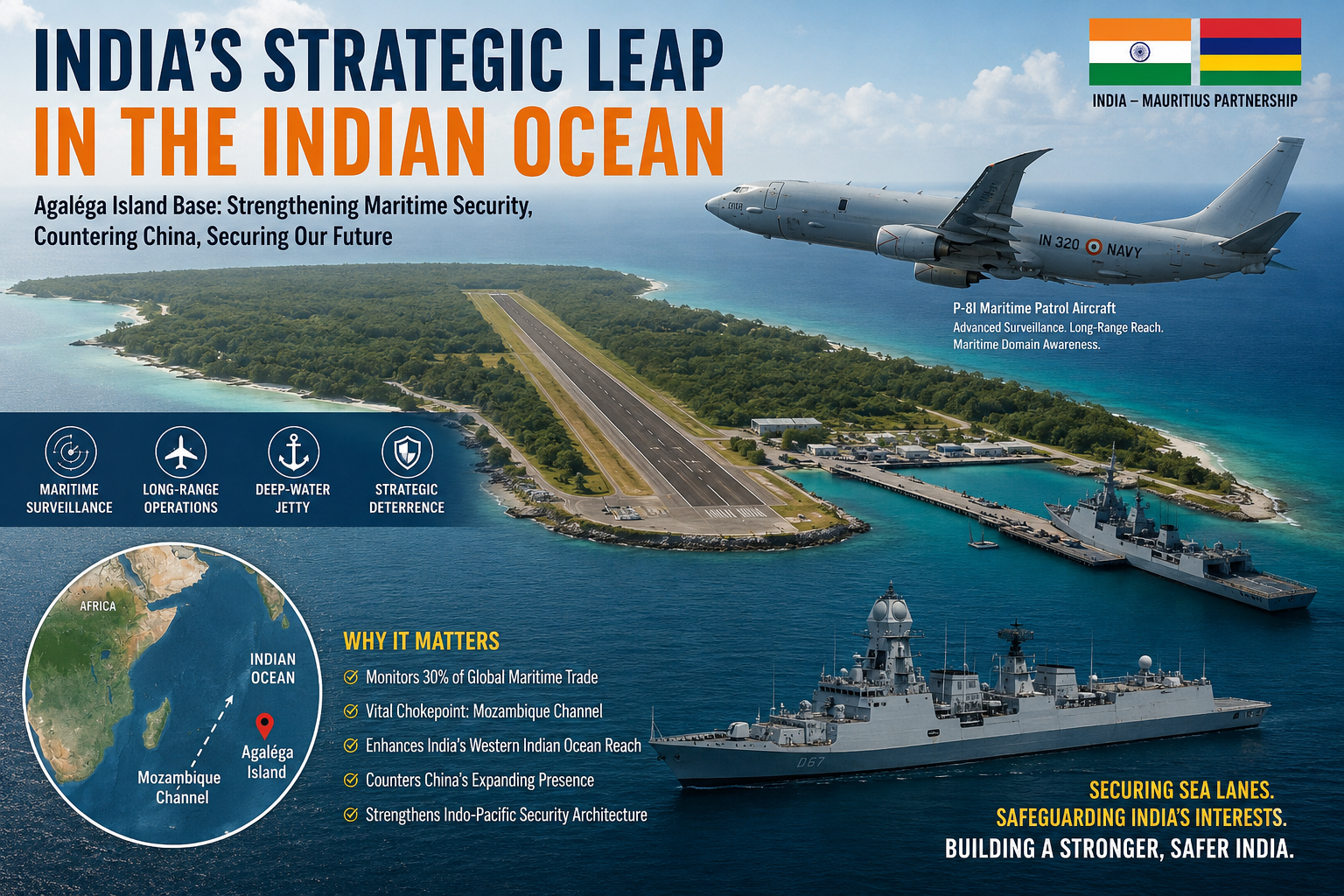
India’s Agaléga Gambit: How the Strategic Island Base is Redefining Power in the Indian Ocean and Challenging China’s Expansion.
India’s strategic military and maritime infrastructure development on Agaléga Island marks a historic shift in Indian Ocean geopolitics. Discover how India is strengthening maritime security, countering China’s influence, protecting global trade routes, and emerging as the dominant Indo-Pacific power.
India Opens Agaléga Base: A Historic Strategic Leap in the Indian Ocean
India’s emergence as a major global power is no longer confined to economic growth, technology leadership, or diplomatic influence. The nation is now decisively asserting itself in the strategic and military domain across the Indian Ocean Region (IOR), a maritime theatre that is rapidly becoming one of the most contested geopolitical spaces on Earth.
The inauguration and operationalization of critical infrastructure on Agaléga Island , a remote territory belonging to Mauritius represents one of India’s most consequential geopolitical moves in decades. Quietly developed over several years with Indian assistance, the long-runway airstrip, deep-water jetty, and surveillance infrastructure on Agaléga have transformed the island into a strategic maritime hub capable of significantly enhancing India’s reach across the western Indian Ocean.
This development is not merely about another military facility. It is about safeguarding sea lanes, securing India’s maritime interests, countering China’s expanding footprint, and ensuring that the Indian Ocean does not become dominated by hostile powers.
For India, Agaléga is not just an island. It is a strategic statement.
Understanding Agaléga Island: A Tiny Territory with Massive Strategic Importance
Agaléga Islands are located approximately 1,100 kilometers north of Mauritius in the western Indian Ocean. Though small in land area and sparsely populated, their geographic location gives them outsized geopolitical value.
Positioned close to the Mozambique Channel — one of the world’s most critical maritime chokepoints — Agaléga offers unparalleled monitoring capabilities over shipping movements between Africa, the Middle East, and Asia.
The Mozambique Channel carries enormous volumes of:
- Oil shipments
- LNG cargo
- Commercial maritime traffic
- Military naval movement
- Strategic energy supplies
Nearly one-third of global maritime trade passes through this broader region. Any power capable of monitoring and projecting force in this zone gains immense leverage over global trade and maritime security.
For decades, external powers recognized this importance. China, the United States, France, and other maritime nations have all increased activity in the region. India’s move into Agaléga is therefore not an isolated event but part of a larger strategic competition shaping the future of the Indo-Pacific.
Why India Needed a Strategic Base in the Western Indian Ocean
India’s maritime strategy has undergone a dramatic transformation over the past fifteen years.
Historically, India focused predominantly on continental threats from Pakistan and China along land borders. However, Beijing’s aggressive maritime expansion — including military bases, port acquisitions, submarine deployments, and infrastructure projects across the Indian Ocean — forced New Delhi to rethink its security doctrine.
China’s “String of Pearls” strategy involves creating a network of ports and strategic footholds around India’s maritime periphery. These include:
- Gwadar in Pakistan
- Hambantota in Sri Lanka
- Djibouti military base
- Kyaukpyu in Myanmar
- Strategic influence in Maldives and East Africa
India increasingly realized that if it failed to establish forward operating positions across the Indian Ocean, it risked strategic encirclement.
Agaléga fills a crucial gap in India’s western maritime arc.
The island enables India to:
- Extend surveillance reach deep into the western Indian Ocean
- Track Chinese naval deployments
- Monitor shipping through the Mozambique Channel
- Support anti-piracy missions
- Enhance disaster relief operations
- Protect energy supply chains
- Strengthen cooperation with African nations
This development marks India’s transition from a regional naval force into a genuine blue-water maritime power.
The Infrastructure on Agaléga: More Than Just an Airstrip
One of the most significant features developed on Agaléga is the long-runway airstrip.
Reports indicate the runway can accommodate:
- P-8I maritime surveillance aircraft
- Military transport aircraft
- Fighter aircraft under specific operational conditions
- Long-range reconnaissance missions
India’s P-8I aircraft, derived from Boeing’s advanced maritime surveillance platform, are among the most sophisticated naval reconnaissance systems in the world. These aircraft can detect submarines, monitor shipping, conduct electronic intelligence operations, and track naval activity across vast oceanic distances.
The deep-water jetty is equally important.
It allows:
- Docking of naval vessels
- Refueling operations
- Logistical resupply
- Maritime patrol coordination
- Strategic naval access
Combined with radar and electronic surveillance systems, Agaléga becomes a powerful maritime intelligence node.
In strategic terms, the island functions as an “unsinkable aircraft carrier” for India in the western Indian Ocean.
Countering China’s Expanding Presence in the Indian Ocean
The most significant geopolitical implication of Agaléga is its role in balancing China’s growing influence.
Over the past decade, China has aggressively expanded its maritime footprint through the Belt and Road Initiative (BRI), port investments, and naval deployments.
Chinese warships and submarines now operate regularly in the Indian Ocean.
Beijing officially claims these deployments are related to anti-piracy missions and commercial protection. However, strategic analysts worldwide recognize the broader military implications.
China’s military base in Djibouti particularly alarmed Indian policymakers. Located near critical Red Sea shipping lanes, the Djibouti facility signaled Beijing’s willingness to establish permanent overseas military infrastructure.
India feared a future scenario where Chinese naval power could dominate the Indian Ocean and threaten:
- Indian trade routes
- Energy imports
- Maritime commerce
- Strategic autonomy
Agaléga changes the equation.
The base allows India to closely observe Chinese activities across the western Indian Ocean and respond rapidly if required.
For the first time, India now possesses enhanced operational reach into areas previously dominated by extra-regional powers.
The Mozambique Channel: Why This Maritime Route Matters
The Mozambique Channel is among the world’s most strategically important maritime corridors.
Located between Madagascar and Mozambique, the channel serves as a vital artery for:
- Oil transportation
- LNG shipments
- Cargo traffic between Europe and Asia
- African resource exports
Any disruption in this corridor would have severe global economic consequences.
India depends heavily on imported energy. Securing sea lines of communication (SLOCs) is therefore a national security imperative.
Through Agaléga, India gains the ability to monitor vessel traffic moving through this critical chokepoint.
This capability becomes especially important during:
- Regional conflicts
- Piracy incidents
- Naval confrontations
- Energy crises
- Geopolitical tensions involving China
Strategically, maritime awareness equals power.
A nation that controls information and surveillance across key sea routes gains tremendous geopolitical influence.
India’s Vision for the Indo-Pacific
India’s Agaléga initiative aligns with its broader Indo-Pacific vision.
New Delhi increasingly sees itself as:
- A net security provider
- A stabilizing maritime power
- A guardian of free navigation
- A counterbalance to authoritarian expansionism
India’s Indo-Pacific strategy emphasizes:
- Freedom of navigation
- Respect for sovereignty
- Maritime security cooperation
- Regional partnerships
- Open sea lanes
Unlike China’s debt-driven infrastructure model, India projects itself as a cooperative security partner.
This distinction matters greatly for smaller Indian Ocean nations wary of Beijing’s growing influence.
Countries across the region increasingly view India as a democratic counterweight capable of balancing Chinese ambitions without imposing coercive control.
Mauritius and India: A Deep Strategic Partnership
India’s relationship with Mauritius is rooted in history, culture, and strategic cooperation.
A significant portion of Mauritius’ population traces its origins to India. Diplomatic ties between the two nations remain exceptionally strong.
The Agaléga development reflects mutual strategic interests:
For Mauritius:
- Infrastructure modernization
- Economic assistance
- Security cooperation
- Enhanced maritime monitoring
For India:
- Strategic access
- Maritime reach
- Intelligence capabilities
- Regional influence
Although opposition voices in Mauritius expressed concerns regarding sovereignty and militarization, both governments have consistently maintained that the infrastructure serves joint security and developmental purposes.
Nevertheless, geopolitical observers widely recognize the strategic military value of the facilities.
The Indian Navy’s Transformation into a Blue-Water Force
Agaléga represents part of a broader transformation underway within the Indian Navy.
India is rapidly modernizing its maritime capabilities through:
- Aircraft carriers
- Nuclear submarines
- Maritime patrol aircraft
- Anti-submarine warfare systems
- Long-range missiles
- Integrated surveillance networks
The Indian Navy increasingly operates across:
- The Persian Gulf
- The Red Sea
- Southeast Asia
- The western Pacific
- The African coastline
India’s maritime doctrine now emphasizes:
- Forward presence
- Strategic deterrence
- Sea control
- Maritime domain awareness
Agaléga strengthens each of these pillars.
It gives India a forward operating position capable of sustaining long-duration operations across the western Indian Ocean.
The Global Power Competition in the Indian Ocean
The Indian Ocean is rapidly emerging as the epicenter of 21st-century geopolitical competition.
Several major powers are competing for influence:
China
Seeking strategic access, energy security, and naval expansion.
United States
Maintaining freedom of navigation and alliance dominance.
France
Protecting overseas territories and maritime interests.
India
Preventing encirclement and asserting regional leadership.
Gulf Nations
Expanding commercial and strategic influence in Africa.
The significance of Agaléga must therefore be understood within this broader strategic context.
India is signaling that it will no longer remain passive while rival powers expand around its maritime sphere.
Maritime Security and Anti-Piracy Operations
Beyond geopolitical competition, Agaléga has practical security applications.
The western Indian Ocean has historically faced threats from:
- Somali piracy
- Maritime terrorism
- Illegal fishing
- Smuggling
- Human trafficking
India has frequently deployed naval assets for anti-piracy missions in the region.
Agaléga enhances operational efficiency by providing:
- Refueling facilities
- Surveillance coverage
- Logistical support
- Rapid deployment capability
This improves India’s ability to respond to maritime emergencies and security threats.
Energy Security: A Core Strategic Objective
India imports a substantial portion of its oil and gas requirements.
Most of these energy supplies travel through vulnerable maritime routes.
Any disruption caused by:
- War
- Piracy
- Blockades
- Chinese military pressure
could severely impact India’s economy.
Agaléga contributes directly to India’s energy security strategy.
By expanding maritime surveillance and operational reach, India improves its ability to safeguard critical energy supply chains.
In an era where energy security equals national security, such infrastructure becomes indispensable.
The Psychological and Strategic Message to Beijing
Strategic infrastructure projects are not only about physical capabilities. They are also about signaling intent.
Agaléga sends multiple messages to China:
- India is prepared for long-term maritime competition.
- The Indian Ocean cannot be dominated unilaterally.
- India will protect its sphere of influence.
- Chinese naval movements will face enhanced scrutiny.
- India possesses growing expeditionary capabilities.
This psychological dimension matters immensely in geopolitical competition.
Deterrence often depends as much on perception as on actual military strength.
India’s Strategic Arc Across the Indian Ocean
Agaléga forms part of a larger network of Indian strategic partnerships and maritime infrastructure.
India has expanded cooperation with:
- Seychelles
- Maldives
- Oman
- Madagascar
- Sri Lanka
- Indonesia
- France
These partnerships collectively enhance India’s maritime awareness and operational flexibility.
India is gradually constructing a comprehensive security architecture across the Indian Ocean.
Agaléga is one critical node within this emerging network.
Challenges and Criticism
Despite its strategic benefits, the Agaléga project has faced criticism.
Some concerns include:
- Militarization of small island territories
- Environmental impact
- Sovereignty debates
- Regional geopolitical tensions
Critics argue that increased militarization could intensify rivalry in the Indian Ocean.
However, Indian strategic thinkers counter that failing to respond to China’s expansion would create even greater long-term instability.
From India’s perspective, deterrence and preparedness are necessary to preserve regional balance.
The Future of India’s Maritime Doctrine
The Agaléga development reflects a broader shift in India’s strategic mindset.
India increasingly recognizes that:
- Economic power requires maritime security.
- Global influence depends on naval reach.
- The Indian Ocean is central to national destiny.
Future Indian strategy will likely focus on:
- Expanded naval infrastructure
- Maritime alliances
- Indigenous defense production
- Surveillance capabilities
- Strategic island partnerships
Agaléga may ultimately be remembered as the moment India decisively embraced its role as a leading Indo-Pacific power.
Conclusion: Agaléga and the Rise of a Confident Maritime India
India’s strategic expansion into Agaléga is far more than a military infrastructure project.
It is:
- A declaration of maritime ambition
- A response to Chinese expansionism
- A commitment to Indo-Pacific security
- A safeguard for global trade routes
- A symbol of India’s emergence as a major geopolitical force
For decades, India was perceived primarily as a continental power constrained by regional challenges.
That era is ending.
Today, India is projecting confidence across the seas, securing its maritime frontiers, and positioning itself as a decisive force in shaping the future balance of power in the Indian Ocean.
The Indian Ocean is no longer merely adjacent to India.
It is becoming India’s strategic arena.
And Agaléga may well become one of the defining pillars of that transformation.
HindustanDigest.com
More Featured Articles
Venture Debt in India: The Complete 2026 Guide for Startups, Founders, CFOs & Growth Companies.
The Ultimate Guide to Burger Singh Franchise: How to Partner with India’s Fastest-Growing QSR Brand.
Unlock Growth: How to Secure ₹1 Cr – ₹15 Cr Unsecured Funding for Your Business :
Strategic Finance Options for Medical and Hospital Businesses in India (2026)
SIDBI – Powering India’s MSME Growth: Funding, Schemes & Business Support.
CFO Services for Startups: Why Virtual CFOs Are Transforming Business Scalability in India
Venture Debt in India: The Complete 2026 Guide for Startups, Founders, CFOs & Growth Companies.
Venture Capital and Private Equity Funding in India: A Complete Founder’s Guide (2025)

2 thoughts on “India’s Agaléga Gambit: How the Strategic Island Base is Redefining Power in the Indian Ocean and Challenging China’s Expansion.”