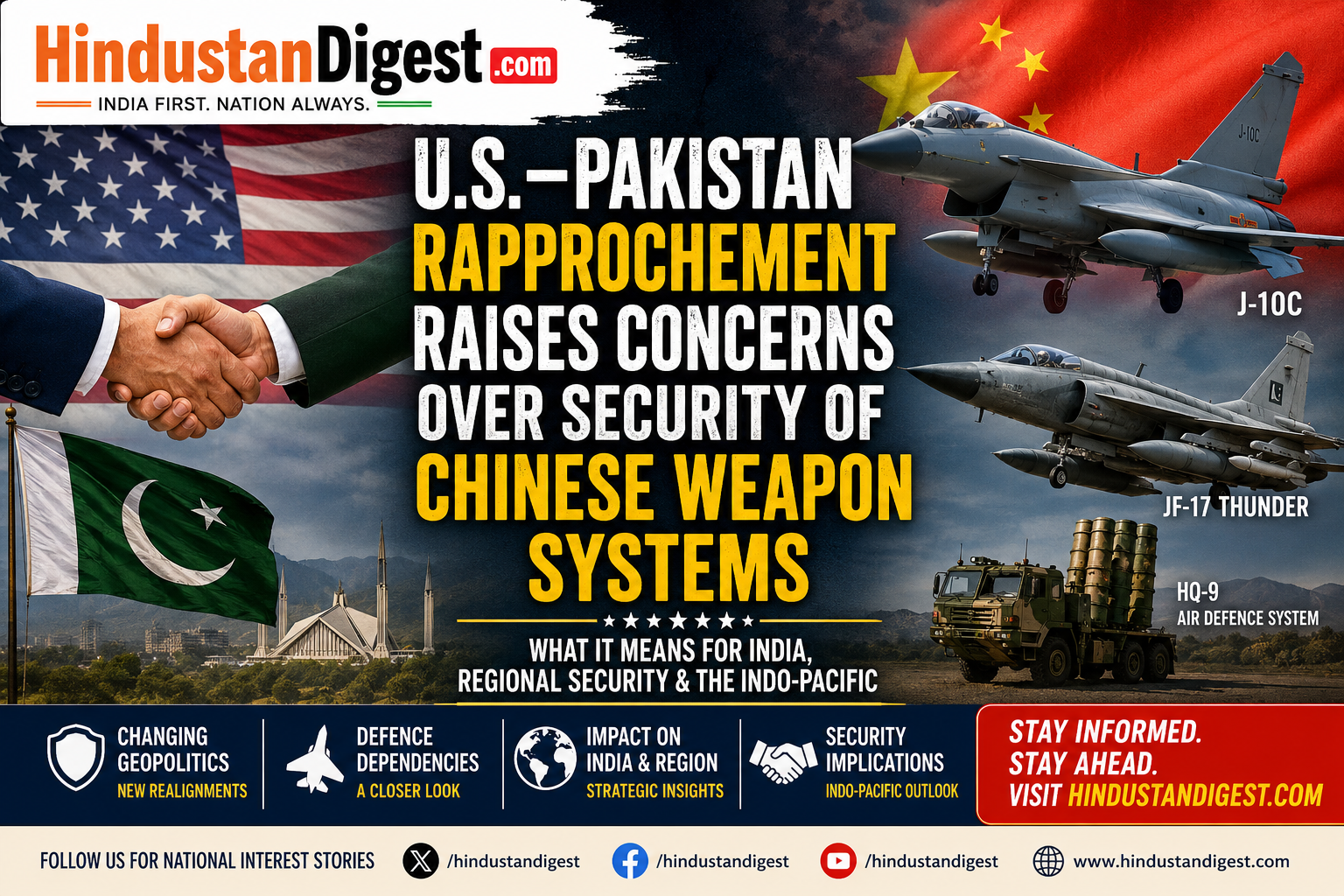
U.S.–Pakistan Rapprochement Raises Questions Over the Future of Chinese Weapon Systems: Strategic Implications for India and the Indo-Pacific.
U.S.-Pakistan relations appear to be entering a new phase, raising questions about Pakistan’s dependence on Chinese military equipment and the strategic consequences for India, China, and the Indo-Pacific security architecture.
Recent diplomatic engagement between the United States and Pakistan has once again drawn attention to the changing geopolitical landscape of South Asia. Reports and strategic commentary suggesting renewed dialogue between Washington and Islamabad have prompted analysts to examine what such a shift could mean for Pakistan’s long-standing defence relationship with China.
For decades, China has been Pakistan’s largest supplier of military hardware, providing fighter aircraft, naval vessels, missile systems, drones, tanks and air defence equipment. Any meaningful improvement in U.S.-Pakistan relations naturally raises questions about whether Pakistan will continue relying almost exclusively on Chinese defence technology or seek a more diversified military partnership.
While no official policy shift has been announced, the evolving diplomatic environment deserves careful analysis from the perspective of regional security, especially for India.
China’s Deep Military Footprint in Pakistan
China has invested heavily in Pakistan’s defence infrastructure over the past two decades.
Major Chinese-origin systems include:
- JF-17 Thunder fighter aircraft
- J-10C multirole fighter jets
- HQ-series air defence systems
- Armed UAVs and reconnaissance drones
- Naval frigates and submarines
- Missile technology and electronic warfare systems
Beyond supplying equipment, China has also partnered with Pakistan in joint production, technology transfer and maintenance support, making the defence relationship far deeper than a normal buyer-seller arrangement.
Why Is the U.S. Re-engaging Pakistan?
Strategic analysts suggest several possible reasons for renewed U.S. engagement:
- Counter-terrorism cooperation
- Regional stability after developments in Afghanistan
- Monitoring extremist networks
- Balancing China’s growing influence in South Asia
- Maintaining diplomatic leverage in the broader Indo-Pacific
Such engagement does not necessarily indicate a return to the close security partnership seen in previous decades. Rather, it may reflect evolving strategic priorities where dialogue serves multiple objectives.
Could Chinese Weapons Face Greater Scrutiny?
One issue frequently discussed by defence experts is whether closer engagement with the United States could increase scrutiny of Chinese-origin military systems used by Pakistan.
Potential concerns raised in strategic circles include:
- Cybersecurity vulnerabilities
- Data security and software integrity
- Dependence on Chinese maintenance ecosystems
- Interoperability challenges with Western technologies
- Long-term logistics and spare parts
These discussions remain analytical in nature, and there is no public evidence that Pakistan intends to replace its Chinese inventory in the near future.
India’s Strategic Perspective
For India, developments in U.S.-Pakistan relations require close observation but not alarm.
India today maintains significantly stronger strategic partnerships with several leading democracies, while continuing to modernize its armed forces and expand indigenous defence manufacturing under the “Make in India” and “Atmanirbhar Bharat” initiatives.
India’s strengths include:
- Diversified defence procurement
- Indigenous missile programmes
- Growing naval capabilities
- Expanding defence exports
- Enhanced cooperation with Quad partners
- Stronger surveillance and space capabilities
These factors provide India with a broader strategic foundation than in previous decades.
The China-Pakistan Defence Relationship Is Unlikely to Disappear
Despite renewed diplomatic contacts with Washington, China is expected to remain Pakistan’s principal defence supplier in the foreseeable future because of:
- Long-term industrial cooperation
- Existing maintenance infrastructure
- Financial arrangements
- Joint manufacturing programmes
- Strategic alignment
Replacing decades of integrated military cooperation would require substantial time, resources and political commitment.
The Indo-Pacific Dimension
The evolving U.S.-Pakistan relationship must also be viewed within the larger Indo-Pacific strategic competition.
The United States continues to strengthen partnerships with India, Japan, Australia and other regional democracies while also engaging multiple countries across Asia to maintain stability and open maritime trade.
Pakistan’s geographic position ensures it remains strategically relevant, even as India continues to play an increasingly central role in regional security and economic growth.
Challenges Ahead for Pakistan
Pakistan faces several defence-related challenges irrespective of changing diplomatic equations:
- Fiscal constraints
- Rising maintenance costs
- Dependence on imported technology
- Need for modernization
- Balancing relationships with both China and the United States
Managing these competing priorities will require careful strategic planning.
Implications for India
India should continue focusing on:
- Accelerating indigenous defence production
- Investing in advanced aerospace technologies
- Strengthening cyber and electronic warfare capabilities
- Expanding maritime security
- Enhancing intelligence cooperation with strategic partners
- Maintaining diplomatic engagement across the region
Rather than reacting to every geopolitical shift, sustained investment in national capabilities remains the most effective long-term strategy.
Conclusion
The reported warming of U.S.-Pakistan relations has sparked debate over the future role of Chinese military equipment within Pakistan’s armed forces. While renewed diplomatic engagement could influence future procurement decisions and strategic calculations, there is currently no indication of an immediate transformation in Pakistan’s defence posture.
For India, the prudent course is continued vigilance, accelerated modernization and sustained investment in self-reliance and strategic partnerships. As geopolitical alignments evolve, national preparedness and technological strength will remain the decisive factors shaping regional security.
Editorial Note
This analysis reflects publicly discussed strategic trends and does not imply that any specific defence systems are insecure or that any policy changes have been officially adopted by the governments concerned. The situation continues to evolve and should be assessed based on verified official information.
Published by: HindustanDigest.com
Delivering informed perspectives on India’s national security, geopolitics, governance and strategic affairs.
More Featured Posts:
SME IPO in India: A Comprehensive Guide for Growing Businesses Looking to Go Public.
Unlock Growth: How to Secure ₹1 Cr – ₹15 Cr Unsecured Funding for Your Business :
Strategic Finance Options for Medical and Hospital Businesses in India (2026)
SIDBI – Powering India’s MSME Growth: Funding, Schemes & Business Support.
One thought on “U.S.–Pakistan Rapprochement Raises Questions Over the Future of Chinese Weapon Systems: Strategic Implications for India and the Indo-Pacific.”