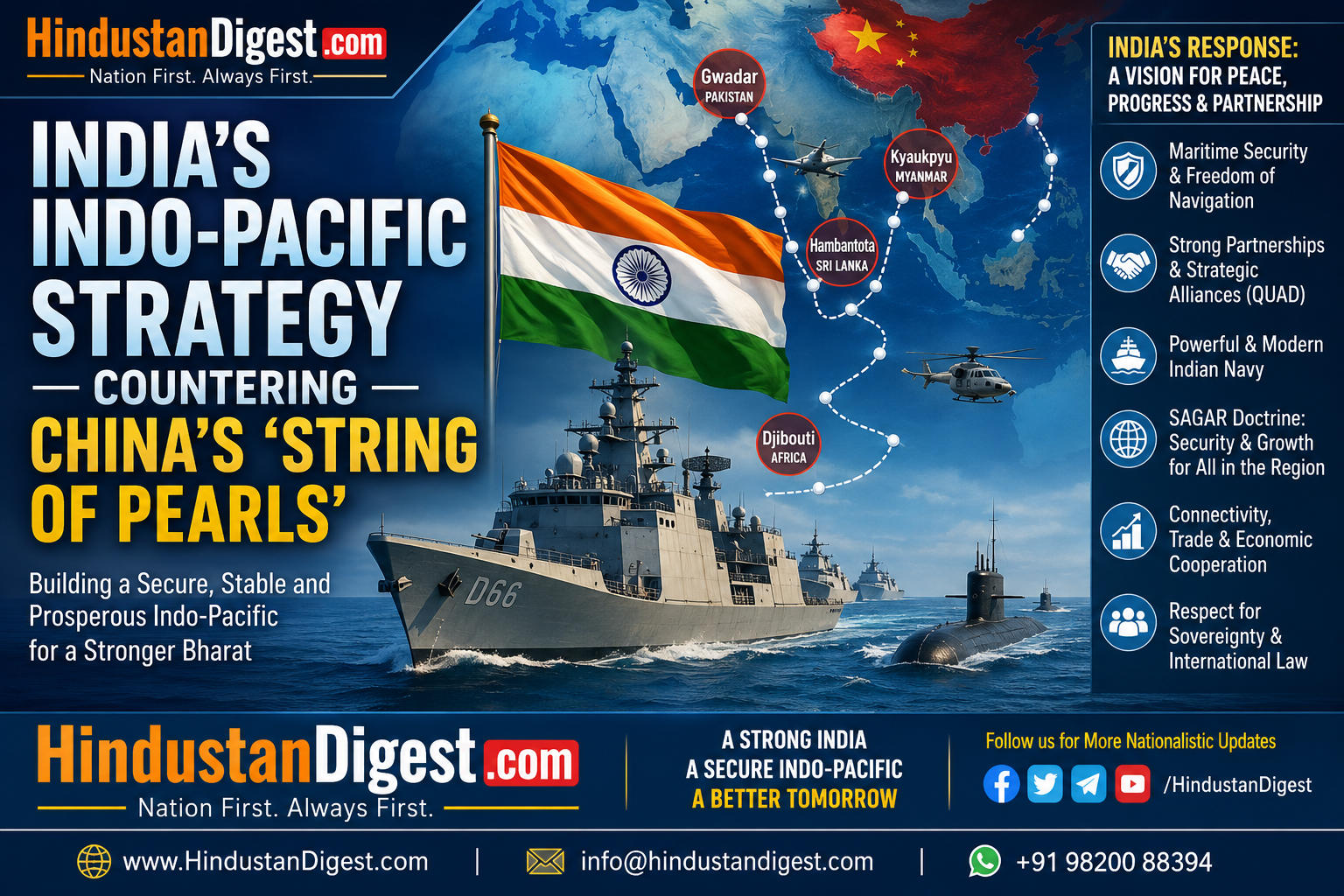
India’s Indo-Pacific Strategy: How New Delhi Is Building a Democratic Maritime Shield to Counter China’s ‘String of Pearls’ Expansion.
India’s Indo-Pacific strategy is emerging as a powerful response to China’s String of Pearls doctrine. Discover how India is strengthening maritime security, strategic partnerships, naval capabilities, and regional diplomacy to safeguard national interests across the Indo-Pacific.
India’s Indo-Pacific Vision: A Strategic Response to China’s Expanding Maritime Ambitions
The Indo-Pacific has emerged as the world’s most strategically important region in the 21st century. Home to nearly 60% of the global population and carrying the majority of international maritime trade, this vast region has become the focal point of geopolitical competition.
Over the past two decades, China has significantly expanded its maritime footprint through infrastructure financing, port development, and strategic investments across Asia, Africa, and the Indian Ocean. This approach is often referred to as the “String of Pearls” strategy.
India, however, has adopted a markedly different approach. Rather than seeking military dominance through overseas bases alone, New Delhi has focused on partnerships, regional stability, economic cooperation, capacity building, and a rules-based maritime order. This strategy reflects India’s long-term objective of promoting a free, open, inclusive, and secure Indo-Pacific.
Understanding China’s “String of Pearls” Strategy
The term “String of Pearls” refers to China’s network of commercial ports, infrastructure projects, logistics hubs, and strategic investments stretching from mainland China through Southeast Asia into the Indian Ocean and beyond.
Frequently discussed locations include:
- Gwadar Port (Pakistan)
- Hambantota Port (Sri Lanka)
- Kyaukpyu Port (Myanmar)
- Djibouti (Horn of Africa)
- Various port developments in the Maldives and East Africa
While many of these projects are presented as commercial investments under the Belt and Road Initiative (BRI), analysts note that dual-use infrastructure can potentially support military logistics in addition to civilian trade.
India’s Alternative Vision: Security Through Partnership
India’s Indo-Pacific strategy emphasizes cooperation rather than confrontation. Key objectives include:
- Freedom of navigation
- Respect for international law
- Maritime security
- Disaster relief cooperation
- Regional connectivity
- Economic development
- Sovereignty and territorial integrity of all nations
This approach seeks to strengthen regional resilience while avoiding zero-sum competition.
The SAGAR Doctrine
Prime Minister Narendra Modi introduced the concept of SAGAR (Security and Growth for All in the Region) as a guiding principle for India’s maritime engagement.
Its objectives include:
- Safe sea lanes
- Humanitarian assistance
- Disaster response
- Maritime domain awareness
- Blue economy cooperation
- Counter-piracy operations
- Coastal security partnerships
India has increasingly provided humanitarian assistance and disaster relief to neighboring countries, reinforcing its role as a dependable regional partner.
The QUAD: Strategic Cooperation Among Democracies
India is a member of the Quadrilateral Security Dialogue (QUAD) alongside:
- United States
- Japan
- Australia
The QUAD focuses on:
- Maritime security
- Supply chain resilience
- Emerging technologies
- Cybersecurity
- Infrastructure
- Disaster response
- Critical technologies
Although not a military alliance, it serves as an important platform for cooperation among like-minded democracies in the Indo-Pacific.
Strengthening India’s Naval Capabilities
India has significantly modernized its naval forces through:
- Indigenous aircraft carriers
- Nuclear-powered submarines
- Advanced destroyers
- Frigates
- Maritime surveillance aircraft
- Anti-submarine warfare capabilities
- Coastal radar networks
The Indian Navy increasingly conducts joint exercises with friendly nations to enhance interoperability and maritime readiness.
Strategic Infrastructure Across the Indian Ocean
India has expanded strategic cooperation with several Indian Ocean partners by supporting:
- Port modernization
- Coastal surveillance systems
- Defence cooperation
- Capacity building
- Maritime training
These initiatives aim to improve regional maritime security while respecting the sovereignty of partner nations.
Act East Policy: Expanding Regional Engagement
India’s Act East Policy complements its Indo-Pacific vision by strengthening ties with Southeast Asian nations through:
- Trade
- Connectivity
- Infrastructure
- Defence cooperation
- Cultural exchanges
- Technology partnerships
ASEAN remains central to India’s Indo-Pacific engagement.
Protecting Critical Sea Lanes
Nearly all of India’s energy imports and a substantial share of its international trade pass through the Indian Ocean.
Maintaining secure Sea Lines of Communication (SLOCs) is therefore essential for:
- Energy security
- Economic growth
- Supply chain resilience
- National security
India’s maritime strategy places considerable emphasis on safeguarding these vital routes.
The Role of Diplomacy
India’s approach combines military preparedness with diplomacy. It engages through regional forums such as:
- ASEAN-led mechanisms
- Indian Ocean Rim Association (IORA)
- BIMSTEC
- East Asia Summit
- Colombo Security Conclave
This reflects India’s preference for cooperative security frameworks.
Technology and Maritime Awareness
Modern maritime security increasingly depends on technology.
India has invested in:
- Satellite surveillance
- Coastal radar chains
- Maritime domain awareness
- Information sharing
- Artificial intelligence applications
- Secure communications
These capabilities help monitor maritime activities across the region and support coordinated responses to emerging challenges.
Balancing Competition with Stability
Strategic competition in the Indo-Pacific is expected to continue as major powers seek to protect their interests. India faces the challenge of safeguarding its security while maintaining regional stability and fostering economic growth.
Its policy has generally emphasized strategic autonomy, diversified partnerships, and adherence to international law.
Conclusion
India’s Indo-Pacific strategy represents a comprehensive effort to enhance maritime security, strengthen partnerships, and contribute to a stable regional order. As geopolitical competition intensifies, New Delhi’s focus on connectivity, capacity building, naval modernization, and diplomatic engagement positions it as an influential stakeholder in shaping the future of the Indo-Pacific.
Rather than relying solely on hard power, India’s approach combines defence preparedness with economic cooperation and multilateral engagement, reflecting its broader vision of a secure, prosperous, and rules-based maritime region.
Disclaimer
This article is an analytical overview of publicly discussed geopolitical strategies and international security developments. The subject involves ongoing strategic assessments by governments, scholars, and policy experts, and interpretations may differ. The article aims to provide informative context for readers and does not endorse hostility toward any nation or people.