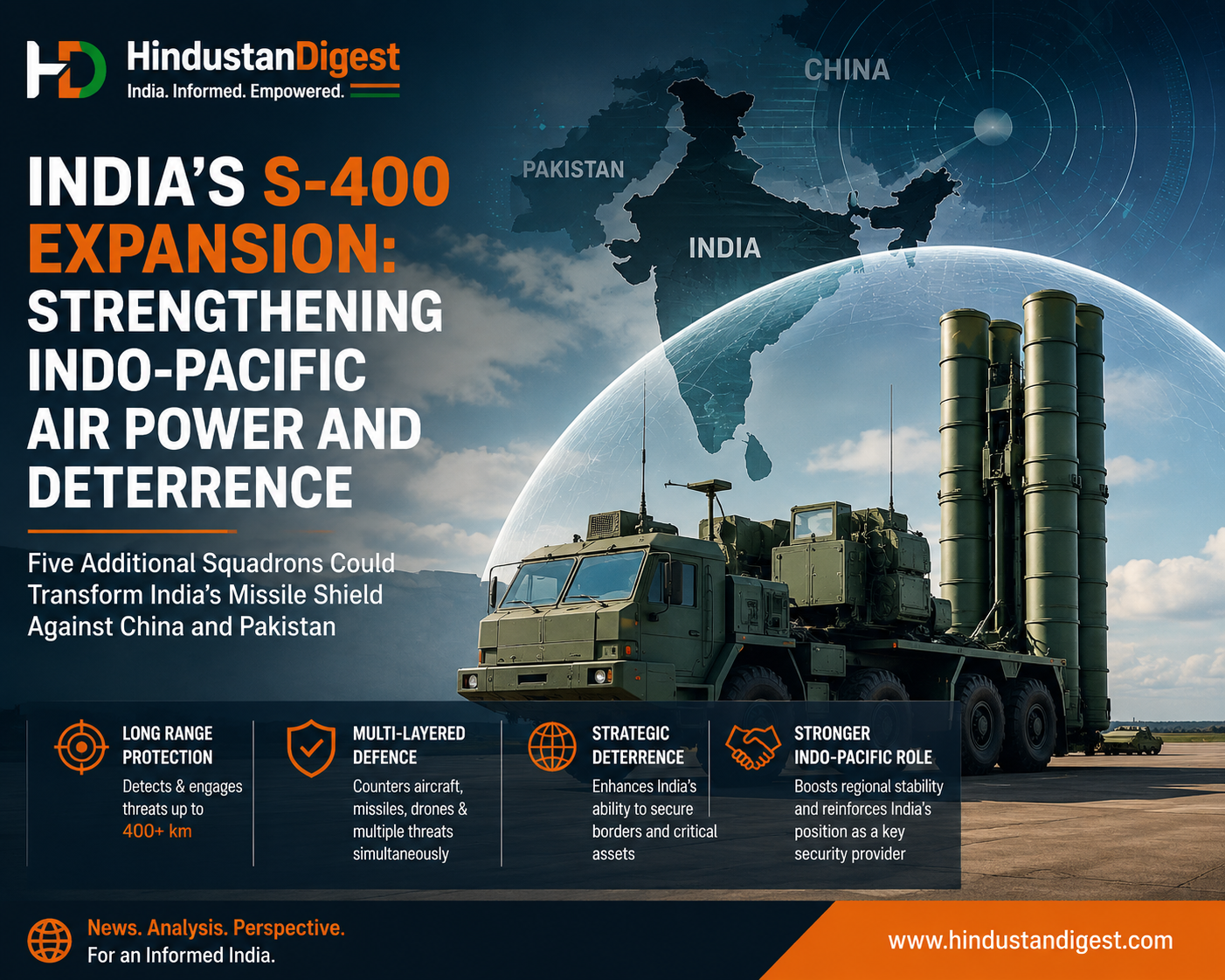
India’s S-400 Expansion: How New Missile Shield Squadrons Could Redefine Indo-Pacific Air Power and Strengthen Deterrence Against China and Pakistan.
India is reportedly planning to expand its S-400 air defence network with five additional squadrons, significantly enhancing its missile shield against threats from China and Pakistan. Explore the strategic, military, and geopolitical implications for the Indo-Pacific region.
India’s ongoing military modernization is entering a critical phase as reports indicate that New Delhi is considering the acquisition of five additional S-400 Triumf air defence squadrons from Russia. If finalized, the move would represent one of the most significant expansions of India’s integrated air defence architecture in recent years and could substantially alter the strategic balance across South Asia and the wider Indo-Pacific region.
The proposed expansion comes at a time when regional security dynamics are becoming increasingly complex. China continues to enhance its military capabilities along the Line of Actual Control (LAC), while Pakistan is modernizing its air force and missile inventory with support from Beijing. Against this backdrop, India is seeking to strengthen its layered defence shield to ensure air superiority, protect critical infrastructure, and enhance deterrence capabilities.
Understanding the S-400 Triumf System
The S-400 Triumf, developed by Russia’s Almaz-Antey defence corporation, is widely regarded as one of the world’s most advanced long-range air defence systems.
Designed to detect, track, and destroy a wide variety of aerial threats, the S-400 can engage:
- Fighter aircraft
- Stealth aircraft
- Ballistic missiles
- Cruise missiles
- Unmanned aerial vehicles (UAVs)
- Early warning and surveillance aircraft
The system employs multiple missile types, allowing it to engage targets at varying distances and altitudes.
Key Capabilities
- Detection range exceeding 600 km
- Engagement range up to 400 km
- Simultaneous tracking of hundreds of targets
- Ability to engage multiple threats at once
- Advanced radar and electronic warfare resistance
- Integration with broader air defence networks
These capabilities make the S-400 one of the most formidable anti-access and area-denial (A2/AD) systems currently deployed anywhere in the world.
India’s Existing S-400 Programme
India signed a landmark defence agreement with Russia in 2018 worth approximately $5.4 billion for five S-400 squadrons despite significant pressure and sanctions threats from the United States under the CAATSA framework.
Since then, deliveries have been progressing gradually despite disruptions caused by the COVID-19 pandemic and the Russia-Ukraine conflict.
Several operational S-400 units have already been deployed at strategic locations to provide coverage against potential threats originating from both China’s western theatre and Pakistan’s airspace.
The system has become a cornerstone of India’s evolving air defence doctrine.
Why India Wants Additional S-400 Squadrons
1. Rising Chinese Military Activity
China has significantly expanded military infrastructure across Tibet and Xinjiang, including:
- Advanced airbases
- Missile installations
- Integrated radar networks
- Long-range strike capabilities
The People’s Liberation Army Air Force (PLAAF) now operates advanced platforms such as:
- J-20 stealth fighters
- H-6 strategic bombers
- Hypersonic missile systems
Additional S-400 deployments would improve India’s ability to monitor and counter these evolving threats.
2. Pakistan’s Expanding Air Capabilities
Pakistan continues to modernize its air force with:
- JF-17 Block III fighters
- Chinese-made advanced radars
- Long-range precision-guided munitions
- Cruise missile systems
The deployment of more S-400 units would significantly complicate Pakistan’s ability to conduct air operations near Indian territory.
3. Protection of Strategic Assets
India’s critical infrastructure includes:
- Nuclear facilities
- Military command centres
- Air bases
- Naval installations
- Economic hubs
Expanding the S-400 network would provide layered protection for these vital assets against both conventional and strategic threats.
Impact on the Indo-Pacific Security Environment
The Indo-Pacific has emerged as the world’s most strategically important geopolitical theatre.
The addition of five more S-400 squadrons would have consequences extending well beyond South Asia.
Enhanced Deterrence
A larger missile shield increases the cost of aggression for potential adversaries. Any military planner must account for India’s growing ability to intercept incoming threats and deny access to contested airspace.
Shift in Air Power Calculations
Air superiority has traditionally played a decisive role in modern warfare. The expansion of India’s long-range air defence umbrella could force both China and Pakistan to alter operational doctrines, flight paths, and strike planning.
Increased Regional Competition
The move could trigger further military modernization efforts across Asia, with neighbouring countries investing in:
- Advanced fighter aircraft
- Electronic warfare systems
- Hypersonic weapons
- Counter-air-defence technologies
The Russia Factor
The proposed acquisition also highlights the enduring defence relationship between India and Russia.
For decades, Russia has remained one of India’s largest defence suppliers, providing:
- Fighter aircraft
- Submarines
- Tanks
- Missile systems
- Strategic technologies
Even as India diversifies procurement through partnerships with the United States, France, Israel, and indigenous manufacturers, Moscow remains a critical defence partner.
An expanded S-400 deal would reinforce these long-standing ties while demonstrating India’s strategic autonomy in defence procurement decisions.
Challenges and Potential Risks
Financial Costs
The acquisition of additional S-400 squadrons could involve several billion dollars in expenditure, requiring careful budgeting within India’s broader defence modernization plans.
Sanctions Concerns
Although India has largely avoided punitive measures under U.S. sanctions frameworks, any major new defence agreement with Russia may reignite diplomatic discussions in Washington.
Emerging Countermeasures
Military technology is evolving rapidly. Adversaries continue to invest in:
- Stealth technologies
- Hypersonic weapons
- Drone swarms
- Electronic warfare
India will need to complement S-400 deployments with indigenous systems, advanced radars, and next-generation air defence capabilities.
Integration with India’s Future Defence Strategy
India is increasingly moving toward a comprehensive multi-layered air defence architecture.
This includes:
Indigenous Air Defence Systems
- Akash Missile System
- Akash-NG
- XRSAM development programme
- Ballistic Missile Defence initiatives
Advanced Surveillance Networks
- Satellite-based monitoring
- Integrated radar coverage
- AI-assisted threat detection
Joint Force Operations
The future battlefield requires seamless coordination among:
- Indian Air Force
- Indian Army
- Indian Navy
- Strategic Forces Command
Additional S-400 squadrons would serve as a key pillar within this broader defensive ecosystem.
What China and Pakistan May Be Watching Closely
For Beijing, the expansion would represent a significant enhancement of India’s ability to challenge Chinese air operations across contested sectors.
For Islamabad, it could reduce operational flexibility and increase the risks associated with any future aerial confrontation.
Both nations are likely to closely monitor deployment locations, radar coverage zones, and integration with India’s wider command-and-control systems.
Conclusion
India’s reported plans to acquire five additional S-400 Triumf squadrons signal more than a routine defence procurement decision. The move reflects New Delhi’s determination to strengthen national security, enhance strategic deterrence, and prepare for an increasingly contested regional environment.
If implemented, the expanded missile shield would substantially improve India’s ability to defend its airspace, protect critical infrastructure, and maintain a credible military balance against both China and Pakistan. At the same time, it would reinforce India’s status as a major Indo-Pacific power capable of shaping the region’s future security architecture.
As geopolitical competition intensifies across Asia, India’s evolving air defence network is likely to become one of the most closely watched elements of the region’s strategic landscape.
Source: HindustanDigest.com Defence & Strategic Affairs Desk.
More Featured Articles:
SME IPO in India: A Comprehensive Guide for Growing Businesses Looking to Go Public.
Venture Debt in India: The Complete 2026 Guide for Startups, Founders, CFOs & Growth Companies.

One thought on “India’s S-400 Expansion: How New Missile Shield Squadrons Could Redefine Indo-Pacific Air Power and Strengthen Deterrence Against China and Pakistan.”