India’s Expanding Nuclear Arsenal: Strategic Deterrence, National Security, and the Emerging Asian Power Balance.
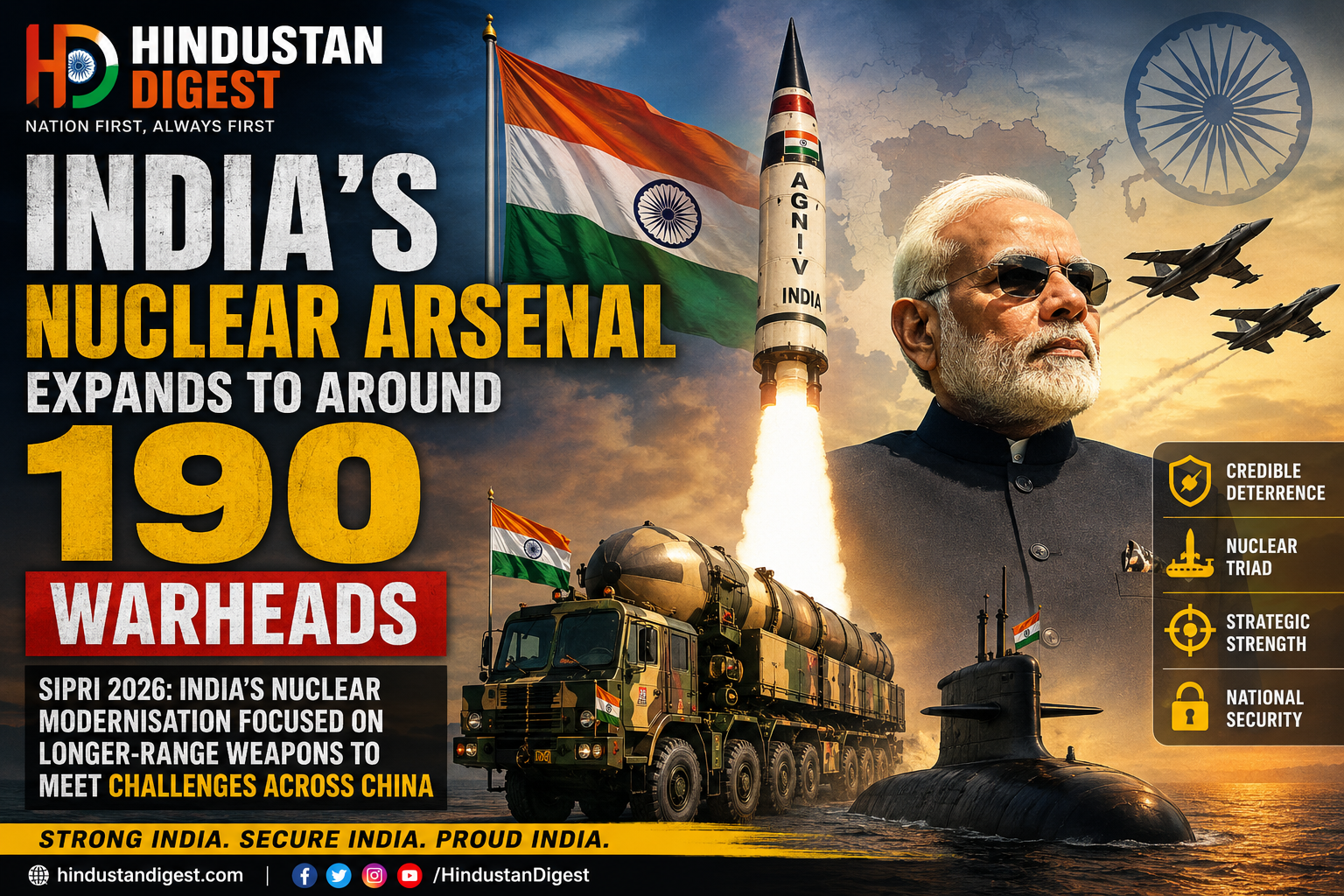
India’s nuclear arsenal has reportedly expanded to around 190 warheads, according to SIPRI 2026. Explore the strategic reasons behind India’s nuclear modernisation, the China factor, regional security implications, and what it means for India’s national defence posture.
India’s emergence as a major global power is increasingly reflected not only in its economic growth and technological capabilities but also in its strategic defence preparedness. According to the latest assessment by the Stockholm International Peace Research Institute (SIPRI) in its 2026 Yearbook, India is estimated to possess approximately 190 nuclear warheads, marking a gradual increase in its nuclear arsenal.
The report suggests that India’s ongoing nuclear modernisation programme is increasingly focused on developing longer-range delivery systems capable of strengthening strategic deterrence against emerging security challenges, particularly in the Indo-Pacific region.
While India’s nuclear doctrine remains rooted in restraint and responsible stewardship, the evolving regional security environment has compelled policymakers to continuously enhance the nation’s strategic deterrence capabilities.
Understanding India’s Nuclear Doctrine
India remains one of the few nuclear powers that has consistently adhered to a policy of responsible nuclear conduct.
The pillars of India’s nuclear doctrine include:
- Credible Minimum Deterrence
- No First Use (NFU) Policy
- Massive Retaliation in case of nuclear attack
- Civilian political control over nuclear weapons
- Commitment to global nuclear disarmament
Unlike several nuclear powers that maintain expansive nuclear inventories, India’s strategy has historically focused on maintaining only those capabilities necessary to deter potential adversaries.
The increase in warhead numbers should therefore be viewed within the framework of maintaining strategic balance rather than pursuing an arms race.
India’s Nuclear Journey: A Brief Historical Perspective
India’s nuclear programme has evolved over decades.
Key Milestones
1948
Establishment of the Atomic Energy Commission under the leadership of Dr. Homi Bhabha.
1974
India conducted its first nuclear test, code-named “Smiling Buddha.”
1998
Pokhran-II nuclear tests formally established India as a declared nuclear weapons state.
2003
Formalisation of India’s Nuclear Doctrine and No First Use policy.
2010-2026
Expansion of missile capabilities, submarine-based deterrence, and strategic command infrastructure.
Today, India possesses one of the world’s most sophisticated nuclear command and control systems.
Why Is India Expanding Its Nuclear Arsenal?
1. Evolving Security Challenges
India’s strategic environment has become significantly more complex.
The country faces two nuclear-armed neighbours:
- Pakistan
- China
Both nations have invested heavily in military modernisation and strategic weapons development.
Maintaining a credible deterrent against multiple adversaries requires continuous technological advancement and force restructuring.
2. China’s Military Modernisation
China’s rapid military expansion has become a major factor shaping India’s strategic planning.
Over the past decade, China has:
- Expanded its nuclear inventory substantially
- Developed advanced hypersonic missile systems
- Enhanced missile defence capabilities
- Expanded naval deployments in the Indian Ocean
- Strengthened military infrastructure along disputed borders
The SIPRI assessment indicates that India’s recent focus appears increasingly directed toward ensuring that its deterrence posture remains effective against longer-range strategic threats.
3. Strengthening the Nuclear Triad
A modern nuclear deterrent depends on maintaining a robust Nuclear Triad:
Land-Based Systems
Agni series ballistic missiles provide a range of strategic options.
Air-Based Systems
Modified fighter aircraft can deliver nuclear payloads if required.
Sea-Based Systems
Nuclear-powered ballistic missile submarines provide survivable second-strike capability.
The sea-based component is particularly important because submarines can remain hidden and operational even during a crisis.
The Importance of Credible Minimum Deterrence
A common misconception is that a larger nuclear arsenal automatically translates into greater security.
Strategic experts often argue that what matters most is:
- Survivability
- Reliability
- Command and control
- Delivery capability
- Second-strike potential
India’s nuclear modernisation appears focused more on quality and survivability rather than merely increasing warhead numbers.
Long-Range Missile Development
India has invested significantly in strategic missile programmes.
These include:
Agni-IV
Capable of covering substantial regional distances while carrying strategic payloads.
Agni-V
One of India’s most advanced long-range ballistic missiles, significantly enhancing deterrence capability.
Emerging Technologies
India is also investing in:
- MIRV technologies
- Enhanced guidance systems
- Improved re-entry vehicles
- Strategic surveillance networks
- Space-based military assets
These developments are intended to ensure that deterrence remains credible in a rapidly evolving technological environment.
India’s Responsible Nuclear Stewardship
Despite possessing nuclear weapons, India has consistently projected itself as a responsible nuclear power.
Key indicators include:
Strong Command and Control
India maintains civilian oversight of strategic forces through established institutional mechanisms.
Export Control Compliance
India has strengthened its export control regime and aligned many practices with international standards.
Support for Global Disarmament
India continues to advocate universal, non-discriminatory, and verifiable nuclear disarmament.
Non-Proliferation Record
India maintains one of the strongest non-proliferation records among nuclear-capable states.
Regional Implications
South Asia
India’s nuclear posture will inevitably influence regional security calculations.
Pakistan continues to maintain a significant nuclear arsenal and has developed tactical nuclear weapons as part of its deterrence strategy.
The challenge for policymakers remains preserving strategic stability while avoiding escalation risks.
Indo-Pacific Region
The Indo-Pacific is increasingly becoming the centre of global strategic competition.
India’s enhanced deterrence capability contributes to:
- Strategic stability
- Protection of national interests
- Security of maritime trade routes
- Regional balance of power
Global Perspective
The SIPRI report highlights a broader global trend.
Major nuclear powers are modernising their arsenals, including:
- United States
- Russia
- China
- United Kingdom
- France
In this context, India’s modernisation programme appears measured and aligned with its long-standing doctrine of credible minimum deterrence.
India’s strategic planners face the challenge of maintaining deterrence while avoiding unnecessary arms competition.
Economic and Technological Benefits
Strategic programmes often generate technological spillovers.
Investments in defence research have contributed to advances in:
- Aerospace engineering
- Satellite technology
- Artificial intelligence
- Advanced materials
- Cybersecurity
- Precision manufacturing
Many of these innovations eventually find civilian applications that support economic growth.
Challenges Ahead
Despite progress, India faces several challenges:
Balancing Security and Development
Defence spending must be balanced with infrastructure, education, healthcare, and social development priorities.
Emerging Technologies
Artificial intelligence, cyber warfare, and hypersonic weapons are transforming strategic calculations.
Strategic Stability
Maintaining effective communication channels with neighbouring countries remains essential for crisis management.
Global Arms Control Frameworks
Future arms-control initiatives may require innovative diplomatic engagement.
Conclusion
India’s reported expansion to approximately 190 nuclear warheads reflects the realities of an evolving strategic environment rather than a departure from its long-standing doctrine of restraint and responsible deterrence.
As geopolitical competition intensifies across Asia and the Indo-Pacific, India appears focused on ensuring that its strategic capabilities remain credible, survivable, and technologically relevant. The emphasis remains on maintaining a secure second-strike capability, strengthening the nuclear triad, and preserving strategic stability.
For India, nuclear weapons are not instruments of coercion but tools of deterrence designed to safeguard national sovereignty, territorial integrity, and long-term peace. As the nation continues its rise on the global stage, the challenge will be balancing strategic preparedness with its enduring commitment to responsible statecraft and global stability.
HindustanDigest.com
More Featured Articles:
SME IPO in India: A Comprehensive Guide for Growing Businesses Looking to Go Public.
Unlock Growth: How to Secure ₹1 Cr – ₹15 Cr Unsecured Funding for Your Business :


2 thoughts on “India’s Expanding Nuclear Arsenal: Strategic Deterrence, National Security, and the Emerging Asian Power Balance.”