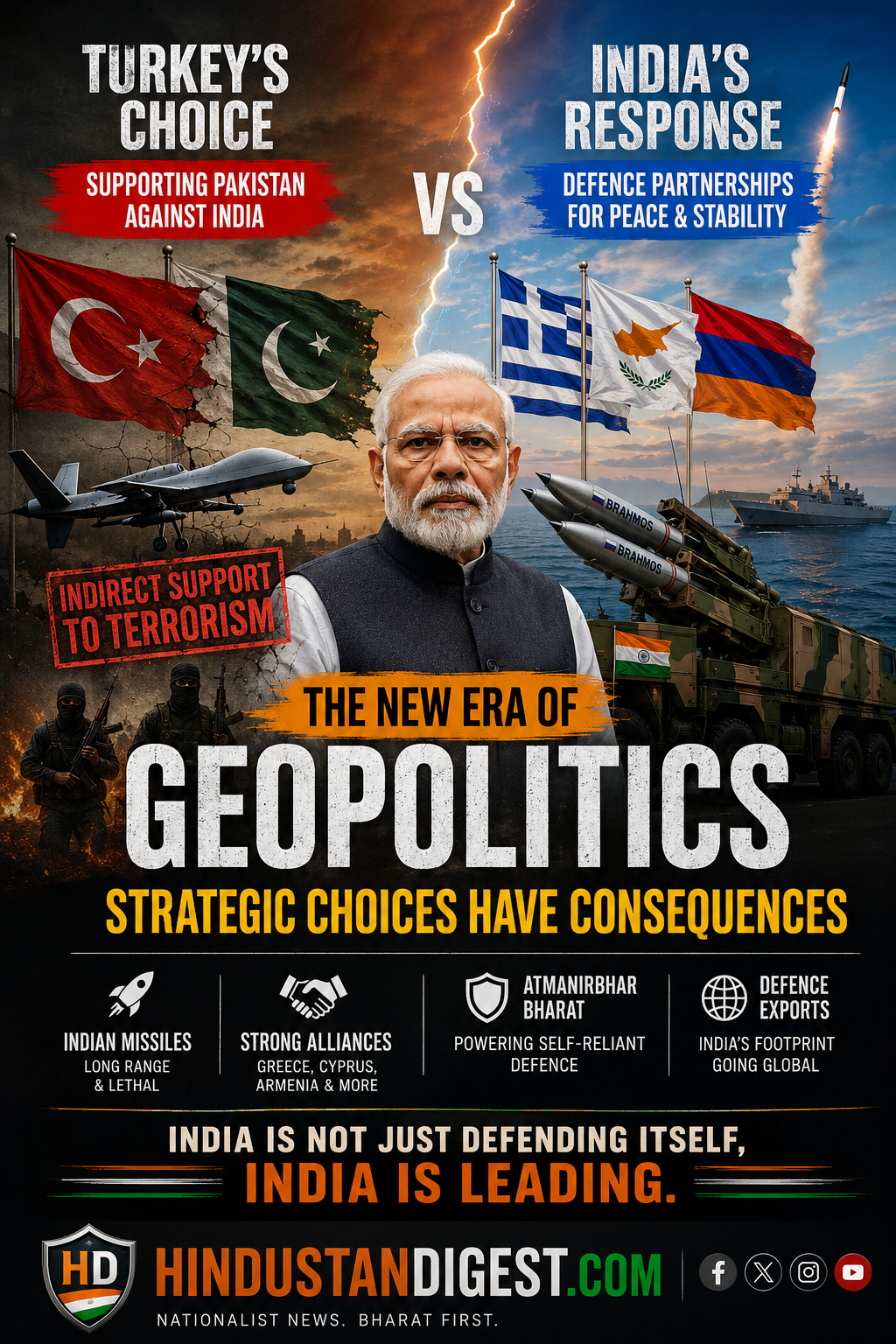
India’s Expanding Defence Diplomacy: Why Turkey’s Support to Pakistan Is Reshaping Geopolitics in the Eastern Mediterranean.
Turkey’s long-standing military support to Pakistan has strained relations with India. As India emerges as a major defence producer and exporter, new strategic partnerships with Greece, Cyprus, and Armenia are redefining regional geopolitics and strengthening New Delhi’s global influence.
Turkey’s Pakistan Policy Comes Full Circle: How India’s Growing Defence Power Is Changing the Strategic Equation
For decades, Turkey has positioned itself as one of Pakistan’s closest strategic partners, extending diplomatic, military, and political support to Islamabad on numerous occasions, including issues directly affecting India’s national security interests.
Today, however, the geopolitical landscape is changing rapidly.
As India emerges as a major defence manufacturing power and a significant exporter of advanced military systems, Turkey appears increasingly concerned about the possibility of deeper defence cooperation between India and countries that have strategic disagreements with Ankara, particularly Greece, Cyprus, and Armenia.
The development reflects a simple reality of international politics: strategic choices have consequences.
Turkey’s Consistent Support for Pakistan
Successive Turkish governments have maintained close military and political ties with Pakistan.
This support has included:
- Defence equipment transfers
- Military training cooperation
- Strategic technology partnerships
- Diplomatic backing on international platforms
- Supportive positions on issues affecting India
From New Delhi’s perspective, Turkey has often chosen to align itself with Pakistan despite India’s repeated concerns regarding cross-border terrorism and extremist networks operating from Pakistani soil.
India has consistently maintained that terrorism remains one of the biggest threats to regional peace and stability. Whenever nations choose to strengthen military partnerships with states accused of supporting or tolerating terror infrastructure, questions naturally arise regarding the broader implications of such support.
Many Indian strategic analysts argue that military assistance to Pakistan indirectly strengthens a state apparatus that has repeatedly faced international scrutiny over terror-related concerns.
The New Reality: India Is No Longer Just a Defence Importer
For decades, India was among the world’s largest importers of military equipment.
That reality is changing.
Under the Atmanirbhar Bharat initiative and sustained investment in indigenous defence production, India has transformed itself into an increasingly capable defence manufacturer.
Today, India produces:
- Advanced missile systems
- Artillery platforms
- Armoured vehicles
- Naval warships
- Electronic warfare systems
- Radar systems
- Drones and unmanned platforms
- Space-based military technologies
Indian defence exports have expanded significantly over the past decade, reaching dozens of countries across Asia, Africa, Europe, and Latin America.
This transformation has given India a new geopolitical tool: defence diplomacy.
Greece and India: A Natural Strategic Partnership
The growing convergence between India and Greece is attracting significant international attention.
While separated by geography, both countries share several strategic concerns:
- Respect for sovereignty and territorial integrity
- Maritime security
- Stable international trade routes
- Counter-terrorism cooperation
- Rules-based international order
Greece occupies a critical position in the Eastern Mediterranean, while India serves as a major power in the Indo-Pacific.
As global supply chains and security architectures evolve, cooperation between New Delhi and Athens appears increasingly logical.
Potential areas of collaboration include:
- Missile systems
- Naval technologies
- Maritime surveillance
- Cyber security
- Joint military exercises
- Defence manufacturing partnerships
The possibility of such cooperation has reportedly generated considerable discussion within Turkish strategic circles.
Armenia: Another Emerging Strategic Partner
India has already demonstrated its willingness to strengthen defence ties with Armenia.
In recent years, defence cooperation between New Delhi and Yerevan has expanded significantly.
Armenia has emerged as an important customer for Indian defence equipment, highlighting India’s growing reputation as a reliable supplier of advanced military systems.
For India, defence exports are not merely commercial transactions. They are instruments of strategic influence, helping strengthen partnerships while promoting regional stability.
Turkey’s close alignment with Azerbaijan and Pakistan has naturally encouraged Armenia to seek deeper relationships with alternative partners, including India.
Cyprus and the Eastern Mediterranean Dimension
Cyprus represents another area where India’s diplomatic and strategic engagement could deepen.
As tensions continue to shape the Eastern Mediterranean, New Delhi’s growing economic and strategic presence provides opportunities for broader cooperation.
India’s expanding defence capabilities create possibilities for:
- Maritime security cooperation
- Intelligence sharing
- Defence technology exchanges
- Counter-terrorism initiatives
Such partnerships would reflect India’s broader strategy of engaging with nations based on mutual interests and respect for sovereignty.
Defence Exports: A New Pillar of Indian Foreign Policy
India’s defence exports have become one of the most important components of its foreign policy toolkit.
Historically, countries such as the United States, Russia, France, Britain, and China used defence exports to build strategic influence.
India is increasingly joining that club.
Key advantages of Indian defence products include:
Cost Effectiveness
Indian systems often offer competitive pricing compared to Western alternatives.
Proven Operational Capability
Many systems are developed based on the requirements of one of the world’s largest armed forces.
Political Reliability
India is viewed by many countries as a stable and dependable strategic partner.
Technology Growth
Rapid advances in missile technology, aerospace engineering, electronics, and unmanned systems have enhanced India’s attractiveness in international markets.
Strategic Reciprocity in International Relations
International relations are rarely driven by sentiment.
They are driven by interests.
When Turkey chose to strengthen military cooperation with Pakistan despite India’s objections, it created strategic consequences that may now be unfolding.
If Ankara considers it legitimate to arm and support Pakistan, it becomes difficult to object when India explores defence cooperation with countries that seek stronger partnerships in Turkey’s broader neighbourhood.
This is not retaliation.
It is geopolitical reciprocity.
Nations pursue relationships that serve their security interests.
India is doing precisely what every major power does—building partnerships, expanding influence, and supporting friendly nations through economic, diplomatic, and defence engagement.
India’s Rise as a Global Strategic Power
The larger story extends beyond Turkey, Pakistan, Greece, or Armenia.
It is about India’s emergence as a global power.
Today, India is:
- The world’s fastest-growing major economy
- A leading Indo-Pacific power
- A key member of multiple strategic groupings
- An increasingly influential defence exporter
- A trusted partner for nations seeking strategic diversification
India’s growing defence footprint reflects confidence, capability, and credibility.
Countries around the world are recognizing that India is no longer merely a regional player. It is becoming an indispensable pillar of the emerging global order.
Conclusion
Turkey’s long-standing support for Pakistan may have delivered short-term diplomatic advantages, but it has also shaped perceptions in New Delhi and influenced India’s strategic calculations.
As India expands defence cooperation with countries such as Greece, Armenia, and potentially Cyprus, the geopolitical balance is evolving.
The message is clear: nations that choose their alliances must also accept the consequences of those choices.
India today possesses something it lacked in earlier decades economic strength, military capability, technological innovation, and a rapidly growing defence industry.
With those tools, New Delhi is steadily expanding its influence from the Indo-Pacific to the Mediterranean and beyond.
The era when India was merely a recipient of global strategic decisions is ending.
India is increasingly becoming a nation that helps shape them.
Published by HindustanDigest.com
National Security | Geopolitics | Defence | Strategic Affairs | Bharat First
More Featured Articles:
SME IPO in India: A Comprehensive Guide for Growing Businesses Looking to Go Public.
Unlock Growth: How to Secure ₹1 Cr – ₹15 Cr Unsecured Funding for Your Business :
Strategic Finance Options for Medical and Hospital Businesses in India (2026)
Funding and Investment Options to Grow India’s Real Estate and Allied Businesses
SIDBI – Powering India’s MSME Growth: Funding, Schemes & Business Support.
CFO Services for Startups: Why Virtual CFOs Are Transforming Business Scalability in India
2 thoughts on “India’s Expanding Defence Diplomacy: Why Turkey’s Support to Pakistan Is Reshaping Geopolitics in the Eastern Mediterranean.”