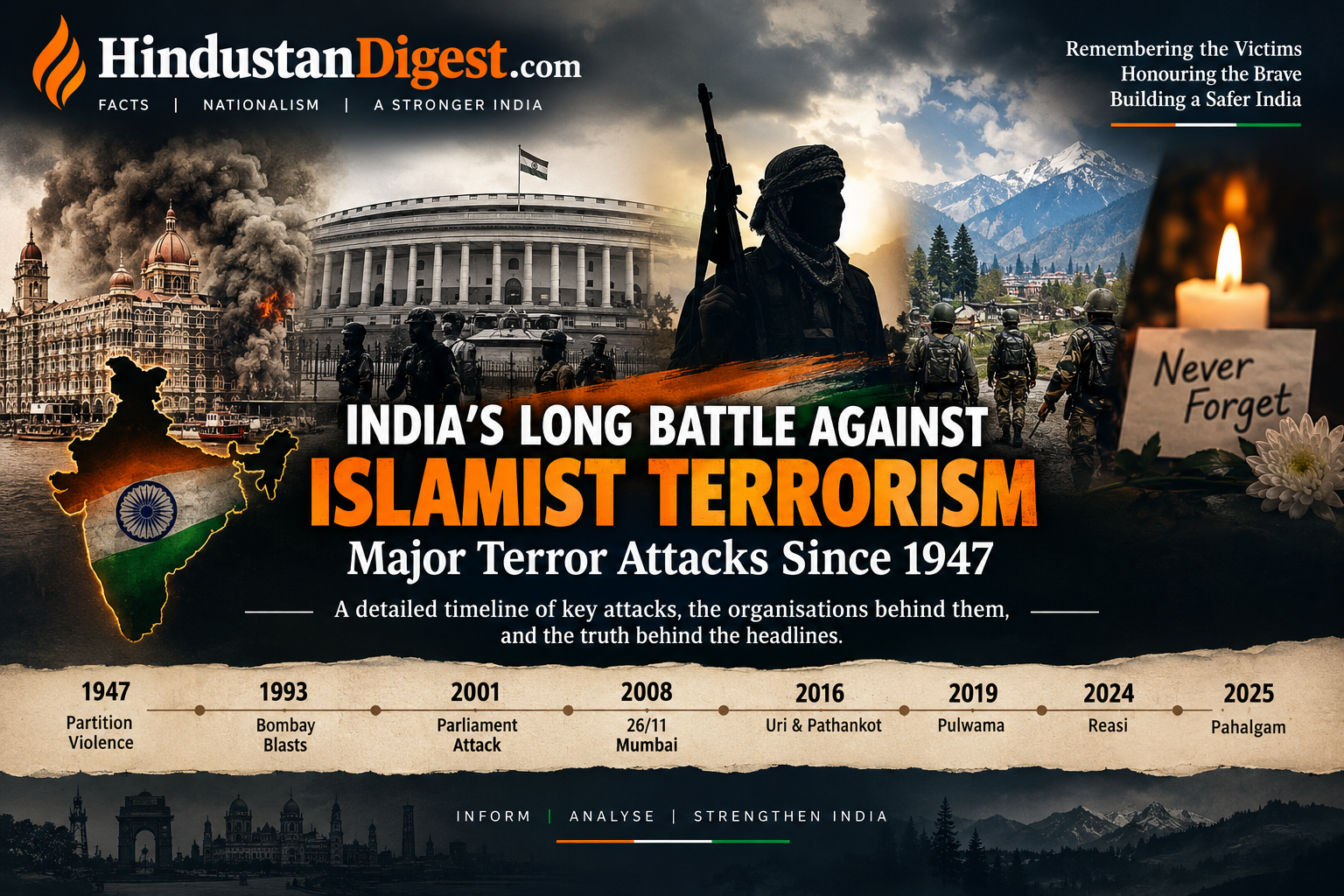
India’s Long Battle Against Islamist Terrorism: A Timeline of Major Terror Attacks Since 1947.
From the Kashmir insurgency and the 1993 Bombay blasts to 26/11, Pulwama and Pahalgam, a chronological record of some of the most consequential terrorist attacks linked to Islamist extremist organisations
A detailed timeline of major Islamist terrorist attacks in India since 1947, covering Kashmir insurgency, 1993 Bombay blasts, Parliament, 26/11, Indian Mujahideen, Pulwama and Pahalgam, with official and judicial context.
By HindustanDigest.com
India’s post-Independence history has been marked by several forms of terrorism and insurgency — including Left-Wing Extremism, separatist militancy, insurgencies in the Northeast and terrorism linked to Islamist extremist organisations.
Among the most devastating has been the long-running campaign of violence associated with Pakistan-based jihadist organisations and, at different periods, domestic extremist networks.
This history deserves to be documented carefully. Terrorist organisations such as Lashkar-e-Taiba (LeT), Jaish-e-Mohammed (JeM), Hizb-ul-Mujahideen (HM), Harkat-ul-Mujahideen (HuM), Al-Badr and Indian Mujahideen (IM) have figured prominently in investigations into major attacks in India. Several of these organisations remain designated terrorist organisations under India’s Unlawful Activities (Prevention) Act (UAPA). The Ministry of Home Affairs’ current list specifically identifies LeT, JeM, HuM, Al-Badr, SIMI, Indian Mujahideen and the Resistance Front, among others.
At the same time, not every attack initially attributed to an Islamist organisation ultimately resulted in a conviction or judicial finding supporting that attribution. Some cases remain contested or ended in acquittals. A responsible historical record therefore has to distinguish between court-established responsibility, official investigative attribution and allegations that were not ultimately proved.
1947: Partition violence — a historical distinction
The violence accompanying Partition in 1947 resulted in an enormous loss of life and mass displacement across the newly created borders of India and Pakistan.
However, it would be historically inaccurate to place the entire Partition violence into a timeline of “Islamist terrorist attacks”. The violence involved communal militias, political forces, state and non-state actors and mobs belonging to different communities.
There were atrocities committed against Hindus, Sikhs and Muslims on both sides of the new border.
For that reason, Partition is better understood as a mass communal catastrophe of Partition, rather than as a single Islamist terrorist campaign.
1990s: Kashmir insurgency and the spread of terror beyond the Valley
1990 — Exodus and killings of Kashmiri Pandits
The outbreak of armed insurgency in Jammu and Kashmir at the end of the 1980s and beginning of the 1990s transformed the security landscape of the country.
Kashmiri Pandits were targeted through killings, threats and intimidation, contributing to the mass displacement of the community from the Kashmir Valley.
The period is commonly associated with organisations including the Jammu and Kashmir Liberation Front (JKLF) and Hizb-ul-Mujahideen, although the insurgency involved multiple organisations and changing networks over time.
The Kashmir conflict should be treated separately from the later wave of spectacular urban bombings elsewhere in India.
The scale of violence was enormous. SATP’s historical assessment records that J&K experienced four-digit annual fatalities in every year from 1990 through 2006, with 4,011 fatalities in 2001 alone.
12 March 1993 — Bombay serial bombings
The 1993 Bombay serial bombings marked one of the most significant early examples of organised transnational terrorism striking a major Indian metropolis.
A series of explosions struck locations including the Bombay Stock Exchange, Air India Building, Zaveri Bazaar, hotels and other crowded areas.
The Supreme Court record states that 257 people were killed and 713 injured. The investigation resulted in a large conspiracy case and convictions of several accused.
The conspiracy was linked to the criminal-terror network involving Dawood Ibrahim, Tiger Memon and associates, with the prosecution establishing the smuggling of weapons and explosives and the wider conspiracy.
Important correction: the Bombay Stock Exchange blast was part of the 12 March 1993 serial bombings, not a separate 16 March terrorist attack.
24 December 1999 — IC-814 hijacking
Indian Airlines flight IC-814 was hijacked after departing Kathmandu and eventually flown to Kandahar, then under Taliban control.
One passenger, Rupin Katyal, was killed.
The hijacking became a defining episode in India’s counter-terrorism history because the crisis ended with the release of three jailed militants, including Masood Azhar, who subsequently founded Jaish-e-Mohammed.
Indian government records later identified Pakistan-based JeM figures in connection with the hijacking case. MHA records also identify JeM as a designated terrorist organisation.
2000–2005: The Parliament era and attacks on strategic and religious targets
22 December 2000 — Red Fort attack, Delhi
Armed terrorists attacked the Red Fort in Delhi, killing three people.
The attack was attributed to Lashkar-e-Taiba.
It demonstrated the continuing vulnerability of major national symbols and crowded civilian locations to Pakistan-based terrorist networks.
1 October 2001 — Jammu & Kashmir Assembly attack
A suicide vehicle bombing and armed assault targeted the Jammu & Kashmir Legislative Assembly complex in Srinagar.
Dozens were killed.
The attack was attributed to Jaish-e-Mohammed, one of the principal Pakistan-based organisations that subsequently became associated with attacks against Indian security installations and political targets.
13 December 2001 — Attack on the Indian Parliament
The attack on India’s Parliament became one of the most consequential terrorist attacks in the country’s history.
Five armed attackers entered the Parliament complex and opened fire.
Nine security and other personnel were killed, while the attackers were also killed.
Indian investigations and the subsequent judicial proceedings linked the conspiracy to Lashkar-e-Taiba and Jaish-e-Mohammed.
The attack brought India and Pakistan close to a major military confrontation and triggered a massive security mobilisation.
2002 — Raghunath Temple and Kaluchak attacks
Jammu witnessed a series of attacks in 2002.
The Raghunath Temple was attacked twice, while the Kaluchak massacre targeted an Army residential area and families of military personnel.
The attacks were attributed to Pakistan-based jihadist organisations, particularly Lashkar-e-Taiba.
They demonstrated a recurring terrorist strategy: attacking civilians, religious sites and military families rather than limiting violence to security forces.
24 September 2002 — Akshardham Temple attack, Gujarat
Gunmen attacked the Akshardham temple complex in Gandhinagar.
More than 30 people were killed.
The attack was initially attributed to Pakistan-based terrorist networks. However, the subsequent legal history of the case makes it inappropriate to present every original allegation as judicially established.
The episode nevertheless remains one of the major terrorist attacks against a religious site in modern Indian history.
25 August 2003 — Mumbai twin bombings
Bombs exploded near Gateway of India and Zaveri Bazaar in Mumbai.
More than 50 people were killed and many more injured.
The investigation linked the conspiracy to extremist networks including Lashkar-e-Taiba and SIMI-linked elements.
5 July 2005 — Ayodhya attack
Terrorists attacked the heavily guarded Ram Janmabhoomi complex in Ayodhya.
Security forces killed the attackers before they could cause greater damage.
The attack demonstrated the continuing terrorist interest in highly symbolic religious and political locations.
29 October 2005 — Delhi serial blasts
On the eve of Diwali, explosions struck Paharganj, Sarojini Nagar and the Govindpuri/Okhla area.
More than 60 people were killed and over 200 injured.
The prosecution linked the conspiracy to Lashkar-e-Taiba networks. A Delhi court subsequently convicted Tariq Ahmed Dar under UAPA provisions relating to membership/support of a terrorist organisation, while two other accused were acquitted.
The case illustrates why terrorist timelines must distinguish between the prosecution theory and what was actually proved against individual accused.
2006–2010: The Indian Mujahideen bombing wave
The middle of the 2000s saw a dramatic increase in coordinated urban bombings.
Investigations increasingly identified networks associated with Indian Mujahideen, which Indian authorities have treated as a terrorist organisation and which emerged from extremist networks associated with SIMI.
The Ministry of Home Affairs lists Indian Mujahideen and SIMI among organisations designated under the UAPA framework.
7 March 2006 — Varanasi blasts
Explosions struck Sankat Mochan Temple and Varanasi Cantonment railway station.
Dozens were killed and many injured.
The investigation linked the attack to extremist networks including Indian Mujahideen and Lashkar-e-Taiba.
11 July 2006 — Mumbai suburban train bombings
Seven coordinated explosions struck Mumbai’s suburban railway network during the evening rush hour.
More than 180 people were killed and hundreds injured.
The investigation and subsequent prosecution linked the conspiracy to Pakistan-based Lashkar-e-Taiba and Indian extremist networks.
The attack remains one of the deadliest coordinated terrorist operations against a civilian transport system in India.
2007 — Hyderabad and Uttar Pradesh attacks
Several major attacks followed:
- Mecca Masjid, Hyderabad — 18 May 2007
- Hyderabad twin blasts — 25 August 2007
- Uttar Pradesh court blasts — 23 November 2007
The Hyderabad twin blasts were subsequently associated with Indian Mujahideen networks.
The Mecca Masjid case, however, is an important example of why attribution must be treated carefully: an NIA court acquitted the accused who faced trial in 2018 for lack of evidence.
Consequently, the Mecca Masjid bombing should not be presented today as a court-established Islamist attack by the accused who were acquitted.
13 May 2008 — Jaipur serial blasts
A coordinated series of explosions struck Jaipur.
More than 60 people were killed and hundreds injured.
Indian Mujahideen claimed responsibility in communications associated with the attack, and the incident became one of the defining episodes of the Indian Mujahideen bombing campaign.
26 July 2008 — Ahmedabad serial blasts
A succession of explosions struck Ahmedabad within a short period.
Fifty-six people were killed, while many more were injured.
Indian Mujahideen claimed responsibility.
The scale and coordination of the attack showed how domestic extremist cells could conduct simultaneous operations across a major metropolitan area.
13 September 2008 — Delhi serial blasts
Explosions struck busy areas including Karol Bagh, Connaught Place and Greater Kailash.
Indian Mujahideen claimed responsibility.
The attacks were followed by an intense investigation into the organisation’s network.
26/11: The attack that changed India’s counter-terrorism architecture
26–29 November 2008 — Mumbai
The Mumbai attacks of November 2008 remain among the most consequential terrorist attacks in India’s history.
Ten armed terrorists arrived by sea and attacked multiple locations, including:
- Chhatrapati Shivaji Terminus
- Taj Mahal Palace Hotel
- Oberoi-Trident
- Nariman House
- Leopold Café
- Cama Hospital and surrounding areas
166 people were killed.
Ajmal Kasab was captured alive, providing investigators with crucial evidence concerning the attackers and their handlers.
The Bombay High Court judgment in the Kasab case established the terrorist character of the operation and the deaths of 166 people.
Indian authorities identified Lashkar-e-Taiba as the organisation behind the attack.
The conspiracy continued to generate investigations internationally. In 2025, the National Investigation Agency announced the extradition of Tahawwur Rana from the United States in connection with the 26/11 conspiracy.
26/11 demonstrated that terrorism could combine maritime infiltration, sophisticated communications, international handlers, live media monitoring and coordinated attacks on multiple targets.
2010–2014: The Indian Mujahideen network continues
13 February 2010 — Pune German Bakery blast
A bomb exploded at the German Bakery in Pune.
17 people were killed and several others injured.
The investigation linked the attack to Indian Mujahideen.
13 July 2011 — Mumbai triple blasts
Three coordinated explosions struck Zaveri Bazaar, Opera House and Dadar.
Twenty-six people were killed.
Investigators linked the attack to Indian Mujahideen networks.
7 September 2011 — Delhi High Court blast
A bomb exploded outside the Delhi High Court.
Fifteen people were killed and many others injured.
The investigation examined links to Hizb-ul-Mujahideen and Indian Mujahideen networks.
21 February 2013 — Hyderabad Dilsukhnagar blasts
Twin explosions in Dilsukhnagar killed 18 people and injured many others.
The attack was subsequently linked to Indian Mujahideen operatives.
2014 onwards: The centre of gravity shifts back toward Kashmir
By the middle of the 2010s, the character of major Islamist terrorism in India increasingly shifted toward attacks in Jammu and Kashmir against security forces, camps and civilians.
Organisations such as Jaish-e-Mohammed and Lashkar-e-Taiba remained central.
The Ministry of Home Affairs continues to designate both organisations as terrorist organisations under the UAPA.
January 2016 — Pathankot Air Force Station
Armed terrorists attacked the Pathankot Air Force Station.
The investigation identified Jaish-e-Mohammed involvement.
The MHA subsequently identified Pakistan-based JeM commander Shahid Latif as a key conspirator and coordinator of the Pathankot attack.
September 2016 — Uri Army camp attack
Terrorists attacked an Army installation at Uri.
Nineteen soldiers were killed.
The attack was attributed to Jaish-e-Mohammed.
It was followed by India’s announcement of the September 2016 cross-border “surgical strikes” against terrorist launch pads across the Line of Control.
2019: Pulwama and the return of suicide terrorism
14 February 2019 — Pulwama CRPF convoy attack
A suicide bomber drove an explosive-laden vehicle into a convoy of Central Reserve Police Force personnel at Pulwama.
Forty CRPF personnel were killed.
The attack was claimed by Jaish-e-Mohammed.
The NIA investigation subsequently arrested and chargesheeted several accused and identified JeM operatives and facilitators involved in the conspiracy.
The attack triggered a major escalation between India and Pakistan, including India’s Balakot air operation.
2020–2024: Proxy organisations and targeted attacks in Jammu & Kashmir
India’s counter-terrorism agencies increasingly identified new names and front organisations associated with established Pakistan-based terrorist groups.
The Ministry of Home Affairs has described The Resistance Front (TRF) as a proxy of Lashkar-e-Taiba and People’s Anti-Fascist Front (PAFF) as a proxy of Jaish-e-Mohammed.
This development created an important challenge for counter-terrorism agencies: terrorist organisations could attempt to operate under new names while retaining personnel, ideology, financing and logistical connections.
9 June 2024 — Reasi pilgrim bus attack
Terrorists opened fire on a bus carrying pilgrims in Reasi district of Jammu and Kashmir.
The bus plunged into a gorge.
Nine people were killed.
The Ministry of Home Affairs officially recorded the incident as a terrorist attack on pilgrims.
The incident demonstrated that attacks on civilians and pilgrims remained a major component of the threat.
22 April 2025 — Pahalgam: a new shock
The terrorist attack at Baisaran Valley near Pahalgam on 22 April 2025 became one of the most serious attacks on tourists in Jammu and Kashmir in recent years.
Twenty-six people — 25 tourists and one local civilian — were killed.
The attack involved targeted killings based on religious identity.
The National Investigation Agency subsequently filed a chargesheet against seven accused, including Pakistan-based Lashkar-e-Taiba/The Resistance Front, and described the attack as involving religion-based targeted killings.
This represents an important distinction from earlier cases: by December 2025, the NIA had formally chargesheeted LeT/TRF as an organisation for its alleged role in planning, facilitating and executing the attack.
The principal organisations in India’s terrorism history
Lashkar-e-Taiba — LeT
Lashkar-e-Taiba is a Pakistan-based terrorist organisation that has been associated with some of the most serious attacks against India.
Its history in India includes major investigations relating to:
- 2000 Red Fort attack
- 2001 Parliament attack
- 2003 Mumbai attacks
- 2005 Delhi blasts
- 2006 Mumbai train bombings
- 2008 Mumbai attacks
- attacks in Jammu & Kashmir
- the 2025 Pahalgam attack through the LeT/TRF network, according to the NIA chargesheet
The organisation is formally listed as a terrorist organisation by the Indian government.
Jaish-e-Mohammed — JeM
Founded by Masood Azhar after his release during the IC-814 crisis, JeM became one of the principal Pakistan-based terrorist organisations targeting India.
Major attacks associated with investigations into JeM include the:
- Jammu & Kashmir Assembly attack
- Parliament attack
- Pathankot attack
- Uri attack
- Pulwama attack
The MHA officially lists JeM as a designated terrorist organisation.
Indian Mujahideen
Indian Mujahideen became synonymous with the wave of coordinated urban bombings during the 2000s.
Investigations connected IM networks with attacks in:
- Varanasi
- Hyderabad
- Jaipur
- Ahmedabad
- Delhi
- Pune
- Mumbai
- other Indian cities
Indian Mujahideen is included in the MHA’s list of terrorist organisations.
Students Islamic Movement of India — SIMI
SIMI was declared an unlawful association and has been the subject of repeated government notifications under the UAPA.
Security investigations have connected former SIMI members and networks to subsequent extremist activity, including networks associated with Indian Mujahideen.
However, an important journalistic distinction is necessary: SIMI as an organisation and individual former members should not automatically be treated as identical to Indian Mujahideen or to every subsequent act of terrorism.
Hizb-ul-Mujahideen
Hizb-ul-Mujahideen has been primarily associated with the armed insurgency in Jammu and Kashmir.
The organisation is included in India’s list of designated terrorist organisations.
Harkat-ul-Mujahideen, Al-Badr and other groups
A range of smaller Pakistan-based or Kashmir-focused terrorist organisations have operated at different times.
Several appear on the Ministry of Home Affairs’ designated terrorist organisation list, including Harkat-ul-Mujahideen and Al-Badr.
The proxy organisation phenomenon
One of the major developments in the Kashmir theatre has been the appearance of organisations operating under names different from the established Pakistan-based groups.
The Government of India has specifically described:
TRF → proxy of Lashkar-e-Taiba
PAFF → proxy of Jaish-e-Mohammed
and has listed them within the broader framework of terrorist organisations and their manifestations/front organisations.
This is important because changing organisational names does not necessarily mean that the underlying networks, personnel, ideology or infrastructure have disappeared.
A critical lesson from India’s terrorism record: attribution matters
A serious historical examination also requires acknowledging cases in which early investigative theories did not survive judicial scrutiny.
Malegaon 2006
The 2006 Malegaon blasts killed 31 people. The investigation went through multiple stages involving different agencies and theories.
In April 2026, the Bombay High Court quashed the charges against the last four remaining accused, citing contradictions between investigative versions and lack of credible evidence.
Therefore, the 2006 Malegaon bombing should not be presented as an established Islamist terrorist attack merely because early investigations initially focused on Muslim suspects.
Mecca Masjid 2007
The NIA court acquitted the accused who stood trial in the 2007 Mecca Masjid case for lack of sufficient evidence.
Samjhauta Express 2007
The 2007 Samjhauta Express bombing killed 68 people. In 2019, a special NIA court acquitted all four accused who faced trial, concluding that the prosecution had not established the case with credible admissible evidence.
These cases demonstrate an essential principle for historians and journalists:
An investigative allegation is not the same thing as a judicially established fact.
The larger picture
India’s experience with Islamist terrorism cannot be reduced to a single organisation or a single period.
The pattern has evolved through several phases:
1990s:
Kashmir insurgency, targeted killings and the emergence of Pakistan-backed militant infrastructure.
1993–2005:
Major urban bombings, attacks on political and religious symbols and the development of transnational terrorist networks.
2006–2013:
A wave of coordinated metropolitan attacks associated with Indian Mujahideen and Pakistan-based networks.
2008:
26/11 demonstrated the international reach, maritime capability and sophistication of Lashkar-e-Taiba’s operational network.
2014–2019:
Increasing emphasis on attacks against military installations and security forces, culminating in Pulwama.
2020–2025:
Greater use of proxy names, targeted killings and attacks on civilians and tourists in Jammu and Kashmir.
SATP’s data also show how dramatically the intensity of the Kashmir conflict has changed over time. After the extraordinarily violent period of the 1990s and early 2000s, annual fatalities fell substantially; SATP recorded 134 fatalities in J&K in 2023 and 127 in 2024, compared with 4,011 in 2001.
That decline is an important part of the story — but it does not mean the terrorist threat has disappeared.
Remembering the victims
Behind every statistic in India’s terrorism history was a human being.
Passengers travelling home on a Mumbai train.
Families visiting a temple.
Office workers in a stock exchange.
Tourists enjoying Kashmir.
Security personnel travelling in a convoy.
Pilgrims returning from a religious journey.
Hotel guests and employees trapped in Mumbai during 26/11.
The history of terrorism is therefore not simply a history of organisations, intelligence failures, investigations and military responses. It is also a history of ordinary Indians and visitors whose lives were permanently altered or extinguished by political violence.
The appropriate response to such history is neither collective blame nor historical amnesia. It is accurate documentation of perpetrators, networks, victims, investigations and judicial findings.
India’s democratic institutions have repeatedly confronted terrorist violence through investigation, prosecution, intelligence cooperation, policing and national security measures.
The continuing challenge is to ensure that terrorist organisations cannot exploit communal divisions, recruit new cadres, obtain financing, cross borders or reinvent themselves under new names.
Editorial note
This timeline focuses on major attacks in which Islamist extremist organisations were officially identified, investigated or otherwise prominently linked by Indian authorities or courts. It does not attempt to catalogue every terrorist incident in India.
The categories of “Islamist”, “Pakistan-based”, “proxy organisation”, “investigative attribution” and “court-established responsibility” are not interchangeable. Where the judicial record has rejected or failed to establish an attribution, this article says so.
Most importantly, terrorist organisations should not be equated with an entire religion or with India’s Muslim citizens, the overwhelming majority of whom have no connection to terrorism.
India’s national security history is best served by facts, evidence and the rule of law.
Hindustan Digest
More Featured Articles:
Osama Bin Laden, India and Terrorism: What the New CIA Files Reveal 25 Years After 9/11
SME IPO in India: A Comprehensive Guide for Growing Businesses Looking to Go Public.
Venture Debt in India: The Complete 2026 Guide for Startups, Founders, CFOs & Growth Companies.

One thought on “India’s Long Battle Against Islamist Terrorism: A Timeline of Major Terror Attacks Since 1947.”