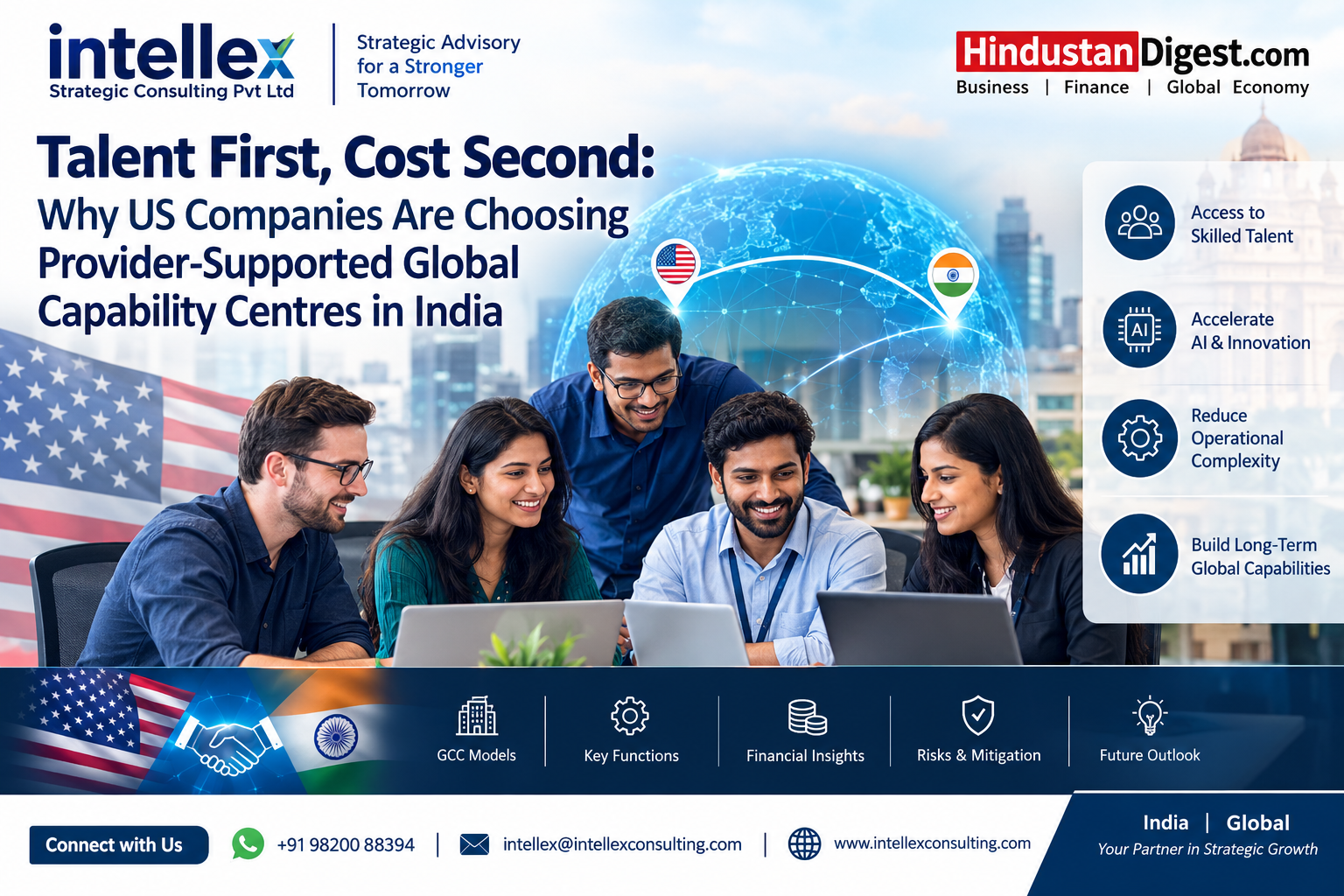
Talent First, Cost Second: Why US Companies Are Choosing Provider-Supported Global Capability Centres in India.
Discover why US companies are choosing provider-supported Global Capability Centres in India to access skilled talent, accelerate AI adoption, reduce operating complexity and build long-term global capabilities.
Published for HindustanDigest.com | Business, Finance & Global Economy
Introduction: India’s Role in the Changing Global Business Landscape
For decades, American companies have looked towards India to reduce operating costs, outsource technology services and access a large pool of skilled professionals. However, the relationship between American businesses and India’s technology and professional services ecosystem is undergoing a significant transformation.
The focus is no longer limited to finding less expensive employees or transferring routine back-office operations overseas. Increasingly, companies want access to specialised artificial intelligence (AI) engineers, data scientists, cybersecurity professionals, product developers, financial analysts and research specialists who can contribute directly to business growth.
This shift is changing the role of India’s Global Capability Centres (GCCs).
A GCC is an offshore operation that supports its parent organisation’s global business activities. Depending on its mandate, it can handle technology development, financial operations, analytics, research and development, cybersecurity, customer experience and other strategic functions.
The next phase of this evolution is being driven by provider-supported capability centres. Under this model, an experienced service provider helps a company establish and operate its Indian capability centre, potentially reducing the time, complexity and initial investment associated with building an independent operation.
For American businesses, the proposition is increasingly straightforward: secure the right talent, establish a reliable operating model and build strategic capabilities in India without necessarily having to manage every aspect of the initial setup independently.
For India, this creates opportunities to attract higher-value business activities, strengthen employment in specialised professions and expand its role in global innovation.
1. India’s GCC Industry Is Moving Beyond Traditional Outsourcing
India has developed one of the world’s most substantial ecosystems for global capability centres.
According to a report released by NASSCOM and Zinnov in July 2026, India had approximately 2,117 GCCs operating across 3,728 units, employing around 2.36 million professionals in FY2026. The report placed the industry’s market revenue at approximately $98.4 billion. PR Newswire
These figures illustrate the scale of India’s position in global business operations.
However, the most important development is not simply the number of centres or people employed. It is the increasing complexity of the work being performed.
Traditional offshore operations frequently focused on activities such as transaction processing, basic customer support and routine software maintenance.
Today’s GCCs increasingly participate in:
- Artificial intelligence and machine learning development.
- Enterprise software engineering and product development.
- Financial planning, analytics and reporting.
- Cybersecurity and digital risk management.
- Research and development.
- Cloud infrastructure and platform engineering.
- Business intelligence and predictive analytics.
- Supply-chain optimisation.
- Regulatory reporting and compliance support.
- Automation of business processes.
- Global finance and shared services.
The distinction is significant.
A conventional outsourcing arrangement often concentrates on delivering an agreed service under a contract. A strategic capability centre can become an integral part of the company’s global organisation, developing institutional knowledge, proprietary technology and specialist expertise.
PwC India’s research, published in June 2025, projected that Indian GCCs would generate value for their headquarters at a weighted average annual growth rate of 11–12% between FY2025 and FY2029. The report also highlighted the importance of collaboration between headquarters and their Indian centres in achieving stronger results. PwC
This evolution helps explain why global companies increasingly view India as a destination for building long-term capabilities rather than merely reducing operating expenditure.
2. What Is a Provider-Supported Global Capability Centre?
Establishing an overseas operation can be a complicated undertaking.
A company may need to establish a legal entity, identify suitable office space, recruit employees, implement payroll systems, comply with employment regulations, establish information security controls and integrate its new team with global operations.
It must also determine how the operation will be governed, funded and expanded.
A provider-supported GCC model allows a business to engage an experienced local partner to manage some or many of these responsibilities.
Depending on the arrangement, the provider may assist with:
- Market-entry planning and operating-model design.
- Entity establishment and administrative support.
- Talent acquisition and recruitment.
- Office infrastructure and technology systems.
- Payroll, employment administration and compliance coordination.
- Information security and operational processes.
- Team management and performance reporting.
- Scaling the workforce as business requirements evolve.
- Transitioning towards a company-owned operating structure, where contractually agreed.
The precise responsibilities depend on the provider, the legal structure and the commercial agreement.
Importantly, provider-supported does not necessarily mean that the foreign company owns the Indian legal entity from the first day.
Different arrangements offer different degrees of ownership and control. Companies must therefore distinguish between a dedicated team operating within a provider’s structure and a legally separate Indian subsidiary owned by the parent company.
This distinction has implications for intellectual property, employment, taxation, data access, regulatory compliance and long-term costs.
Why is this model attracting attention?
A company entering India for the first time may not have the local expertise needed to establish every operational function independently.
An experienced provider can potentially shorten the setup process by using established recruitment networks, infrastructure and administrative capabilities.
The company can then concentrate on defining the work its Indian team must perform and integrating that team with its international business.
This is particularly relevant to medium-sized American businesses that want access to Indian talent but do not initially need a large standalone campus.
It can also appeal to larger enterprises testing a new business function before deciding whether to establish a fully owned centre.
3. Why American Companies Are Prioritising Talent Over Cost
The phrase talent first, cost second captures an important change in the international expansion strategy of many businesses.
Cost remains a major consideration. Nevertheless, a lower salary bill offers limited value if a company cannot recruit the right people, retain them or convert their expertise into measurable business outcomes.
A. Access to specialised technology professionals
American businesses face intense competition for experienced professionals in fields such as AI, machine learning, data engineering, cloud architecture and cybersecurity.
India offers a substantial technology workforce, established engineering institutions and a mature ecosystem of technology companies and professional service providers.
For an American company developing an AI product, for example, an Indian capability centre could house machine-learning engineers, data specialists, software developers and testing professionals working alongside teams in the United States.
Rather than relying entirely on external contractors, the company can gradually build a dedicated team familiar with its products, technology architecture and business objectives.
This continuity can become a competitive advantage.
B. Faster access to experienced teams
Recruiting a complete team through an independent overseas setup can take time.
A provider-supported model may give businesses access to local recruitment expertise, established administrative processes and an existing operating infrastructure.
Depending on the scope and complexity of the project, some provider-supported arrangements may become operational in weeks or a few months. However, there is no universal launch timeline: specialised hiring, regulatory approvals, security requirements and the size of the operation can materially affect implementation.
The real advantage is not simply opening an office quickly. It is building a functioning team that can contribute to the company’s objectives.
C. Better continuity and institutional knowledge
Companies often struggle when important work is distributed across multiple vendors or when project teams change frequently.
A dedicated capability centre can help retain knowledge within the organisation.
Over time, employees learn the company’s systems, customer requirements, products and internal processes. This accumulated knowledge can improve problem-solving, reduce repeated training and support the development of proprietary solutions.
The benefits are particularly relevant to businesses whose competitive advantage depends on technology, data, research or specialised industry expertise.
D. Long-term cost management
India may offer meaningful operating-cost advantages compared with hiring equivalent teams in many expensive Western markets.
However, headline salary comparisons do not provide a complete picture.
Companies must consider recruitment fees, employee benefits, infrastructure, management, technology licences, compliance, employee attrition and transition costs.
A provider-supported model may reduce certain initial costs but introduce recurring service fees or provider margins.
An independent centre may require a greater initial commitment but become more economical as it reaches sufficient scale.
The correct decision depends on the company’s projected workforce, functions, operating horizon and governance requirements.
The objective should be to minimise total cost of ownership while preserving the quality and control required to run the business.
4. Provider-Supported GCCs Versus Traditional Outsourcing
Although the terms are sometimes used interchangeably, provider-supported GCCs and conventional outsourcing arrangements are not identical.
Their differences can be understood by examining how the work is organised and who controls the underlying capabilities.
| Parameter | Traditional outsourcing | Provider-supported GCC |
|---|---|---|
| Primary objective | Purchase a defined service | Build dedicated organisational capabilities |
| Team structure | Depends on the outsourcing contract | Often a dedicated team aligned with the client |
| Business knowledge | May be distributed across provider teams | Can accumulate within the dedicated team |
| Technology development | Usually defined by the service scope | Can include product ownership and innovation |
| Management | Shared or vendor-led, depending on the contract | Greater client involvement may be possible |
| Scalability | Depends on contractual terms and provider capacity | Can be designed around the client’s growth plans |
| Intellectual property | Determined by the contract and applicable law | Client ownership can be structured contractually |
| Long-term transition | May involve contract renewal or provider changes | May include an agreed transition to a captive centre |
These are general distinctions, not universal rules. Outsourcing providers can also supply dedicated teams, and a provider-supported GCC can operate with substantial provider control.
Intellectual property ownership, data rights, access to source code and the ability to transfer employees or operations must be explicitly established in the relevant agreements.
For businesses seeking a long-term strategic presence in India, these issues deserve as much attention as the initial setup cost.
5. Three Major GCC Operating Models American Businesses Should Understand
Before establishing a centre in India, an enterprise should decide how much ownership, operational control and flexibility it requires.
Three commonly considered models are the following.
Model 1: Fully owned or captive GCC
Under this structure, the foreign parent establishes and owns its Indian subsidiary and operates the capability centre through that entity.
Advantages include:
- Direct ownership and governance.
- Greater control over hiring and organisational culture.
- Direct management of technology, processes and business priorities.
- Potentially better economics at sufficient scale.
- A long-term structure for building proprietary capabilities.
Challenges include:
- Initial establishment and operating costs.
- Responsibility for local employment and regulatory compliance.
- The need to build management and administrative functions.
- Greater exposure to fixed costs if business requirements change.
This model may suit large enterprises with substantial, predictable and long-term demand.
Model 2: Provider-supported or GCC-as-a-service
In this model, a specialist provider helps establish and operate the centre or dedicated team.
Depending on the contract, the arrangement may involve a dedicated team within the provider’s legal structure or support for a client-owned subsidiary.
Advantages include:
- Access to local expertise.
- Potentially faster initial implementation.
- Reduced administrative burden.
- Flexibility to expand the team.
- Access to established recruitment and operational processes.
Challenges include:
- Recurring provider fees.
- Potential dependency on the service provider.
- The need to define decision-making authority.
- Contractual complexity around employee transfer, data access and intellectual property.
This model may suit businesses entering India for the first time or companies seeking to establish a smaller team before making a larger commitment.
Model 3: Build-Operate-Transfer (BOT)
Under a BOT arrangement, a service provider helps establish and operate the centre for an agreed period before transferring the operation to the client, subject to the contractual structure.
A typical arrangement may involve the provider helping with recruitment, infrastructure, operating processes and management during the initial phase.
The client subsequently assumes greater or full operational ownership according to the agreed transfer conditions.
Potential advantages include:
- Support during the difficult early stages.
- Time to develop local management capabilities.
- A planned route towards greater independence.
- Reduced need to build every operational function from scratch.
However, the transfer should never be assumed to happen automatically.
The parties must establish in advance how employees, contracts, equipment, intellectual property, technology systems and other relevant assets will be transferred, along with the associated costs and approvals.
A BOT model can be useful for companies seeking eventual ownership but requiring specialist assistance during market entry.
6. Which Business Functions Should US Companies Move to India First?
The most effective GCC strategy is not necessarily to move the largest possible number of jobs overseas.
It is to identify functions where India offers a strong combination of talent availability, business value, operational feasibility and sustainable economics.
Artificial intelligence and data analytics
AI is becoming a major driver of enterprise technology investment.
Indian teams can support machine-learning development, data engineering, model evaluation, AI-enabled automation and analytics platforms.
For American businesses, a dedicated team may also help move AI initiatives from experimentation towards production deployment.
However, the results depend on access to reliable data, appropriate infrastructure, cybersecurity controls and collaboration with business leaders.
An AI centre should be measured by outcomes such as productivity improvements, better decisions, product development and risk reduction—not simply by the number of engineers hired.
Software engineering and product development
Technology companies can establish Indian teams to support application development, platform engineering, quality assurance, cloud migration and product maintenance.
More mature centres may contribute to product architecture, technical roadmaps and the development of new commercial offerings.
This can be particularly attractive to software companies that need to expand their engineering capacity without concentrating all recruitment in one country.
Finance and accounting
Finance functions offer another opportunity.
Depending on the business and regulatory requirements, Indian teams can support:
- Financial reporting and consolidation.
- Management accounting.
- Financial planning and analysis.
- Accounts payable and receivable.
- Treasury operations support.
- Management dashboards.
- Reconciliation and reporting automation.
- Internal controls documentation.
Sensitive decisions, statutory responsibilities and regulated activities must remain with appropriately authorised personnel where required.
A well-designed finance GCC can nevertheless improve reporting consistency and give senior management better visibility into financial performance.
Cybersecurity and technology risk
Cybersecurity threats are becoming more complex, increasing the demand for specialist professionals.
Capability centres can support security monitoring, vulnerability management, cloud security, security engineering and risk analytics.
Companies must ensure that access permissions, escalation procedures, incident response arrangements and regulatory obligations are clearly established.
Research, engineering and innovation
Manufacturing, automotive, healthcare, life sciences and industrial technology companies may use Indian centres for product engineering, simulation, research support and specialised analytics.
The suitability of these functions depends on the availability of domain-specific talent, intellectual property safeguards and the need for collaboration with laboratories, manufacturing sites or clinical and regulatory teams.
7. The Financial Case: How Companies Should Calculate the Return on Investment
For CFOs and corporate boards, a GCC decision must be supported by a realistic financial model.
A simple comparison of American and Indian salaries is insufficient because it ignores the cost of establishing, managing and scaling the operation.
A useful assessment should include at least the following components.
Initial setup costs
These may include:
- Entity formation and professional fees.
- Recruitment and onboarding.
- Office fit-out or workplace infrastructure.
- Computers, software and security systems.
- Initial training.
- Legal and compliance support.
- Provider implementation fees.
Recurring operating expenses
These may include:
- Salaries, benefits and recruitment.
- Office rent and facilities.
- Technology infrastructure.
- Software licences.
- Local management.
- Professional services.
- Compliance and insurance.
- Provider fees, where applicable.
Expected financial and operational benefits
The business should estimate measurable benefits such as:
- Reduced cost per transaction or completed task.
- Lower dependence on external contractors.
- Shorter product-development cycles.
- Improved quality and reduced rework.
- Higher employee productivity.
- Reduced recruitment bottlenecks.
- Faster financial reporting.
- Better use of automation.
- Lower operating expenditure compared with a credible alternative.
Illustrative example
Consider an American company planning to establish an Indian technology and analytics team.
The company could compare two options:
Option A: Establish an independent subsidiary and recruit a dedicated team.
Option B: Start with a provider-supported centre and pay a recurring service fee.
The assessment should compare the initial investment, annual operating costs, management requirements and expected productivity under both options.
The following simplified formula can help:
Net annual operating benefit = Avoided alternative operating costs + Measurable productivity benefits − Total GCC operating costs
The company should also calculate the initial investment required, the expected payback period and the sensitivity of its projections to changes in staffing, attrition, wages and demand.
This example is illustrative, not a forecast of savings. Actual results depend on the business, location, team composition and contractual structure.
A company should also test whether its preferred model remains financially attractive if hiring takes longer than expected or projected business demand declines.
8. How Provider-Supported GCCs Can Benefit India
The expansion of provider-supported capability centres creates opportunities that extend beyond the companies establishing them.
High-skilled employment
Demand for experienced professionals can create employment opportunities in engineering, finance, analytics, cybersecurity, research and management.
It may also encourage employees to develop specialised skills that are valuable across industries.
Growth of professional services
Setting up and operating a capability centre requires services ranging from recruitment and legal advice to accounting, compliance, commercial real estate and technology infrastructure.
This supports a wider network of Indian service providers.
Technology and knowledge transfer
Employees working on international products and complex business processes can develop valuable expertise.
Over time, this may contribute to stronger domestic capabilities in software development, enterprise systems, research and management.
The extent of knowledge transfer depends on the nature of the work and the extent to which employees participate in decision-making and innovation.
Opportunities for smaller Indian cities
Bengaluru, Hyderabad, Pune, Chennai, Mumbai and the National Capital Region are established locations for technology and corporate operations.
However, companies are also examining emerging locations where talent, infrastructure, operating costs and employee retention may offer an attractive combination.
Expansion beyond the largest cities could create additional employment opportunities, provided businesses can secure the necessary connectivity, management expertise and specialist workforce.
Strengthening India’s global business position
The strongest long-term benefit will arise when Indian centres move beyond executing routine activities and participate in product development, research, strategic decision-making and the creation of intellectual property.
That would strengthen India’s position in the global economy and increase the value generated by its professional workforce.
9. What Risks Should American Businesses Consider Before Establishing a GCC?
Despite the advantages, establishing a capability centre is not automatically the right decision for every company.
A careful evaluation of operational and legal risks is essential.
A. Intellectual property protection
Companies developing proprietary software, AI systems, designs or confidential business processes must establish clear contractual protections.
They should address ownership of newly developed intellectual property, source-code access, confidentiality, employee obligations and the use of third-party technology.
The legal structure should support the company’s commercial objectives rather than rely on assumptions about ownership.
B. Data protection and cybersecurity
A centre handling customer information, financial data or sensitive business records must operate within applicable Indian laws and the requirements governing the parent company’s industry and overseas markets.
Businesses should review data access, cross-border transfers, retention, incident reporting and vendor access.
Financial services, healthcare and other regulated industries may face additional requirements.
C. Talent retention and wage inflation
Demand for experienced technology professionals can create competition between employers.
High employee turnover can weaken institutional knowledge, increase recruitment expenses and delay projects.
Companies should consider career development, compensation, management quality and opportunities for employees to work on meaningful projects.
D. Dependence on a service provider
A provider-supported model can simplify operations, but excessive dependence on one partner may create risks.
Businesses should examine the provider’s financial stability, recruitment capabilities, operational track record and experience in the relevant industry.
They should also establish contingency arrangements if the provider fails to meet agreed standards.
E. Compliance and employment responsibilities
The appropriate responsibilities of the foreign parent, Indian subsidiary and service provider depend on the legal structure and actual operating arrangement.
Companies should obtain professional advice on employment obligations, taxation, transfer pricing where applicable, corporate governance, contractual liabilities and relevant sector-specific regulations.
F. Weak integration with headquarters
A GCC can struggle if the parent company treats it merely as a low-cost delivery unit.
Without clear accountability, shared objectives and access to decision-makers, the centre may find it difficult to progress towards more strategic work.
The parent company should establish a governance structure that connects the Indian team’s performance with broader corporate priorities.
10. A Practical Readiness Checklist for US Companies
Before committing to a provider-supported GCC in India, business leaders should answer the following questions.
1. What business problem are we trying to solve?
The company should identify whether its primary objective is to access scarce talent, improve technology delivery, reduce operating costs, expand research capacity or support international growth.
2. Which functions are suitable for India?
Not every activity needs to be relocated. Businesses should identify work that can be performed effectively from India while maintaining appropriate oversight and collaboration.
3. What scale do we need?
The business should estimate its initial team size and likely requirements over the next three to five years.
4. Which operating model suits our objectives?
A captive centre, provider-supported operation or BOT arrangement may be appropriate under different circumstances.
5. How will ownership and control work?
The company should clarify who owns the legal entity, employs the team, controls the technology environment and holds the relevant intellectual property.
6. How will the centre be measured?
Performance indicators should include quality, productivity, delivery time, cost, employee retention, security and measurable business outcomes.
7. What is the exit or transition plan?
If the company eventually wants to establish its own operation, the contractual agreement should specify how the transition will work and what it will cost.
8. Has the financial case been independently tested?
Management should evaluate total costs, expected benefits and alternative scenarios rather than relying exclusively on headline savings estimates.
11. The Future of Provider-Supported GCCs in India
The future of the GCC industry will increasingly depend on the ability of Indian teams to contribute to business outcomes rather than simply execute assigned tasks.
Three developments are likely to shape the next phase.
AI will change the definition of productivity
As businesses deploy AI tools and automation, they may need fewer people for certain repetitive activities but more specialised professionals to develop, integrate, supervise and secure advanced systems.
This could change the composition of GCC work and increase the importance of technical expertise.
Companies will need to measure the value generated by their centres rather than relying exclusively on workforce expansion.
Provider-supported models may broaden access
Smaller and mid-sized businesses may find it easier to explore India if they can use established providers rather than immediately build every local function themselves.
This could extend the GCC model beyond companies able to commit to large facilities and substantial initial staffing.
However, the suitability of these arrangements will depend on provider quality, contractual flexibility and the economics of each operation.
Strategic ownership will become more important
As capability centres gain experience, their parent companies may entrust them with more complex responsibilities.
These could include product roadmaps, AI development, research, enterprise architecture and global process transformation.
PwC’s research highlights the importance of alignment between GCC leadership and corporate headquarters in creating greater business value. PwC
The implication is clear: a successful GCC requires more than an effective Indian operating team. It requires a parent company prepared to integrate that team into its strategy, decision-making and innovation processes.
12. Opportunities for Indian Businesses and Professional Service Providers
The expansion of international capability centres creates commercial opportunities for Indian businesses across multiple sectors.
Recruitment firms, technology providers, office-space operators, accounting practices, legal advisers, compliance specialists and cybersecurity companies can all participate in the ecosystem.
Indian consulting firms may also help foreign businesses assess market-entry options, compare operating structures, develop financial projections and coordinate the professional support required for expansion.
For entrepreneurs and established Indian companies, this ecosystem can create opportunities to develop specialised services for international clients.
However, businesses entering the market should avoid assuming that every GCC-related opportunity will produce attractive returns.
Success will depend on differentiated expertise, credible delivery capabilities, pricing discipline and the ability to serve international clients consistently.
For service providers, the strongest proposition is likely to be the ability to solve specific business problems rather than simply offering lower prices.
How Intellex Strategic Consulting Can Support International Business Expansion
For companies exploring India as a destination for global operations, strategic planning is an important first step.
Intellex Strategic Consulting Private Limited works with businesses on strategic consulting, corporate finance, business expansion and related advisory requirements across India and internationally.
Depending on the client’s requirements, professional advisory support can help with:
- Evaluating business expansion opportunities in India.
- Developing financial projections and investment assessments.
- Assessing operating models and commercial feasibility.
- Identifying relevant professional service providers.
- Supporting business strategy and growth planning.
- Evaluating strategic partnerships and corporate opportunities.
Companies considering a GCC should seek appropriate legal, tax, employment and regulatory advice before selecting an operating structure or entering into binding agreements.
Contact Intellex Strategic Consulting Pvt Ltd
- WhatsApp: +91 98200 88394
- Email: intellex@intellexconsulting.com
- Website: IntellexConsulting.com
- Corporate Finance: IntellexCFO.com
- LinkedIn: Intellex Strategic Consulting
Intellex Strategic Consulting Private Limited provides strategic and business advisory services. Any specific engagement would be subject to the agreed scope of work.
Conclusion: India Is Becoming a Destination for Capability, Not Just Cost Savings
The growing interest in provider-supported Global Capability Centres reflects a broader transformation in international business strategy.
American companies increasingly need access to specialised talent, technological expertise and operational capabilities that can help them innovate and compete globally.
India offers a substantial talent ecosystem, established business infrastructure and experience supporting international organisations. Provider-supported models can make it easier for some companies to establish an initial presence, while fully owned centres may offer greater control and potentially stronger economics at scale.
Nevertheless, choosing the right model requires careful consideration of costs, talent availability, legal structure, intellectual property, governance and long-term business objectives.
The central lesson for business leaders is that a GCC should not be viewed merely as an offshore cost centre.
When properly designed and integrated with its parent organisation, it can become a source of innovation, institutional knowledge, technology development and competitive advantage.
For India, the opportunity is equally significant. The next phase of growth will depend on moving beyond routine service delivery towards higher-value research, engineering, AI development and strategic business functions.
In the evolving global economy, the companies that succeed will not necessarily be those that hire at the lowest cost. They will be those that build the right capabilities, in the right locations, with the right long-term operating model.
More Business Posts:
Blackstone Plans to Double India Investments to $100 Billion: Where Will the Money Go?
Venture Debt in India: The Complete 2026 Guide for Startups, Founders, CFOs & Growth Companies.
Why Kjøller Is an Important Venture Capital Investor for Startups Globally.
Ultimate Guide to Early Stage Startup Funding in MENA (2026): Top Investors & Strategies


One thought on “Talent First, Cost Second: Why US Companies Are Choosing Provider-Supported Global Capability Centres in India.”