Vidyamandir Classes (VMC) Franchise: Investment, Business Model, ROI, Risks & Due Diligence Guide.
VMC Franchise | Education Franchise Opportunity | JEE & NEET Coaching Franchise | Investment & ROI Guide
Explore the Vidyamandir Classes (VMC) franchise opportunity, investment, business model, JEE & NEET coaching support, profitability, risks, ROI analysis and due diligence checklist for franchise investors in India.
India’s education and test-preparation industry continues to attract entrepreneurs seeking businesses built around recurring student demand, established brands and structured operating models.
Within the competitive-examination coaching segment, Vidyamandir Classes (VMC) is a recognised name, particularly in the JEE preparation ecosystem. For entrepreneurs evaluating an education franchise, a VMC centre can potentially provide the advantage of operating under an established academic brand rather than building a coaching institution completely from scratch.
However, an education franchise is not simply a matter of taking a brand name, opening a centre and expecting admissions.
The actual commercial success of a coaching centre depends on several interconnected factors:
- Location
- Local student population
- Competitive landscape
- Faculty quality
- Student acquisition
- Fee structure
- Admission conversion
- Marketing
- Academic outcomes
- Centre management
- Operating expenses
- Working capital
- Franchise economics
Accordingly, prospective franchise investors should evaluate VMC as a business investment, not merely as an education brand.
What is Vidyamandir Classes (VMC)?
Vidyamandir Classes, popularly known as VMC, is an established Indian coaching and test-preparation organisation with a long association with competitive examinations.
Its academic offerings include programmes associated with:
- JEE Main
- JEE Advanced
- NEET
- Foundation programmes
- Olympiad-oriented programmes
- School-level academic preparation
- Online and technology-enabled learning
VMC’s current franchise proposition describes the organisation as a brand founded by IITians, with a long academic legacy and presence across multiple Indian cities. Its franchise offering is designed to enable partners to establish and operate coaching centres under the VMC brand.
For an entrepreneur, this can potentially reduce some of the challenges associated with creating an independent coaching brand.
Why Consider an Education Franchise?
Building an education business independently requires significant effort.
An entrepreneur starting a coaching institute from the ground up may have to develop:
- Curriculum
- Study material
- Academic processes
- Faculty training
- Testing systems
- Brand identity
- Marketing strategy
- Student counselling
- Admission systems
- Technology infrastructure
- Parent communication
- Academic performance monitoring
An established franchise system can potentially provide access to some of these resources.
The franchisee can therefore concentrate more heavily on local execution, admissions, centre management and business development, while leveraging the franchisor’s academic and brand infrastructure.
That is one of the principal attractions of the franchise model.
VMC Franchise Opportunity
VMC currently markets its franchise proposition as an opportunity for entrepreneurs to establish coaching centres serving students preparing for competitive examinations and foundation programmes.
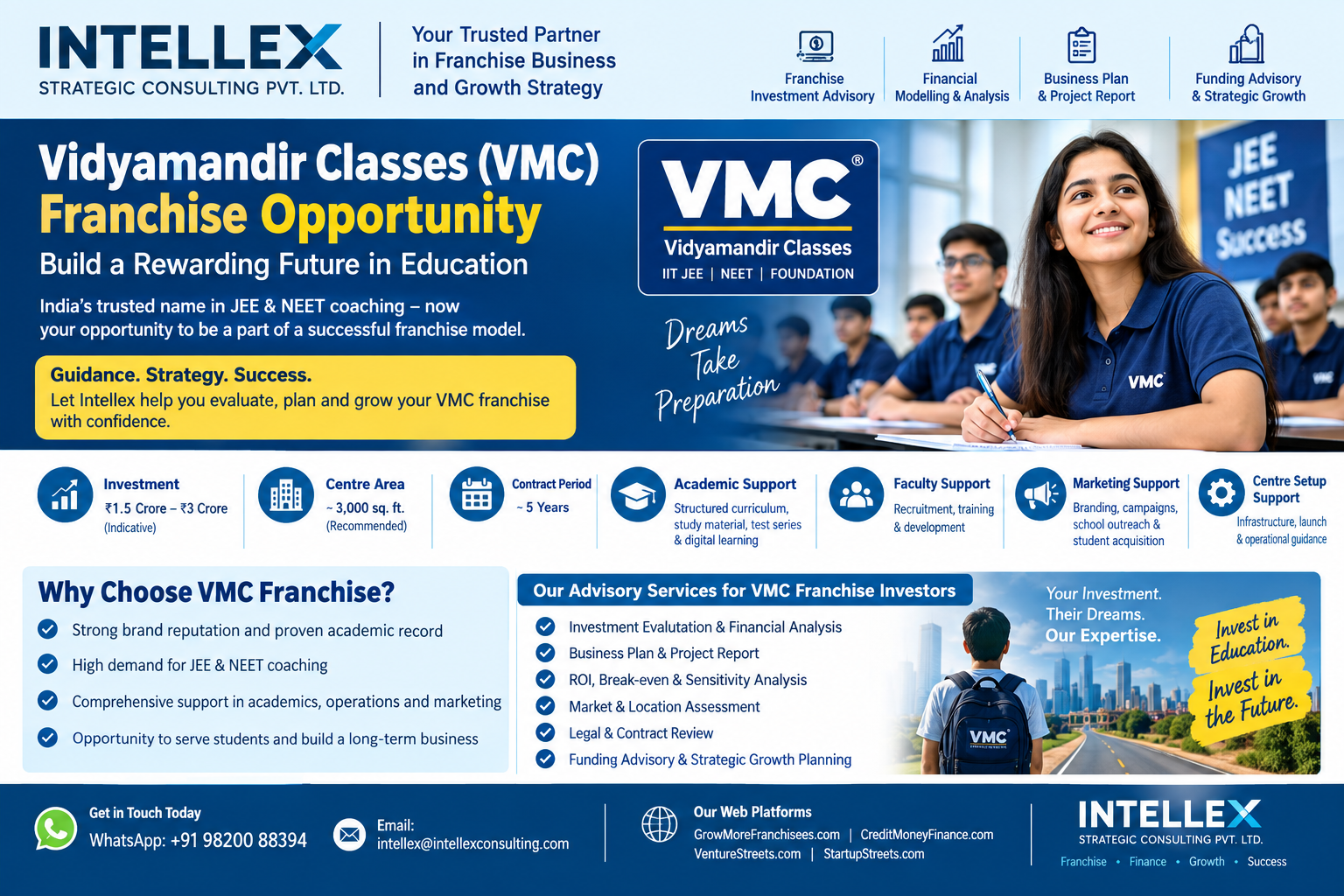
According to VMC’s current franchise information, the standard franchise proposition indicates:
Indicative Initial Investment
₹1.5 crore – ₹3 crore
Recommended Centre Area
Approximately 3,000 sq. ft.
Contract Period
Approximately 5 years
VMC also states that the actual investment can depend on the city and scale of the centre. Therefore, prospective franchisees should obtain a detailed commercial proposal and written cost schedule before making any commitment.
Importantly, the headline investment should not automatically be interpreted as the total cash requirement for reaching operational break-even.
A serious investor should separately analyse:
- Franchise/brand fees
- Interiors
- Security deposits
- Rent
- Furniture
- Classroom equipment
- Technology
- Recruitment
- Faculty salaries
- Administrative salaries
- Marketing
- Local advertising
- Student acquisition costs
- Scholarships and discounts
- Working capital
- Pre-launch expenditure
- Contingency reserves
What Does the VMC Franchise Model Offer?
One of the major attractions of the VMC franchise proposition is the combination of an established academic system with local entrepreneurial execution.
VMC’s current franchise information highlights support in several important areas.
1. Centre Setup & Launch Support
Setting up a coaching centre requires more than simply leasing commercial space.
The centre must provide an environment appropriate for:
- Classroom teaching
- Student counselling
- Parent meetings
- Faculty operations
- Testing
- Administration
- Student interaction
- Admissions
VMC indicates that its business-development team provides guidance relating to infrastructure setup and centre launch. It also describes inauguration and launch support.
2. Academic Support
Academic quality is arguably the most important component of a coaching business.
VMC states that franchise partners receive access to academic resources including:
- Structured curriculum
- Study material
- Lesson plans
- Learning resources
- Test series
- Assessment tools
- Monthly test papers
This can be particularly valuable for a new education entrepreneur because developing a competitive JEE or NEET academic system internally can require significant expertise and resources.
3. Faculty Recruitment and Training
In the coaching industry, faculty can determine the success or failure of a centre.
Students may initially join because of the brand.
They remain because of the quality of:
- Teaching
- Mentoring
- Doubt resolution
- Testing
- Academic guidance
- Student engagement
- Performance improvement
VMC’s franchise information indicates support in recruitment and training of teaching and non-teaching personnel, along with training for faculty, counsellors and sales teams.
However, this is an area where prospective franchisees should undertake particularly detailed due diligence.
Questions should include:
- Who recruits faculty?
- Who employs them?
- Who pays salaries?
- Who evaluates performance?
- What is the expected faculty strength?
- What happens if a key faculty member leaves?
- Is senior faculty available locally?
- How frequently is faculty training conducted?
4. Business Development & Admissions Support
A coaching centre cannot survive without students.
Therefore, admissions and lead generation are central to the economics of the business.
VMC states that its franchise support includes joint business-development efforts, career-coach support, school presentation initiatives and dedicated sales support.
Nevertheless, the franchisee should independently understand the local acquisition economics.
For example:
How much does it cost to acquire one paying student?
This can be more important than the overall number of enquiries generated.
5. Marketing & Branding Support
An established education brand can potentially provide a significant marketing advantage compared with an unknown local coaching centre.
VMC states that franchisees can receive centralised marketing and creative support, marketing plans and support around scholarship-related initiatives.
However, local marketing remains extremely important.
A centre may require:
- School outreach
- Parent seminars
- Career counselling sessions
- Digital advertising
- Local outdoor advertising
- Social media
- Referral programmes
- Scholarship examinations
- Community engagement
The franchisee should therefore understand exactly what marketing expenditure is borne by the franchisor and what must be funded locally.
VMC Franchise and the JEE & NEET Market
JEE and NEET remain among India’s most competitive academic pathways.
For parents, the decision to select a coaching institution can involve significant financial and emotional considerations.
Factors influencing the decision may include:
- Brand reputation
- Faculty
- Past results
- Study material
- Testing methodology
- Personal attention
- Location
- Fees
- Student reviews
- Peer group
- Safety
- Academic discipline
- Digital learning support
An established coaching brand can therefore have an advantage in the initial customer-acquisition stage.
However, the brand itself does not eliminate competition.
Every centre must compete for students in its local market.
The Importance of Location
Location can make or break an education franchise.
A theoretically attractive city may not necessarily support a profitable centre at a particular location.
Before selecting a property, investors should analyse:
Student Catchment
How many students in the relevant age groups live within a practical travel radius?
School Ecosystem
How many schools are located nearby?
Competition
Which JEE, NEET and foundation coaching institutes already operate in the market?
Accessibility
Can students easily reach the centre by public transport?
Visibility
Is the centre visible and accessible to parents and students?
Rental Economics
Does the expected rent make sense relative to projected student admissions?
Demographics
Does the local population contain sufficient middle-class and upper-middle-class households able and willing to pay coaching fees?
Tier-2 and Tier-3 Cities: Potential Opportunity
While India’s largest cities have substantial demand for competitive-examination coaching, they can also have intense competition.
Selected Tier-2 and Tier-3 cities may offer a different opportunity.
Potential advantages could include:
- Lower real-estate costs
- Less intense competition in certain micro-markets
- Strong aspirations for IITs and medical colleges
- Growing disposable income
- Local demand for established brands
- Lower employee costs in some markets
- Stronger local relationships
But investors should not assume that every Tier-2 or Tier-3 city is automatically attractive.
A city should be selected using actual data.
How to Evaluate VMC Franchise Profitability
The most common mistake made by inexperienced franchise investors is to focus on revenue rather than unit economics.
Suppose:
Number of students × Average realised fee = Gross Revenue
That is only the beginning.
The centre may then have to pay:
- Faculty salaries
- Counsellor salaries
- Sales salaries
- Administrative salaries
- Rent
- Electricity
- Maintenance
- Marketing
- Technology expenses
- Local promotional expenses
- Study-material related costs
- Franchise-related charges
- Revenue-sharing or royalty, if applicable
- Scholarships and discounts
- Taxes
- Other operating expenses
The result is the actual operating profit.
Build a Three-Scenario Financial Model
Before investing, the entrepreneur should build at least three financial scenarios.
Conservative Scenario
Assume:
- Lower student admissions
- Higher marketing expenditure
- Higher faculty costs
- Lower average realised fee
- Slower admission growth
Base Scenario
Use realistic estimates based on comparable centres and local market research.
Optimistic Scenario
Assume strong admissions, good retention and effective marketing.
The Golden Rule
Do not invest only because the optimistic scenario produces an attractive ROI.
The business should remain financially manageable even under a conservative scenario.
Break-Even Analysis
A prospective franchisee should calculate the number of students required to cover annual operating costs.
A simplified formula is:
Break-Even Students = Annual Fixed Costs ÷ Contribution per Student
For example, if a centre has substantial annual fixed expenses, the investor needs to know exactly how many students are required before the centre becomes profitable.
This analysis should be performed separately for:
- JEE programmes
- NEET programmes
- Foundation programmes
- Repeaters
- Integrated programmes
- Test series
- Other academic offerings
The investor should also calculate the impact of discounts and scholarships.
A student paying a nominal fee is not necessarily equivalent to a student generating the full advertised fee.
Is VMC Franchise Profitable?
There is no responsible way to guarantee a specific ROI or profitability for a VMC franchise.
The economics will depend heavily on the individual centre.
Important variables include:
- Investment amount
- City
- Rent
- Student admissions
- Average realised fee
- Faculty costs
- Marketing costs
- Franchise economics
- Student retention
- Academic results
- Competition
- Centre capacity
- Working capital
Therefore, prospective investors should treat any projected ROI as a financial forecast, not a guaranteed outcome.
The correct question is not:
“What ROI does VMC guarantee?”
Instead, the investor should ask:
“What ROI can this specific centre reasonably generate under conservative, base and optimistic assumptions?”
Key Risks of a VMC Franchise
Every franchise investment involves risk.
An education franchise is no exception.
1. Student Acquisition Risk
A franchise centre cannot generate meaningful revenue without sufficient enrolments.
2. Faculty Risk
Poor faculty quality or high faculty attrition can negatively affect student satisfaction and results.
3. Local Competition
The centre may compete against established national, regional and independent coaching institutions.
4. High Fixed Costs
Rent, salaries and other expenses can continue even when admissions are below expectations.
5. Academic Performance Risk
A coaching centre’s reputation can be strongly influenced by student outcomes.
6. Brand Dependency
The franchisee is dependent on the franchisor’s brand, academic systems and policies.
7. Contractual Risk
The franchise agreement may contain provisions concerning territory, fees, renewal, termination, branding, operations and other obligations.
8. Working Capital Risk
A centre may take time to achieve its targeted student base.
Therefore, adequate working capital is essential.
Brand Reputation: Important, But Not Sufficient
VMC’s established presence and historical association with competitive-examination preparation can be valuable.
Its current franchise materials highlight its long academic legacy, national presence and student outcomes.
However:
A strong national brand does not automatically guarantee a profitable individual franchise centre.
The performance of a particular centre can depend on:
- Local leadership
- Faculty
- Location
- Marketing
- Admissions
- Student profile
- Competition
- Parent relationships
- Academic outcomes
- Cost control
This is why centre-level due diligence is essential.
VMC Franchise Due Diligence Checklist
Before signing a franchise agreement, prospective investors should obtain detailed written information.
Commercial Due Diligence
Ask:
- What is the complete initial investment?
- What does the quoted investment include?
- Is the franchise fee included?
- Are interiors included?
- Are technology costs included?
- Are security deposits included?
- What working capital is recommended?
- Are there recurring franchise charges?
- Is there a royalty or revenue-sharing mechanism?
- What other mandatory payments apply?
Territory Due Diligence
Ask:
- Is the territory exclusive?
- What geographical area is protected?
- Can another VMC centre be opened nearby?
- What happens if another centre is proposed?
- Is exclusivity contractual?
- Does exclusivity continue throughout the agreement?
VMC’s current franchise FAQ indicates that territorial rights may depend on the agreement and city, so this should be confirmed specifically in writing for the proposed centre.
Academic Due Diligence
Investigate:
- Curriculum
- Faculty model
- Study material
- Test series
- Digital platform
- Faculty training
- Student mentoring
- Doubt-solving mechanism
- Academic monitoring
- Performance reporting
Operational Due Diligence
Understand:
- Centre staffing requirements
- Recruitment responsibilities
- Faculty compensation
- Counsellor requirements
- Sales-team requirements
- Technology requirements
- Reporting requirements
- Operating procedures
- Quality-control systems
Financial Due Diligence
Prepare a detailed five-year financial model covering:
Initial Investment
- Franchise fee
- Interiors
- Furniture
- Equipment
- Technology
- Deposits
- Pre-launch marketing
Recurring Costs
- Rent
- Salaries
- Marketing
- Utilities
- Maintenance
- Technology
- Franchise/royalty costs
- Administrative expenses
Revenue
- Student enrolments
- Average realised fee
- Programme mix
- Repeat students
- Scholarships
- Discounts
- Other revenue streams
Then calculate:
- EBITDA
- Cash flow
- Break-even point
- Payback period
- ROI
- IRR
- Working-capital requirement
Questions Every Prospective Franchise Investor Should Ask
Before signing, ask VMC for written clarification on:
Investment
- What is the exact capital requirement?
- What is included and excluded?
Agreement
- What is the franchise tenure?
- What are renewal conditions?
- What are termination provisions?
Territory
- What territory protection is available?
Economics
- What fees or royalties are payable?
- What is the revenue-sharing structure, if any?
Faculty
- Who recruits faculty?
- Who pays faculty?
- Who controls faculty deployment?
Marketing
- What central marketing is provided?
- What local marketing must the franchisee fund?
Admissions
- How are leads generated?
- What support is provided for student acquisition?
Academic
- What academic resources are supplied?
- How frequently are materials updated?
Performance
- What KPIs must the franchisee achieve?
The answers should be reviewed carefully before signing.
Why Professional Franchise & Financial Advisory Can Matter
Investing ₹1.5 crore–₹3 crore or more into an education business is a substantial financial decision.
The franchisee should therefore evaluate the opportunity from multiple perspectives:
Commercial + Financial + Legal + Operational + Market + Strategic
This is where independent professional advisory can add value.
An entrepreneur may be highly experienced in business but still require assistance with:
- Franchise investment evaluation
- Financial modelling
- ROI analysis
- Break-even analysis
- Project feasibility
- Business-plan preparation
- Funding strategy
- Debt structuring
- Working-capital planning
- Market evaluation
- Investment documentation
- Strategic growth planning
Intellex Strategic Consulting Pvt. Ltd. – Supporting Franchise Business & Growth Decisions
Intellex Strategic Consulting Pvt. Ltd. provides professional consulting and financial advisory support to entrepreneurs, investors, business owners and companies evaluating growth opportunities.
For prospective franchise investors, our role can include helping assess the commercial and financial viability of a proposed franchise investment.
Our advisory areas can include:
Franchise Investment Evaluation
Understanding the investment requirement, projected revenues, costs, cash flows and potential returns.
Financial Modelling
Building detailed financial models covering:
- Revenue projections
- Operating expenses
- EBITDA
- Cash flow
- Break-even
- Payback
- ROI
- Sensitivity analysis
Business Plan & Project Report
Developing structured business plans and project reports for franchise and expansion projects.
Funding Advisory
Where appropriate, assisting eligible businesses and entrepreneurs in evaluating debt and other funding options for business expansion.
Strategic Growth Advisory
Helping entrepreneurs assess location strategy, expansion plans, capital requirements and long-term business objectives.
Due Diligence Support
Helping investors organise and analyse commercial and financial information before committing substantial capital.
Franchise Investment Is a Business Decision — Not Just a Brand Decision
A recognised brand can reduce some of the barriers associated with starting a new business.
But the entrepreneur still needs to build a profitable local operation.
The most important question is therefore not simply:
“Is VMC a good brand?”
The more important question is:
“Can a VMC centre in my selected city, at my selected location, with my investment capacity and realistic student-admission assumptions generate acceptable risk-adjusted returns?”
That question requires financial modelling and market analysis.
Final Verdict: Is VMC Franchise Worth Exploring?
Vidyamandir Classes can be an interesting education franchise opportunity for entrepreneurs with adequate capital, local market knowledge and the ability to operate a professional coaching business.
The proposition is particularly relevant for investors interested in the JEE, NEET and foundation education market.
VMC’s current franchise information indicates an initial investment of approximately ₹1.5 crore–₹3 crore, a centre requirement of around 3,000 sq. ft. and a contract period of approximately five years, together with support covering centre setup, academics, recruitment and training, business development and marketing.
But these figures should be treated as indicative franchise information rather than a promise of profitability.
The ultimate success of the investment will depend on:
Location + Faculty + Admissions + Academic Results + Marketing + Cost Control + Working Capital + Franchise Economics
A prospective franchisee should therefore conduct detailed due diligence before investing.
Looking to Invest in a Franchise Business?
If you are evaluating an education franchise, coaching franchise or another franchise business opportunity, Intellex Strategic Consulting Pvt. Ltd. can assist with professional financial, commercial and strategic evaluation.
We can help entrepreneurs and investors assess:
Franchise Investment | Business Plan | Financial Modelling | ROI Analysis | Project Feasibility | Funding Advisory | Business Expansion | Strategic Consulting
Contact Intellex Strategic Consulting Pvt. Ltd.
WhatsApp: +91-98200-88394
Email: intellex@intellexconsulting.com
Web Platforms:
GrowMoreFranchisees.com
CreditMoneyFinance.com
VentureStreets.com
StartupStreets.com
Intellex Strategic Consulting Pvt. Ltd.
Important Disclaimer
This article is intended for general informational and educational purposes. Investment requirements, franchise terms, territory rights, fees, operating requirements and other commercial conditions may change and should be independently verified with Vidyamandir Classes before entering into any agreement. Any profitability, ROI or payback assessment must be based on the specific centre, location, investment structure and independently prepared financial projections. This article should not be treated as a guarantee of franchise approval, revenue or investment returns.
More Featured Articles
SME IPO in India: A Comprehensive Guide for Growing Businesses Looking to Go Public.
Venture Debt in India: The Complete 2026 Guide for Startups, Founders, CFOs & Growth Companies.