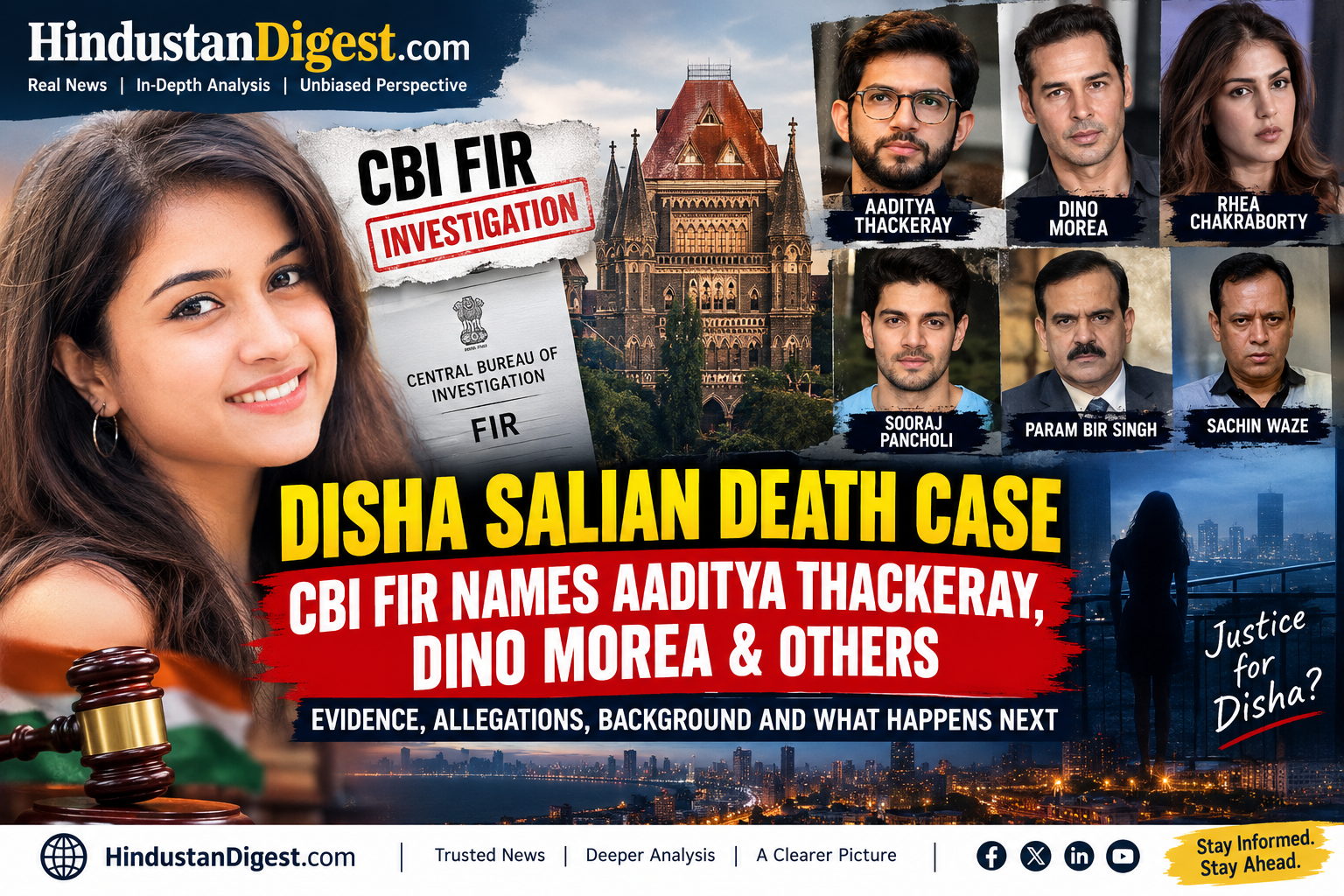
Disha Salian Death Case: CBI FIR Names Aaditya Thackeray, Dino Morea & Others – Evidence, Allegations, Background and What Happens Next
Editorial note: This is an analysis of a live criminal investigation. Allegations, statements made by the complainant and material that may be tested by investigators are not the same as proven facts. No person should be treated as guilty merely because their name appears in an FIR or complaint.
An investigative analysis of the Disha Salian death case, CBI FIR, Aaditya Thackeray and other names, evidence, allegations, Bombay High Court findings, Sushant Singh Rajput connection and possible legal outcomes.
The death of celebrity manager Disha Salian has returned to the national spotlight six years after the June 2020 incident, following a major intervention by the Bombay High Court and the subsequent registration of a fresh FIR by the Central Bureau of Investigation (CBI).
The case is particularly sensitive because Salian had worked as the manager of actor Sushant Singh Rajput, who died six days after her death. For years, the proximity of the two deaths generated intense public speculation about whether they were connected.
What has changed in September 2026 is not merely the volume of political and media discussion. The matter has now entered a formal central-agency investigation.
The CBI registered an FIR on September 14 after the Bombay High Court directed the agency to investigate Salian’s death.
But one distinction is crucial: an FIR is the beginning of a criminal investigation, not proof of guilt.
The Night That Started It All
Disha Salian, a 28-year-old celebrity manager, died on June 8, 2020, after falling from a high-rise residential building in Mumbai’s Malad area.
At the time, the Mumbai Police treated the incident as an accidental/suicidal death and proceeded through an Accidental Death Report (ADR) inquiry.
Six days later, on June 14, Sushant Singh Rajput was found dead at his residence in Bandra.
The chronological proximity immediately generated questions in the public domain.
However, proximity in time is not evidence of a causal connection.
That distinction becomes particularly important now because the CBI has been directed to investigate the circumstances surrounding Salian’s death, while any alleged connection with Rajput’s death would itself have to be established through admissible evidence.
The Bombay High Court specifically directed the CBI to investigate all aspects of the matter rather than accepting any predetermined theory.
Why Did the Bombay High Court Intervene?
This is arguably the most important part of the story.
The High Court did not declare that Disha Salian was murdered.
Nor did it declare that any particular individual was responsible.
Instead, the court found sufficient reasons to require a substantive investigation.
The court expressed concern that the police inquiry had continued for years without the registration of an FIR into a cognisable offence. It observed that the investigation raised more questions than it answered and directed the CBI to conduct a fresh investigation.
One issue that attracted judicial attention was the timing of the spot panchnama. According to reporting on the judgment, it was conducted several hours after the incident, a circumstance the court considered among the issues requiring examination.
The court also questioned the prolonged use of the Section 174-style death inquiry mechanism, whose principal purpose is to ascertain the apparent cause of an unnatural death rather than substitute indefinitely for a substantive criminal investigation.
This distinction is legally important.
The High Court effectively said:
If there is a cognisable offence, investigate it properly. If there isn’t, establish that through a legally valid investigation and closure process.
It also expressly protected people from being prematurely branded accused.
The court directed that nobody should be treated as an accused unless the investigating officer finds sufficient material giving rise to reasonable suspicion against that person.
What Evidence Exists?
This is where responsible journalism must separate documented facts from allegations.
1. The death itself
The fact that Disha Salian died after falling from a high-rise building on June 8, 2020 is established.
The precise circumstances surrounding the fall are now the subject of the CBI investigation.
2. Earlier police investigation
The Mumbai Police had previously maintained that there was no evidence requiring prosecution for murder and that its investigation did not establish foul play. The State’s lawyers told the High Court that witness statements and forensic material did not establish sexual assault or murder.
This represents the existing investigative record, which the CBI will now scrutinise.
3. Questions raised about the investigation
The High Court identified what it considered discrepancies and unanswered questions concerning the manner and duration of the earlier inquiry.
These do not automatically prove a crime.
They establish why the court considered a fresh investigation necessary.
4. Statements and allegations of Disha’s father
Disha’s father, Satish Salian, has alleged that his daughter was murdered and that there was a subsequent cover-up.
In September 2026, he recorded his statement before the CBI and reportedly named Aaditya Thackeray, Rhea Chakraborty, Sooraj Pancholi, Dino Morea and others.
Those statements are now potentially part of the investigative material.
But a complainant’s statement is evidence to be investigated and corroborated, not by itself proof of the allegations.
Who Are the Prominent People Being Named?
Reports surrounding the complaint and the current investigation have referred to several prominent individuals.
Aaditya Thackeray
Aaditya Thackeray is a senior political figure associated with Shiv Sena (UBT) and the son of former Maharashtra Chief Minister Uddhav Thackeray.
His name has repeatedly surfaced in allegations made by Disha Salian’s family and their lawyer.
Thackeray has denied involvement and has previously described the allegations against him as politically motivated.
There has been no judicial finding that he caused Disha Salian’s death.
His inclusion in investigative proceedings therefore has to be understood as a matter for the CBI to establish or disprove through evidence.
Dino Morea
Actor Dino Morea has also been named in allegations surrounding the case.
The allegations originate from the complainant side and require independent verification.
At present, being named in the proceedings should not be interpreted as a finding of guilt.
Rhea Chakraborty
Actor Rhea Chakraborty became one of the most publicly scrutinised figures following Sushant Singh Rajput’s death.
Her name has now also surfaced in the Disha Salian investigation.
Importantly, reports have noted that the CBI’s earlier investigation into Rajput’s death had reached a closure stage and that Chakraborty was not prosecuted for causing Rajput’s death. The Disha Salian investigation is a separate matter and must be assessed on its own evidence.
Sooraj Pancholi
Actor Sooraj Pancholi has also been named in the allegations made by the Salian family side.
Again, the legal question is not whether a person’s name appears in a complaint, but whether investigators can establish a credible evidentiary connection to a cognisable offence.
Police officials
Former Mumbai Police Commissioner Param Bir Singh and dismissed police officer Sachin Waze have also been named in allegations concerning an alleged cover-up.
Those allegations likewise require independent investigation.
The Most Important Question: Is There Proof Against Aaditya Thackeray and the Others?
At this stage, the publicly available information does not establish a proven case against any of the named individuals.
This is perhaps the single most important point that should not get lost amid television debates and social-media claims.
There are:
- allegations by the deceased’s father;
- statements recorded or expected to be recorded;
- questions raised about the original investigation;
- documentary and forensic material from the 2020 inquiry;
- circumstances surrounding the death that the High Court considered worthy of further investigation; and
- now a formal CBI investigation.
But these are not equivalent to a completed prosecution case.
The CBI must still establish the evidentiary chain.
What Will the CBI Have to Establish?
The investigation could potentially revolve around several fundamental questions.
Was the death suicide, accident or homicide?
This is the central question.
Investigators will have to examine the physical evidence, injuries, medical evidence, scene reconstruction, witness testimony and digital evidence.
Who was present?
Investigators are likely to examine:
- mobile-phone records;
- location data;
- CCTV footage;
- building access records;
- telephone calls;
- WhatsApp and other digital communications;
- photographs and videos;
- statements of people present that night;
- transportation records; and
- financial or other relevant links, if any.
What happened immediately before the fall?
The minutes and hours preceding the death could become critically important.
A credible timeline could either strengthen or weaken competing theories.
Were important pieces of evidence lost?
This is particularly sensitive because six years have passed.
Electronic evidence may have been deleted or overwritten. Memories may have deteriorated. Witnesses may have moved, become unavailable or changed their accounts.
That is precisely why the High Court expressed concern about prolonged investigative delay.
The Six-Year Problem
The passage of time may ultimately prove to be the biggest challenge facing the CBI.
A murder investigation conducted immediately after an incident is fundamentally different from one conducted six years later.
Investigators now face questions such as:
Were CCTV recordings preserved?
Are original digital devices available?
Can deleted communications be recovered?
Were the original forensic samples properly preserved?
Can witnesses independently remember events from June 2020?
Were the original crime-scene photographs and panchnama accurately recorded?
Was any evidence improperly handled?
These questions could determine whether the CBI can move from suspicion to prosecution.
The Sushant Singh Rajput Connection
This is the aspect that makes the case exceptionally sensitive.
Disha Salian died on June 8.
Sushant Singh Rajput died six days later.
The two events became linked in public discourse almost immediately.
But an investigative journalist must draw a firm line between chronology and causation.
The fact that one person died six days before another does not prove that the deaths were connected.
If the CBI discovers reliable evidence connecting the two cases, that would dramatically change the investigative landscape.
If it does not, the cases must legally remain separate regardless of public speculation.
Why This Case Is Politically Explosive
There are three overlapping worlds in this investigation:
Politics + Bollywood + Law Enforcement.
Aaditya Thackeray is a prominent political leader.
Several people named in the allegations are well-known figures from India’s entertainment industry.
And the allegations include claims of possible police involvement or cover-up.
That combination makes the case uniquely vulnerable to political narratives.
One side may portray the investigation as the long-awaited search for truth.
Another may portray the allegations as politically motivated.
Neither narrative should substitute for evidence.
The CBI’s credibility will therefore depend heavily on whether it can demonstrate an evidence-based chain of investigation rather than appearing to pursue a predetermined conclusion.
What Could Happen Next?
There are several realistic outcomes.
Scenario 1: Evidence establishes homicide
If forensic, digital and witness evidence establishes that Disha Salian was murdered, the investigation could progress toward charges against individuals for whom sufficient evidence exists.
The exact offences would depend on the evidence and applicable law.
Scenario 2: Evidence establishes sexual assault and homicide
This would represent an even more serious development, but it would require forensic and corroborative evidence capable of standing up in court.
Allegations alone cannot establish this.
Scenario 3: Evidence establishes an investigative cover-up
If the CBI discovers deliberate destruction, fabrication or suppression of evidence, separate criminal proceedings could potentially arise against those responsible.
Scenario 4: Evidence supports the original conclusion
The CBI could ultimately conclude that the evidence does not establish murder or another cognisable offence.
The Bombay High Court has expressly contemplated this possibility: if no offence is established, the CBI is to file appropriate closure proceedings, while the complainant would retain the right to challenge the conclusion through the legal process.
Scenario 5: The evidence remains inconclusive
This may be the most difficult outcome.
Suspicion can remain high while legally admissible evidence remains insufficient to establish guilt beyond the required standard.
A criminal court cannot convict simply because a theory appears convincing in the public domain.
What Would Constitute a Strong Case?
For investigators, the strongest case would not be a single dramatic allegation.
It would be a converging chain of independent evidence.
For example:
digital records + CCTV + location data + independent witnesses + forensic evidence + medical evidence + financial records + consistent timelines
If several independent sources point toward the same conclusion, the evidentiary case becomes considerably stronger.
Conversely, if allegations are contradicted by independent forensic and digital evidence, the prosecution theory could weaken substantially.
The Real Test Begins Now
The most significant development on September 14, 2026 is therefore not that certain famous names have appeared in reports.
It is that the case has moved from years of competing narratives into a formal CBI investigation.
The Bombay High Court has already provided the investigators with an unusually clear framework:
Investigate all aspects.
Do not presume guilt.
Do not shield anyone if evidence establishes culpability.
Do not harass anyone against whom evidence does not exist.
And if a crime is established, prosecute it; if not, close the case through the proper legal process.
That is the standard by which this investigation should ultimately be judged.
Conclusion: From Suspicion to Evidence
For six years, the Disha Salian case has existed at the intersection of tragedy, celebrity, politics, conspiracy theories and public distrust.
The latest development changes the legal significance of the story.
But it does not yet answer the fundamental question:
What actually happened to Disha Salian on the night of June 8, 2020?
The answer will have to come from evidence.
Not television debates.
Not political speeches.
Not social-media campaigns.
Not the reputations of the people involved.
And not from the mere fact that someone’s name appears in an FIR.
The CBI now has the opportunity—and the enormous responsibility—to reconstruct the events of that night using the surviving forensic, documentary, digital and testimonial record.
If the evidence establishes a crime, those responsible must face the legal consequences.
If the evidence establishes that the earlier conclusion was correct, that too must be stated clearly.
And if the evidence is insufficient, the public may have to accept an uncomfortable reality: a highly controversial case can remain surrounded by unanswered questions without those questions becoming proof of criminal guilt.
For HindustanDigest.com, that distinction may be the most important story of all.
More Featured Articles:
Osama Bin Laden, India and Terrorism: What the New CIA Files Reveal 25 Years After 9/11
SME IPO in India: A Comprehensive Guide for Growing Businesses Looking to Go Public.
Venture Debt in India: The Complete 2026 Guide for Startups, Founders, CFOs & Growth Companies.

