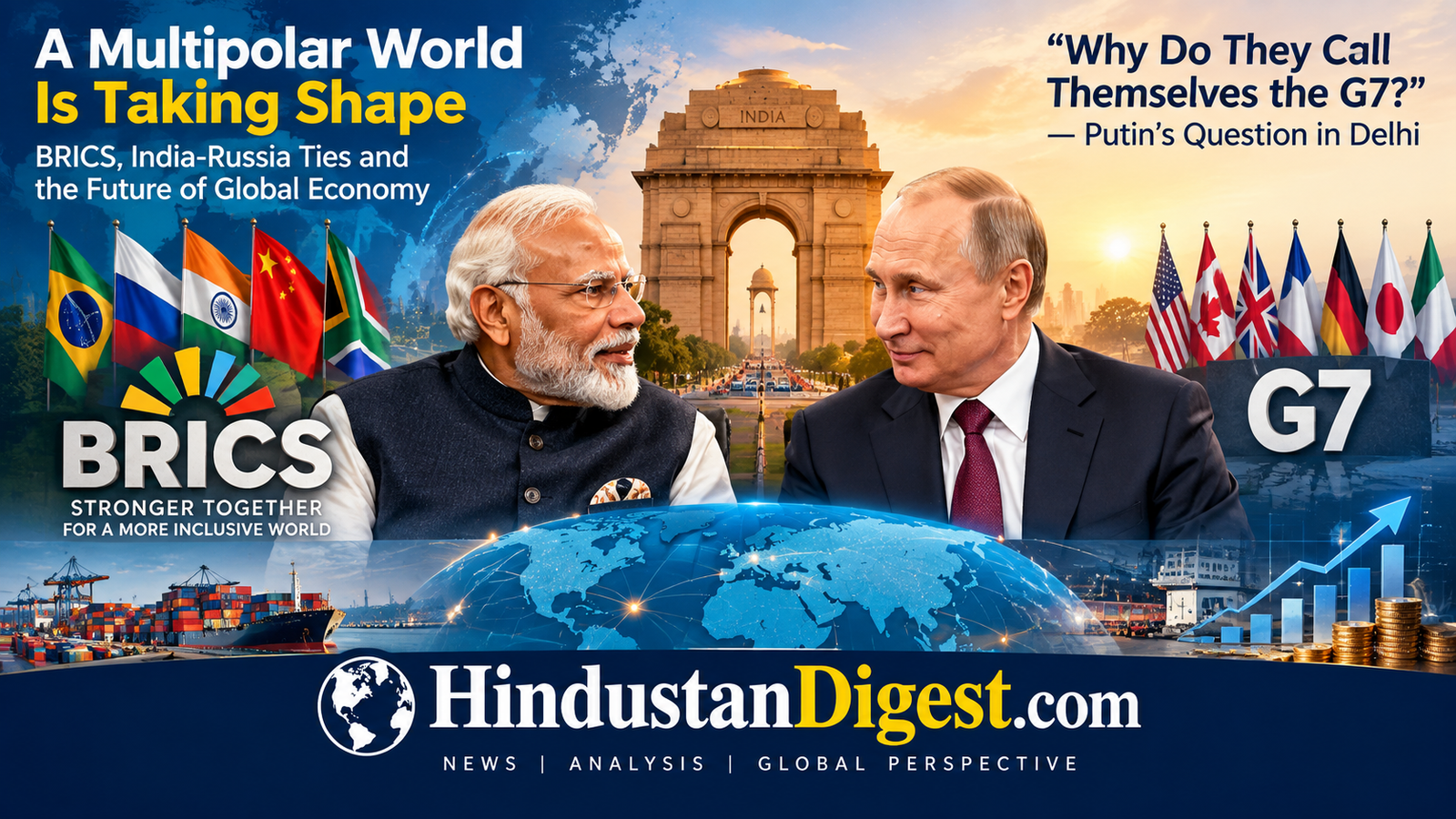
Putin’s “Why Do They Call Themselves the G7?” Question in Delhi Signals a Changing Global Economic Order.
By HindustanDigest.com | International Affairs & Geopolitics.
Putin’s G7 remarks at the 2026 BRICS Summit in New Delhi highlight the changing global economic order, India-Russia ties, BRICS influence and India’s growing geopolitical role.
Russian President Vladimir Putin’s pointed remarks about the G7 at the BRICS Business Forum in New Delhi have added a striking political dimension to the 2026 BRICS Summit. But beyond the rhetoric, his message reflected a much larger argument: that the centre of global economic gravity is steadily shifting towards emerging economies, and that India is becoming one of the most important places where competing global powers meet.
Addressing the BRICS Business Forum in New Delhi, Putin questioned why the G7 continues to describe itself as the “Group of Seven”, pointing to the growing economic weight of BRICS countries. He said BRICS economies accounted for more than 40% of global GDP over the preceding five years, compared with around 29% for the G7, while also arguing that BRICS had generated a larger share of recent global economic growth.
The comments were delivered in India, making the message particularly significant. New Delhi was not merely hosting another international summit. It was becoming the stage for a wider debate over who will shape the next phase of the global economy.
Putin’s G7 Question Was More Than a Political Jab
Putin’s comments can easily be interpreted as another example of Russia challenging Western-led international institutions. However, there was a broader economic argument behind them.
The traditional global economic architecture was built around institutions and groupings dominated by the United States and other advanced Western economies. BRICS, meanwhile, has expanded significantly from its original Brazil-Russia-India-China-South Africa configuration.
The enlarged grouping brings together major economies and energy producers across Asia, Africa, the Middle East and Latin America.
Its combined economic weight, population and natural-resource base gives BRICS considerable influence over global trade, energy markets, commodities and supply chains.
Putin’s argument is therefore essentially about economic representation and global influence: if emerging economies are responsible for an increasingly large share of global output and growth, should their political and institutional influence also increase?
That question is likely to become more important over the coming decade.
Why New Delhi Was the Perfect Stage
The timing and location of Putin’s remarks were particularly important.
India is simultaneously a member of BRICS, the Shanghai Cooperation Organisation and other Global South platforms, while maintaining extensive economic, technological and strategic relationships with the United States, Europe, Japan and other Western economies.
Prime Minister Narendra Modi’s government has repeatedly emphasized that India’s foreign policy is based on strategic autonomy rather than permanent alignment with one geopolitical bloc.
That approach was visible throughout the 2026 BRICS Summit.
India hosted Russian President Vladimir Putin as well as Chinese President Xi Jinping and other important leaders while continuing to maintain its broader engagement with Western economies.
The message from New Delhi is therefore different from Moscow’s more confrontational interpretation of the changing world order.
India is not necessarily seeking to replace the West with BRICS.
Instead, India appears determined to ensure that no single power centre defines India’s choices.
Modi-Putin Relationship Moves Beyond Defence and Energy
One of the most important developments surrounding Putin’s visit was the increasing economic dimension of the India-Russia relationship.
For decades, India-Russia relations have been strongly associated with defence cooperation. Energy, particularly Russian crude oil, has also become an important component of bilateral economic relations.
But both governments are now trying to broaden the relationship into manufacturing, technology, investment, infrastructure, logistics, nuclear energy, critical minerals and industrial cooperation.
Prime Minister Modi and President Putin reviewed cooperation covering political, economic, defence, energy, space, skills and people-to-people ties during their New Delhi meeting. They also visited INNOPROM India, the Russian international industrial exhibition held in India for the first time from September 9 to 11.
This is an important shift.
The objective is increasingly to move the relationship from “buying and selling” to “building together.”
INNOPROM India: A Sign of the New Economic Partnership
The first INNOPROM India exhibition was particularly significant because it placed industrial cooperation at the centre of the India-Russia relationship.
The event brought together manufacturers, technology companies, investors, government representatives and industrial organisations from both countries.
India is attempting to position its industrial corridors and investment-ready infrastructure as destinations for Russian companies seeking manufacturing and localisation opportunities.
According to India’s National Industrial Corridor Development Corporation, the country’s industrial ecosystem showcased opportunities involving manufacturing, technology, investment, logistics, localisation and industrial clusters.
This could eventually prove more consequential than political statements.
If Russian companies begin establishing manufacturing operations, technology partnerships and supply chains in India, the relationship would acquire a deeper commercial foundation.
$100 Billion India-Russia Trade Target
India and Russia are working towards increasing bilateral trade to $100 billion by 2030.
The two governments have also articulated an ambition for approximately $50 billion in two-way investment by 2030. India’s Commerce and Industry Minister Piyush Goyal highlighted both targets during INNOPROM India 2026.
The scale of the ambition is substantial.
India is seeking greater access for its exports to Russia, including pharmaceuticals, automobile components, agricultural and food products and other manufactured goods.
At the same time, Russia has opportunities to participate in India’s rapidly expanding manufacturing and infrastructure ecosystem.
The challenge, however, will be converting political announcements into commercially viable projects.
Manufacturing Could Become the Next Big Pillar
The most interesting part of the emerging India-Russia relationship may not be oil or defence.
It could be manufacturing.
India wants to become a larger global manufacturing hub, while Russia possesses industrial capabilities, engineering expertise, technology and access to natural resources.
The combination could create opportunities in:
- Heavy engineering
- Industrial machinery
- Automobile components
- Railways and transportation
- Energy equipment
- Nuclear technology
- Pharmaceuticals
- Chemicals
- Agriculture and food processing
- Critical minerals
- Industrial automation
- Aerospace and defence production
- Digital and technological infrastructure
India’s industrial corridors could provide Russian businesses with platforms for manufacturing within India and potentially accessing other international markets.
The Strategic Importance of Payments and Trade Routes
There is another problem that both countries must solve: how to make bilateral trade easier in an increasingly fragmented global financial system.
India and Russia have already explored mechanisms involving national currencies and alternative payment arrangements.
The two countries have also discussed improving logistics through routes such as the International North-South Transport Corridor and other maritime connections. India’s official strategic economic framework with Russia has identified national-currency settlements and improved transport connectivity as important areas of cooperation.
If these mechanisms become more efficient, they could reduce transaction costs and make bilateral trade less vulnerable to disruptions in Western financial systems.
However, sanctions, compliance requirements, currency volatility and banking restrictions remain significant challenges for companies.
BRICS Is Becoming More Than an Economic Acronym
The significance of the 2026 BRICS Summit extends beyond Russia’s criticism of the G7.
BRICS is increasingly attempting to become a platform through which developing and emerging economies can influence global governance.
At the New Delhi Summit, leaders discussed global conflicts, trade, financial systems, development, energy, technology and reforms of international institutions. The final discussions also highlighted the group’s desire for greater representation of the Global South in international decision-making.
But BRICS faces a fundamental question.
Can countries with very different political systems, strategic interests and foreign-policy priorities operate as an effective economic bloc?
India and China have competing strategic interests. Russia’s relationship with the West remains deeply confrontational. Middle Eastern BRICS members have their own regional rivalries.
Therefore, BRICS is unlikely to become a traditional alliance comparable to NATO.
Its more realistic future may be as a flexible economic and diplomatic platform where countries cooperate where their interests overlap.
India Does Not Want a New Cold War
This is where India’s position becomes particularly important.
Russia may view BRICS as part of a broader transformation away from Western dominance. China has also advocated greater international influence for emerging economies.
India’s approach is more nuanced.
New Delhi has repeatedly emphasized that BRICS is not intended to be an anti-Western grouping. India wants stronger representation for the Global South while simultaneously maintaining relationships with the United States, Europe and other advanced economies.
This gives India an unusual diplomatic position.
It can speak to Moscow.
It can engage Beijing.
It can work with Washington.
It can cooperate with European economies.
And it can simultaneously build relationships with Africa, Latin America, the Middle East and Southeast Asia.
That flexibility could become one of India’s greatest strategic assets.
The Real Question: Who Will Shape the Global Economy of 2035?
Putin’s “Why do they call themselves the G7?” remark is likely to generate headlines for several days.
But the more important question lies underneath it.
Will the global economic system of the next decade continue to be dominated by a relatively small group of advanced economies, or will emerging economies demand a larger role in determining global trade rules, financial systems, technology standards and international institutions?
The answer may not be either-or.
The world could instead move towards a multipolar economic system, in which the G7, BRICS, the European Union, regional organisations and individual major powers all exercise influence in different areas.
India’s rise could be particularly important in that environment.
With its large domestic market, expanding manufacturing capacity, technology sector, growing infrastructure investment and increasingly active diplomatic outreach, India is becoming too important for competing power centres to ignore.
What the Modi-Putin Relationship Could Mean for India
For India, the immediate benefits of closer economic engagement with Russia could include greater access to energy, technology, industrial capabilities, investment and strategic resources.
But India will also need to manage risks.
These include:
Sanctions risk: Indian companies dealing with Russian entities must carefully navigate international sanctions and compliance rules.
Payment challenges: Financial transactions can become complicated when major banks and currencies are affected by geopolitical restrictions.
Trade imbalance: Increasing bilateral trade is useful, but India wants substantially greater exports to Russia rather than simply increasing imports.
Technology access: Advanced cooperation will depend on technology-transfer arrangements and commercial viability.
Geopolitical balancing: India must maintain its Russian partnership without damaging its expanding relationships with the United States, Europe and other partners.
The success of the relationship will therefore depend less on political symbolism and more on whether businesses can create sustainable commercial partnerships.
A New Delhi Moment
The significance of Putin’s BRICS speech ultimately lies beyond his criticism of the G7.
It came at a moment when the world economy is being reshaped by geopolitical conflict, trade restrictions, supply-chain realignment, energy insecurity, technological competition and the growing influence of emerging economies.
And it happened in New Delhi.
India’s ability to host Putin, Xi Jinping and other major leaders while maintaining relationships across competing geopolitical camps demonstrates the country’s growing diplomatic importance.
The India-Russia relationship is also being tested in a new way: can an old strategic partnership reinvent itself for an era dominated not just by defence and energy, but by investment, manufacturing, technology, logistics and industrial cooperation?
The answer could have consequences well beyond Moscow and New Delhi.
Putin’s question about the G7 may therefore be remembered less as a provocative remark and more as a reflection of a larger global debate.
The world is becoming more multipolar. The question is no longer whether that transformation is happening, but who will shape it.
And at the 2026 BRICS Summit, much of that conversation was taking place in New Delhi.
Editorial note: Figures and developments in this article reflect information available around the 2026 New Delhi BRICS Summit. Putin’s GDP comparison is presented as his stated assessment, rather than an independently established measure.
More Featured Articles:
SME IPO in India: A Comprehensive Guide for Growing Businesses Looking to Go Public.

