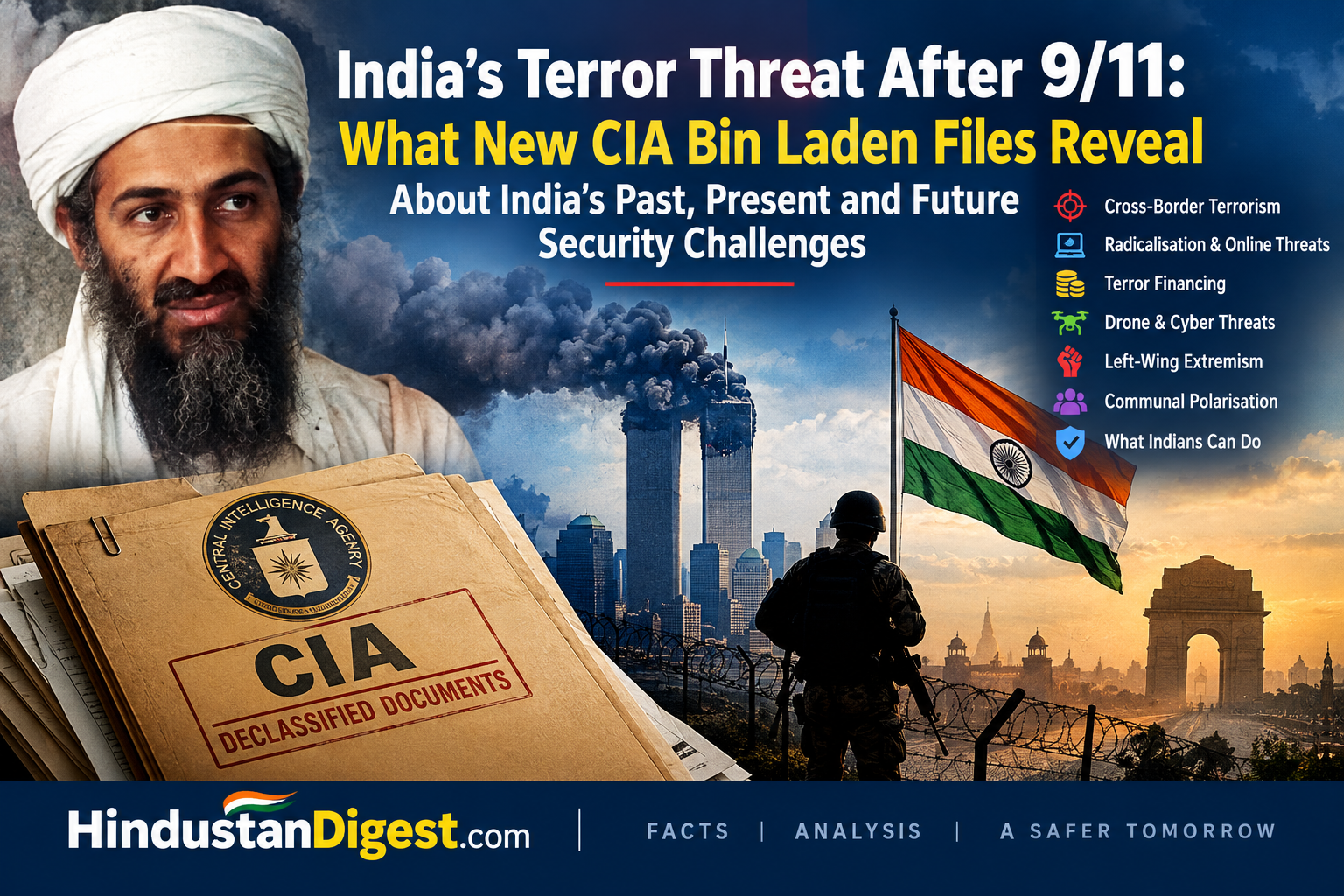
Osama Bin Laden, India and Terrorism: What the New CIA Files Reveal 25 Years After 9/11.
India, Osama Bin Laden and the Terror Threat: What Newly Declassified CIA Files Reveal And What Indians Should Watch For Next.
By HindustanDigest.com | Special Analysis.
New CIA files released on the 25th anniversary of 9/11 reveal years of warnings about Osama bin Laden and al-Qaeda. Here is what they mean for India’s past, present and future terrorism threats.
The release of a fresh collection of declassified US intelligence documents marking the 25th anniversary of the September 11, 2001 attacks has once again raised an uncomfortable question: how much did governments know about the emerging global terrorist threat before it became a catastrophe?
The Central Intelligence Agency has released 71 previously classified President’s Daily Brief products and more than 100 pages of analysis relating to Osama bin Laden and al-Qaeda. The documents cover the period before and immediately after 9/11 and show that US intelligence had been warning senior policymakers for years about bin Laden’s growing capabilities and intentions.
But there is an important distinction to make regarding the headline circulating in Indian media: the newly released CIA material does not, by itself, establish that India was formally placed on a specific “bin Laden hit list.” The CIA’s public catalogue contains warnings about attacks against the United States, US interests and allies, bin Laden’s activities and his links to militant networks. Some historical evidence also establishes bin Laden’s interest in the Kashmir conflict and connections with militant groups operating in South Asia.
That distinction matters because the larger lesson is not simply about what bin Laden wanted to attack 25 years ago. It is about how terrorist movements evolve—and why India must remain prepared for threats that may look very different from the terrorism of the 1990s and early 2000s.
What the Newly Released CIA Files Tell Us
The CIA’s latest release is significant because it provides an unusually detailed timeline of intelligence assessments preceding 9/11.
The documents include briefings from 1998 through 2001, with titles such as:
- “Potential Targets for Anti-US Attacks by Bin Ladin”
- “Reports That Bin Ladin is Planning Attacks Inside the US”
- “Bin Ladin Preparing To Hijack US Aircraft and Other Attacks”
- “Bin Ladin Still Planning Attacks Despite Pressure”
- “Bin Ladin Determined To Strike in US”
- “Bin Ladin Operations Are Expert and Flexible”
The CIA says the collection demonstrates how analysts’ understanding of al-Qaeda developed over time despite intelligence that was often incomplete, vague or imperfect.
The central historical lesson is therefore striking.
Warnings can exist without governments necessarily understanding their full significance.
That is one of the most important lessons for counter-terrorism agencies everywhere.
Was India Really on Osama Bin Laden’s Hit List?
The answer requires some qualification.
India was certainly part of the broader South Asian security environment in which al-Qaeda and allied militant organisations operated. Bin Laden’s network developed relationships with extremist organisations in South Asia, including groups involved in the Kashmir conflict. The 9/11 Commission documented bin Laden’s links with extremist networks in South and Southeast Asia, including Pakistani groups engaged in the Kashmir conflict.
However, the newly released CIA catalogue does not contain a document explicitly titled “India Hit List” or equivalent.
Consequently, it would be more accurate journalistically to say:
India and the wider South Asian region were part of the extremist ecosystem associated with al-Qaeda and allied organisations, but the newly released documents do not independently prove that India was specifically placed on a formal bin Laden “hit list.”
This distinction is particularly important when discussing terrorism because exaggerated claims can themselves create fear and misinformation.
The Bigger Lesson for India
India has experienced several different forms of terrorism and violent extremism over the decades.
The country has faced:
- Cross-border terrorism
- Militancy in Jammu & Kashmir
- Islamist extremist networks
- Left-Wing Extremism
- Separatist violence
- Terror financing networks
- Arms and narcotics trafficking linked to extremist activity
- Radicalisation and recruitment
- Attempts to establish sleeper networks
- Increasingly sophisticated use of digital communications
The National Investigation Agency itself notes that terrorist incidents in India have historically had complex interstate and international connections, including links involving arms, drugs, counterfeit currency and cross-border infiltration.
This means India’s future counter-terrorism challenge is unlikely to come from one organisation or one geographical direction.
What Terrorist Threats Should Indians Keep in Mind?
It is important to emphasise that the following are risk categories, not predictions of specific future attacks.
No responsible analyst can say that a particular city, location or date will be targeted without credible intelligence.
But several broad risks deserve continued attention.
1. Cross-Border Terrorism
The Jammu & Kashmir region remains an important counter-terrorism concern.
The NIA’s current case information includes investigations involving alleged cross-border terrorist activity, while the government continues to maintain specialised security and intelligence mechanisms concerning Jammu & Kashmir.
For ordinary citizens, the important lesson is that terrorism can involve not only attackers but also networks facilitating financing, recruitment, logistics and communications.
2. Radicalisation Through the Internet
The terrorist threat of the future may increasingly begin inside a smartphone rather than inside a training camp.
Extremist propaganda can travel internationally within minutes.
Young people can potentially encounter:
- Extremist propaganda
- Recruitment material
- Violent ideological messaging
- Manipulated videos
- Fake news
- Incitement
- Encrypted communications
This makes digital literacy an increasingly important component of national security.
Families, schools and universities therefore have a role to play in recognising sudden exposure to extremist propaganda without unfairly stereotyping communities.
3. Small, Decentralised Terror Networks
The post-9/11 terrorist landscape has changed substantially.
Large organisations remain dangerous, but decentralised networks and individuals influenced by extremist ideology can also pose challenges to security agencies.
The advantage for terrorists is obvious: a large organisation is easier to detect than a collection of loosely connected individuals.
For counter-terrorism agencies, this makes intelligence sharing, behavioural analysis and early intervention increasingly important.
4. Drone-Enabled Security Threats
Drones are transforming security environments worldwide.
India’s security agencies have increasingly had to consider drones in relation to border security, smuggling and potential delivery of prohibited material.
The NIA’s current case listings include an investigation involving an alleged drone intrusion and a cross-border consignment of arms and ammunition.
This illustrates how relatively inexpensive commercial technology can potentially create new security challenges.
The future threat therefore may not resemble the conventional terrorist operations of the 1990s.
5. Terror Financing and Criminal Networks
Terrorism requires money.
Consequently, financial investigations have become an important component of counter-terrorism.
Terrorist organisations can potentially exploit:
- Illegal financial transfers
- Smuggling networks
- Front organisations
- Criminal proceeds
- Fraud
- Narcotics trafficking
- Informal financial channels
The NIA specifically notes the connection that can exist between terrorism and activities such as arms and drug smuggling and counterfeit currency.
India’s financial-intelligence and enforcement systems will therefore remain an important line of defence.
6. Left-Wing Extremism Has Not Completely Disappeared
India’s terrorism conversation often focuses overwhelmingly on jihadist terrorism and cross-border militancy.
That would be a mistake.
The government continues to classify the CPI (Maoist) as a terrorist organisation and maintains a dedicated Left-Wing Extremism division.
The Ministry of Home Affairs said in its latest review that 11 districts in five states remained classified as LWE-affected districts for special attention, although the geographical footprint of the problem has declined substantially.
The lesson is that even declining insurgencies can retain the capacity to cause serious violence if networks are allowed to regenerate.
7. Attacks Designed to Create Panic
A terrorist organisation does not necessarily need to inflict enormous casualties to achieve its objective.
Sometimes the objective is psychological:
Create fear → generate media attention → provoke communal tension → damage confidence → create political pressure.
This makes India’s large cities, transport systems, public gatherings and symbolic locations important considerations for security agencies.
However, citizens should avoid turning every unusual object, rumour or social-media post into a terrorism scare.
8. Communal Polarisation Can Become a Security Vulnerability
This may be one of the most underestimated aspects of modern terrorism.
Terrorist organisations thrive when societies become divided.
An attack followed by communal retaliation can potentially produce a much larger social impact than the original incident.
Therefore, one of the most effective ways citizens can deny terrorists their strategic objective is to avoid spreading unverified information or blaming entire communities for crimes committed by individuals or extremist organisations.
Terrorism is an ideology of violence—not a characteristic of an entire religion, ethnicity or community.
9. Cyber and Information Warfare
The next generation of terrorism may involve more than physical attacks.
Terrorist organisations and hostile networks can attempt to exploit:
- Social media
- Deepfakes
- Fake emergency messages
- Disinformation
- Hacked accounts
- Psychological operations
- Online fundraising
- Digital recruitment
The objective may be to create confusion rather than simply cause physical destruction.
India’s enormous digital population makes information resilience increasingly important.
What Can Ordinary Indians Actually Do?
National security is primarily the responsibility of governments and law-enforcement agencies.
But citizens can help enormously.
Citizens should:
Verify before forwarding.
Do not circulate unverified claims about terrorist attacks, communities, suspects or security operations.
Report genuinely suspicious activity.
The NIA provides mechanisms for reporting suspicious activities and advises citizens to contact local police or 112 for emergencies.
Avoid touching suspicious objects.
Move away and inform security personnel or police.
Be cautious about online radicalisation.
Parents, teachers and communities should take sudden exposure to violent extremist propaganda seriously.
Do not publish sensitive security information during an ongoing incident.
Real-time information about security deployments can potentially complicate emergency operations.
Follow official advisories.
During a genuine security incident, information from police, state governments, the Ministry of Home Affairs and other authorised agencies should take precedence over WhatsApp forwards and anonymous social-media accounts.
India’s Counter-Terrorism Strategy Is Also Changing
India has now moved towards a more integrated counter-terrorism framework.
The Ministry of Home Affairs unveiled PRAHAAR, India’s National Counter Terrorism Policy & Strategy, in February 2026.
According to the government, the strategy emphasises prevention, rapid response, coordination across government, the rule of law and addressing conditions conducive to radicalisation.
That represents an important shift.
Counter-terrorism is no longer simply about finding terrorists after an attack.
It increasingly involves:
Prevention + Intelligence + Technology + Financial Tracking + Border Security + Cyber Monitoring + Community Resilience + Rapid Response.
The 9/11 Lesson: Intelligence Is Only Useful If It Leads to Action
Perhaps the most important message from the newly released CIA documents is not that intelligence agencies knew about terrorism.
They did.
The more difficult question is:
What happens after the warning reaches decision-makers?
The newly released documents show years of warnings concerning bin Laden and al-Qaeda, including increasingly serious assessments before September 2001.
The tragedy of 9/11 demonstrated that intelligence can fail in several different ways:
- Information may be fragmented.
- Agencies may not connect separate pieces of information.
- Threats may be underestimated.
- Warnings may be too broad to identify a specific attack.
- Bureaucratic barriers may slow responses.
- Decision-makers may struggle to distinguish an imminent threat from a long-term threat.
For India, this lesson remains highly relevant.
India’s Future Security Challenge
India is now a far larger, richer and more globally connected country than it was in 2001.
It has:
- Major international airports
- Global financial centres
- Massive digital infrastructure
- Large ports
- Nuclear facilities
- International tourism
- Huge urban populations
- Critical infrastructure
- Extensive railway and road networks
- A globally integrated economy
These strengths also create a large security responsibility.
The terrorist threat of tomorrow may therefore not look like the terrorist threat of yesterday.
The next major challenge could emerge from the intersection of ideology, technology, organised crime, social-media manipulation and international networks.
That is why preparedness must evolve continuously.
Conclusion: Vigilance Without Panic
The newly declassified CIA files offer a valuable historical lesson 25 years after 9/11.
Osama bin Laden’s al-Qaeda network did not emerge overnight. It developed gradually, built international relationships, adapted its methods and repeatedly demonstrated its willingness to exploit weaknesses.
India has learned many painful lessons of its own.
But vigilance should not mean fear.
Nor should national security become an excuse for suspicion of entire communities.
The strongest defence against terrorism is a combination of professional intelligence agencies, capable police forces, secure borders, financial surveillance, technological preparedness, responsible journalism and an informed public.
The central lesson from 9/11 remains as relevant today as it was then:
A warning is valuable only when society has the ability to recognise it, connect it to other information and act before tragedy occurs.
And for ordinary Indians, perhaps the most practical message is simple:
Stay alert. Stay informed. Verify before sharing. Report genuine concerns. And never allow terrorists to achieve their secondary objective of dividing society.
More Featured Articles:
SME IPOs in India: Insights from Regulators, Bankers & Advisors
The Ultimate Guide to Burger Singh Franchise: How to Partner with India’s Fastest-Growing QSR Brand.
SIDBI – Powering India’s MSME Growth: Funding, Schemes & Business Support.
Venture Debt in India: The Complete 2026 Guide for Startups, Founders, CFOs & Growth Companies.