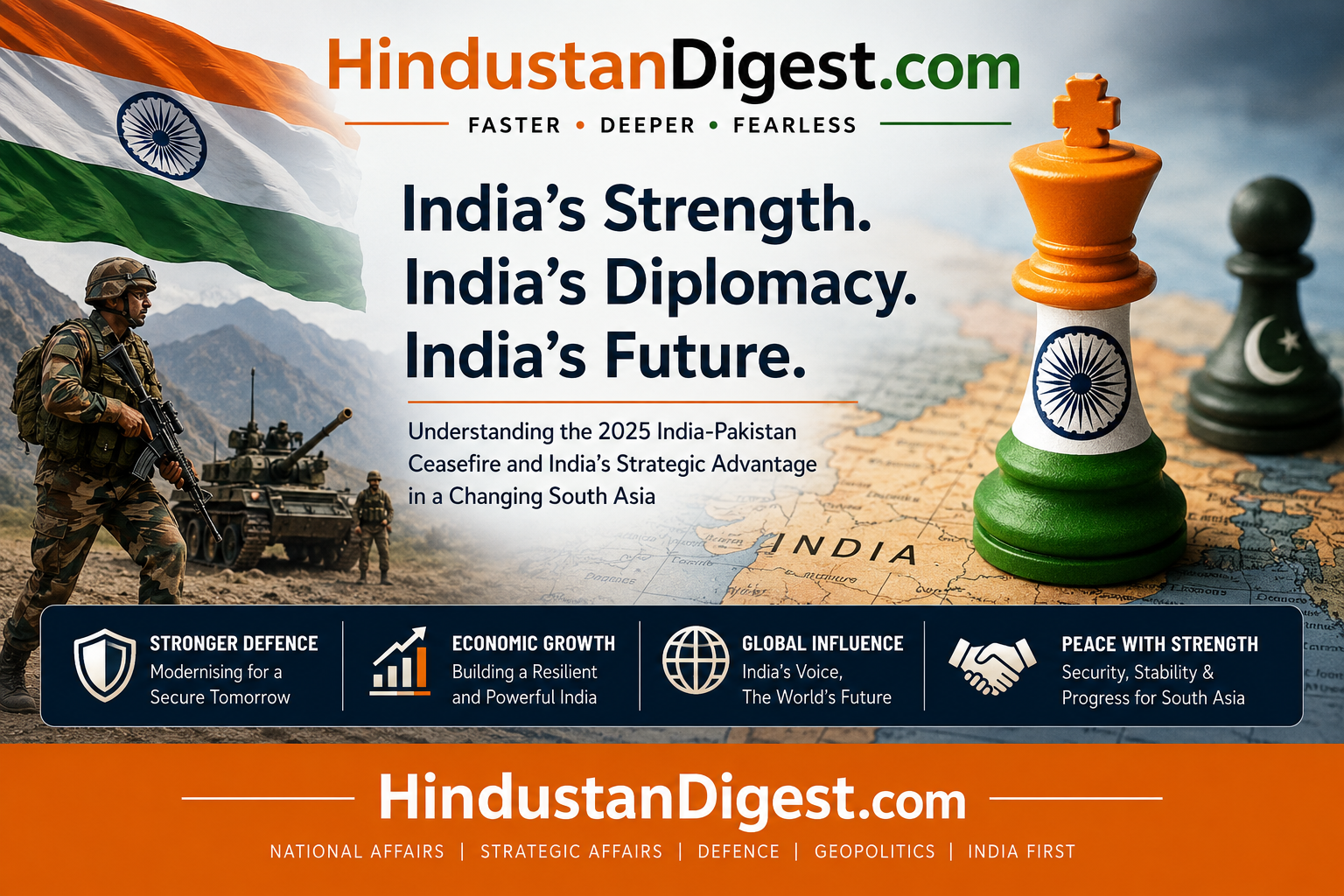
India’s Strategic Advantage in South Asia: Understanding the 2025 India-Pakistan Ceasefire, Diplomatic Dynamics, and the Evolving Regional Balance.
An in-depth analysis of the 2025 India-Pakistan ceasefire episode, Pakistan’s diplomatic outreach, India’s strategic position, military preparedness, and the changing geopolitical landscape of South Asia. Explore how India’s growing economic, military, and diplomatic strength is reshaping regional equations.
India’s Strategic Advantage in South Asia: Understanding the 2025 India-Pakistan Ceasefire, Diplomatic Dynamics, and the Evolving Regional Balance
Introduction
Recent discussions on social media have highlighted remarks attributed to senior diplomatic officials regarding the circumstances surrounding the May 2025 India-Pakistan ceasefire. Various reports and commentaries have suggested that Pakistan actively sought de-escalation through diplomatic channels during a period of heightened military tensions with India.
While individual social media posts should always be treated with caution until independently verified, the broader strategic reality remains clear: the events of 2025 demonstrated India’s growing military capability, diplomatic confidence, and geopolitical influence in the region.
The episode also underscored a larger trend that has been visible over the past decade—India is increasingly shaping regional security outcomes from a position of strength.
Historical Context: A Relationship Defined by Conflict and Competition
Since Partition in 1947, India and Pakistan have fought multiple wars and experienced recurring military confrontations:
Major Conflicts
- 1947-48 Kashmir War
- 1965 Indo-Pak War
- 1971 Bangladesh Liberation War
- 1999 Kargil Conflict
- Various cross-border terrorism incidents
Despite numerous peace initiatives, trust between the two countries has remained limited.
A defining feature of Indian policy has been its insistence that terrorism and dialogue cannot proceed simultaneously. Successive Indian governments have emphasized that cross-border terrorism remains the principal obstacle to lasting peace.
The Transformation of India’s Strategic Posture
Over the last decade, India’s national security doctrine has evolved significantly.
Earlier periods often focused primarily on deterrence and diplomatic protest following terror incidents. However, recent years have seen India adopt a more proactive approach.
Key Milestones
2016 Surgical Strikes
Following the Uri terrorist attack, India conducted cross-border strikes against terrorist launch pads.
2019 Balakot Air Strike
After the Pulwama terror attack, India struck terrorist infrastructure deep inside Pakistani territory.
2025 Military Operations
The 2025 military confrontation further reinforced India’s willingness and capability to respond decisively against threats to national security.
These developments have altered strategic calculations throughout South Asia.
Why the 2025 Ceasefire Matters
The significance of the 2025 ceasefire lies not merely in the cessation of hostilities but in what it reveals about regional power dynamics.
Several strategic observations emerge:
1. India Demonstrated Escalation Dominance
Military analysts increasingly point to India’s ability to undertake calibrated operations while maintaining control over escalation.
India demonstrated that it could:
- Conduct precision strikes
- Protect critical infrastructure
- Maintain operational readiness
- Sustain diplomatic support internationally
2. Pakistan Faced Significant Strategic Pressure
Pakistan had to simultaneously manage:
- Military challenges
- Economic constraints
- International diplomatic scrutiny
- Domestic political considerations
This combination increased incentives for de-escalation.
3. Global Powers Favored Stability
The international community broadly supported efforts to prevent a wider conflict between two nuclear-armed neighbors.
However, unlike previous decades, India approached the situation with greater confidence and less dependence on external mediation.
India’s Rising Military Strength
One of the most important developments in South Asia has been India’s steady military modernization.
Indigenous Defence Manufacturing
India has significantly expanded domestic production through initiatives such as:
- Tejas fighter aircraft
- BrahMos missile systems
- Akash air defense systems
- Advanced naval platforms
- Indigenous drones and surveillance systems
The push for self-reliance has reduced dependence on foreign suppliers while enhancing strategic autonomy.
Naval Expansion
India’s maritime capabilities continue to grow.
The Indian Navy now plays an increasingly important role in:
- Indian Ocean security
- Protection of sea lanes
- Counter-piracy operations
- Strategic deterrence
This provides India with advantages extending well beyond the subcontinent.
Economic Strength as Strategic Power
Military capability alone does not determine geopolitical influence.
India’s greatest strategic advantage today is arguably its economic trajectory.
Key Indicators
- One of the world’s fastest-growing major economies
- Expanding manufacturing base
- Rapid digital transformation
- Growing infrastructure investment
- Increasing global investor confidence
In contrast, Pakistan continues to face recurring economic challenges, including:
- External debt pressures
- IMF dependence
- Currency instability
- Fiscal constraints
Economic strength directly translates into military sustainability and diplomatic leverage.
India’s Diplomatic Success Story
India’s global standing has improved dramatically over the past decade.
Today, India maintains strong relations with:
- United States
- France
- Japan
- Australia
- Gulf nations
- ASEAN countries
- African partners
India has also become a leading voice of the Global South.
Strategic Achievements
- Successful G20 Presidency
- Expansion of strategic partnerships
- Growing role in Indo-Pacific security
- Increased influence in multilateral institutions
This diplomatic network provides India with substantial geopolitical resilience.
The Pakistan Challenge
A realistic assessment requires acknowledging that Pakistan remains an important regional military power.
However, structural challenges continue to affect its strategic position:
Key Constraints
- Economic instability
- Political uncertainty
- Security concerns
- Dependence on external financial support
These factors reduce strategic flexibility during periods of crisis.
Lessons from the 2025 Crisis
The events surrounding the 2025 ceasefire offer several important lessons.
Military Preparedness Matters
India’s investments in modernization and readiness have strengthened deterrence.
Economic Growth Enhances National Security
A strong economy provides the resources necessary for sustained military capability.
Diplomatic Influence Multiplies Power
International credibility amplifies national strength.
National Unity Remains Critical
A united national response during periods of crisis enhances resilience and strategic effectiveness.
The Road Ahead
India’s long-term objective remains stability, security, and economic growth.
While military strength is essential, lasting peace in South Asia ultimately depends upon:
- Elimination of terrorism
- Respect for sovereignty
- Economic cooperation
- Responsible state behavior
India’s rise as a major global power places it in a strong position to shape the future regional order.
The events of 2025 will likely be remembered as another milestone in India’s evolution from a regional power to an increasingly influential global actor.
Conclusion
Whether viewed through the lens of military capability, economic strength, diplomatic influence, or technological advancement, India enters the second half of the 2020s from a position of considerable strategic confidence.
The discussions surrounding the 2025 ceasefire have reignited debate about changing power balances in South Asia. Regardless of differing political narratives, the broader reality is difficult to ignore: India today possesses greater economic weight, stronger international partnerships, more advanced military capabilities, and significantly enhanced diplomatic leverage than at any point in its modern history.
For South Asia, this changing balance will continue to influence security, diplomacy, and regional stability for years to come.
Published by HindustanDigest.com
National Affairs | Strategic Affairs | Defence | Geopolitics | India First
More Featured Articles:
India-Israel Strategic Partnership: From Civilisational Bonds to a Modern Geopolitical Alliance.

3 thoughts on “India’s Strategic Advantage in South Asia: Understanding the 2025 India-Pakistan Ceasefire, Diplomatic Dynamics, and the Evolving Regional Balance.”