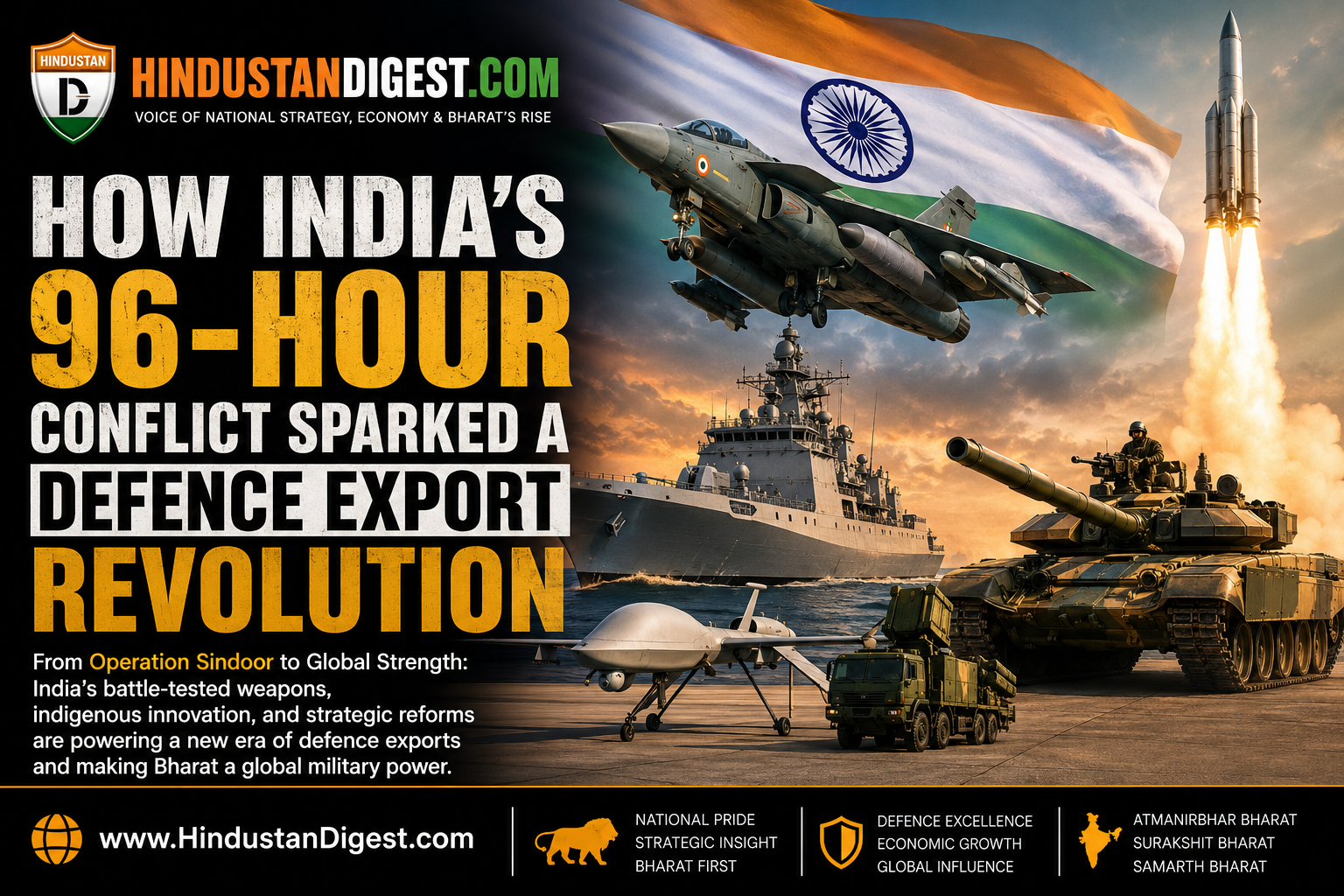
How India’s 96-Hour Conflict Sparked a Defence Export Revolution: The Rise of Bharat as a Global Military Power.
India’s battle-tested defence systems, strategic military reforms, and indigenous manufacturing push are transforming the nation into a global defence export powerhouse. Discover how Operation Sindoor accelerated Bharat’s rise in the global military-industrial ecosystem.
How India’s 96-Hour Conflict Sparked a Defence Export Revolution: The Rise of Bharat as a Global Military Power
For decades, India was known as one of the world’s largest importers of defence equipment. From fighter jets and submarines to missile systems and surveillance technologies, the country depended heavily on foreign suppliers to secure its borders. However, the geopolitical realities of the modern era, coupled with strategic national vision and military necessity, have dramatically changed this trajectory.
Today, Bharat stands at the threshold of a historic transformation.
What was once considered an import-dependent military ecosystem is rapidly evolving into one of the world’s most ambitious defence manufacturing and export hubs. The turning point, according to many strategic analysts, came after India’s swift and decisive 96-hour military engagement popularly referred to as “Operation Sindoor” — a conflict that demonstrated not only India’s operational capabilities but also the growing effectiveness of indigenous military technology.
The outcome has been far greater than military success. It has ignited a defence export revolution.
From Import Dependency to Strategic Self-Reliance
India’s defence modernization journey has accelerated under the broader vision of Atmanirbhar Bharat. The objective is not merely to reduce imports but to establish India as a trusted global supplier of high-quality, battle-proven defence systems.
For decades, foreign dependence exposed India to geopolitical vulnerabilities:
- Delays in procurement
- Technology transfer restrictions
- Escalating defence budgets
- Strategic dependence on external powers
The new doctrine aims to reverse this imbalance by strengthening domestic research, indigenous production, and private sector participation.
Today, India is manufacturing:
- Advanced missile systems
- Combat drones
- Electronic warfare systems
- Radar technologies
- Armoured vehicles
- Naval platforms
- Precision-guided munitions
- Indigenous artillery systems
The shift represents not just industrial growth, but a declaration of strategic sovereignty.
Operation Sindoor: A Defining Strategic Moment
The reported 96-hour conflict showcased the importance of speed, coordination, technology, and indigenous defence preparedness. Indian military systems reportedly performed with remarkable efficiency, particularly in surveillance integration, rapid deployment, electronic warfare, and precision response mechanisms.
The conflict demonstrated several important realities:
1. Indigenous Systems Can Deliver Under Real Combat Conditions
Battle-tested equipment earns credibility in global defence markets. Nations purchasing defence systems seek proven reliability, not merely laboratory performance.
India’s operational deployment significantly improved international confidence in indigenous platforms.
2. Integrated Warfare Capabilities Have Matured
India showcased increasing capabilities in:
- Network-centric warfare
- Real-time intelligence coordination
- Drone integration
- Indigenous missile deployment
- Cyber defence preparedness
These capabilities positioned India as a serious emerging military technology power.
3. Strategic Confidence Has Increased
Military success often translates into diplomatic influence and economic opportunity. India’s assertive posture demonstrated that indigenous defence capability is no longer an aspiration — it is becoming operational reality.
Defence Exports: India’s Emerging Global Opportunity
India’s defence exports have witnessed unprecedented growth over the last decade. Countries across Asia, Africa, Latin America, and the Middle East are increasingly exploring Indian systems because they offer:
- Competitive pricing
- Proven operational performance
- Lower maintenance costs
- Flexible strategic partnerships
- Reduced political dependency compared to Western suppliers
India’s export portfolio is expanding rapidly.
Key Export Areas
Missile Systems
Indian missile technologies are attracting global attention due to their reliability and cost efficiency.
Naval Equipment
India is emerging as a significant supplier of patrol vessels, maritime surveillance systems, and naval engineering capabilities.
Drone Technologies
The rise of modern warfare has dramatically increased demand for UAVs and anti-drone systems — an area where Indian startups and defence firms are growing rapidly.
Electronic Warfare Systems
Modern conflicts increasingly rely on electronic dominance. Indian defence firms are investing aggressively in radar, jamming, and cyber defence technologies.
Ammunition & Artillery
India’s large-scale production ecosystem allows competitive manufacturing for global supply chains.
The Rise of India’s Private Defence Sector
One of the most significant developments in recent years has been the rise of private participation in defence manufacturing.
For decades, the sector remained dominated by public-sector enterprises. Today, however:
- Startups are building defence AI systems
- Private firms are manufacturing drones
- MSMEs are supplying precision components
- Technology companies are entering military electronics
- Defence innovation corridors are emerging across India
This transformation is creating an entirely new industrial ecosystem.
The defence sector is no longer viewed solely as a government-controlled strategic domain. It is becoming an engine of innovation, employment, exports, and national capability.
Why Global Buyers Are Turning Towards India
The international defence market is undergoing structural change.
Several nations now seek alternatives to traditional suppliers due to:
- High Western procurement costs
- Geopolitical uncertainty
- Supply chain disruptions
- Sanctions-related risks
- Overdependence on dominant powers
India offers a balanced alternative.
India’s Competitive Advantages
Cost Efficiency
Indian defence systems are often significantly more affordable without compromising functionality.
Skilled Engineering Talent
India possesses one of the world’s largest pools of technical and engineering talent.
Strategic Neutrality
India’s diplomatic positioning allows broader international defence engagement.
Rapid Manufacturing Capacity
The expansion of domestic industrial infrastructure has increased production scalability.
Battle-Tested Credibility
Operational validation dramatically increases buyer confidence.
Defence Manufacturing and the Indian Economy
The defence revolution is not only strategic — it is economic.
A strong domestic defence industry can generate:
- High-value employment
- Advanced manufacturing ecosystems
- Technology transfer
- Export revenues
- Startup innovation
- Research and development growth
- Supply chain expansion
India’s defence ecosystem is gradually integrating:
- AI
- Robotics
- Space technologies
- Semiconductor applications
- Autonomous systems
- Cybersecurity infrastructure
This creates multiplier effects across the broader economy.
The Geopolitical Impact of India’s Defence Rise
Military-industrial strength often translates into geopolitical influence.
As India expands defence exports and indigenous capability, it gains:
- Strategic leverage
- Stronger diplomatic partnerships
- Regional influence
- Supply chain independence
- Enhanced deterrence capability
India is increasingly being viewed not merely as a regional power, but as a rising global strategic actor.
This transition is especially significant in the Indo-Pacific region, where geopolitical competition continues to intensify.
Challenges Ahead
Despite remarkable progress, several challenges remain:
- Need for faster procurement reforms
- Continued investment in R&D
- Global certification standards
- Export financing support
- Technology ecosystem scaling
- Semiconductor dependence
- Supply chain resilience
India must continue strengthening:
- Defence innovation
- Manufacturing quality
- Export diplomacy
- Indigenous IP development
Long-term success will depend on sustained policy consistency and strategic execution.
The Future of Bharat’s Military-Industrial Ecosystem
India’s defence transformation is no longer theoretical.
The combination of:
- Strategic urgency
- Political will
- Indigenous innovation
- Private sector participation
- Military modernization
- Export ambition
has created the foundation for a new era.
The global defence landscape is evolving rapidly, and Bharat is positioning itself not just as a consumer of military technology, but as a producer, innovator, and exporter.
The 96-hour conflict became more than a military episode — it became a symbol of national transformation.
India’s defence revolution has begun.
And the world is watching.
Conclusion
India’s rise as a defence manufacturing and export power represents one of the most important strategic shifts in modern Indian history. The convergence of indigenous capability, operational success, and geopolitical ambition is reshaping the nation’s military-industrial future.
From self-reliance to global leadership, Bharat’s defence journey reflects a broader national awakening — one driven by confidence, innovation, and strategic determination.
As the world enters an era of heightened geopolitical uncertainty, India is increasingly emerging not merely as a participant, but as a decisive force shaping the future global security architecture.
Published by:
HindustanDigest.com – Voice of National Strategy, Economy & Bharat’s Rise on the Global Stage.

2 thoughts on “How India’s 96-Hour Conflict Sparked a Defence Export Revolution: The Rise of Bharat as a Global Military Power.”