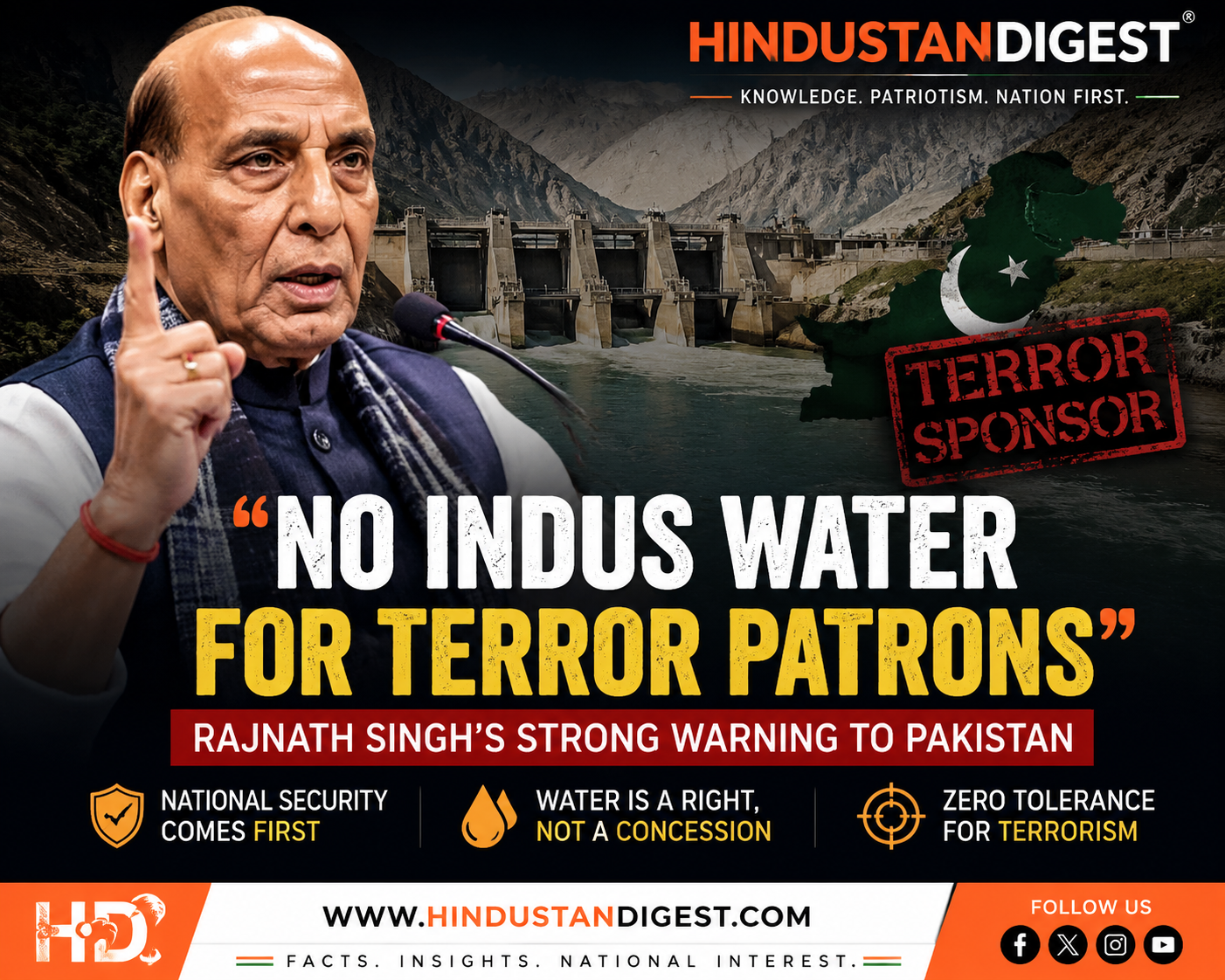
No Indus Water for Terror Sponsors”: Rajnath Singh’s Strong Warning Signals Tough New India Doctrine on Pakistan.
Defence Minister Rajnath Singh issues a strong warning stating “No Indus water for terror patrons,” reinforcing India’s firm stance against cross-border terrorism. Explore the geopolitical significance, Indus Waters Treaty context, and India’s evolving strategic posture.
“No Indus Water for Terror Patrons”: Rajnath Singh’s Stern Warning and India’s Evolving Strategic Doctrine
India’s strategic messaging toward Pakistan has entered a sharper and more assertive phase, with Defence Minister Rajnath Singh reportedly issuing a strong warning: “No Indus water for terror patrons.” The statement, made in the context of national security concerns and cross-border terrorism, signals a deepening shift in how India views long-standing agreements like the Indus Waters Treaty (1960) in relation to security realities on the ground.
This development is not just a political statement—it reflects a broader recalibration of India’s foreign policy where terrorism and diplomacy are increasingly being treated as interconnected issues rather than separate domains.
🌊 Understanding the Indus Waters Treaty: A Historic Agreement Under Stress
The Indus Waters Treaty, brokered by the World Bank in 1960, has long been considered one of the most durable water-sharing agreements between India and Pakistan.
- India controls eastern rivers (Ravi, Beas, Sutlej)
- Pakistan receives major rights over western rivers (Indus, Jhelum, Chenab)
- The treaty survived multiple wars and crises between the two countries
However, in recent years, India has increasingly questioned whether a purely technical treaty can remain insulated from persistent cross-border terrorism concerns.
The latest remarks from the Defence Minister reflect growing political and strategic frustration over this imbalance.
⚔️ “No Water for Terror”: What the Statement Signals
Rajnath Singh’s warning, as reported, is being interpreted as a strong articulation of India’s evolving doctrine:
1. Linking Water Diplomacy with National Security
India is increasingly signalling that strategic resources cannot be separated from security behaviour of neighbouring states.
2. Pressure Through Treaty Interpretation
Without formally withdrawing from international commitments, India has been revisiting operational aspects of treaty implementation, including hydroelectric and infrastructure projects on western rivers.
3. Message to Pakistan
The underlying message is clear:
If cross-border terrorism continues, India will reassess all available leverage including water rights.
🧭 Operation Sindoor Context and Strategic Messaging
The statement also ties into broader references to India’s military and security posture, including operations such as “Op Sindoor” (as referenced in media reporting).
Such narratives are increasingly being used to demonstrate that:
- India is willing to respond beyond diplomatic protest
- National security doctrine now includes economic and resource-based deterrence
- Terror incidents will have multi-dimensional consequences
This represents a shift from reactive diplomacy to assertive strategic signalling.
🌐 Geopolitical Implications
For India:
- Reinforces domestic political consensus on zero tolerance for terrorism
- Strengthens bargaining position in treaty-related negotiations
- Projects India as a more assertive regional power
For Pakistan:
- Raises concerns over water security dependence on Indus system
- Increases diplomatic pressure on cross-border terror policy
- Forces reconsideration of long-term water management strategy
🌏 For the World:
- Highlights how climate, water, and security are increasingly interconnected
- Signals possible future disputes over shared river systems globally
- Places South Asia at the centre of resource-security geopolitics
📊 Strategic Analysis: Why This Matters Now
India’s messaging comes at a time when:
- Cross-border terrorism remains a recurring concern
- Regional water stress is increasing due to climate variability
- Infrastructure development on river systems is accelerating
- Strategic doctrines globally are shifting toward resource leverage
In this context, water is no longer just an environmental or economic issue—it is becoming a tool of strategic diplomacy.
Conclusion
Rajnath Singh’s reported statement, “No Indus water for terror patrons,” is more than political rhetoric. It reflects a broader transformation in India’s strategic thinking where national security, diplomacy, and resource control are increasingly intertwined.
As India continues to grow as a regional power, such assertions underline a clear message: security concerns will shape every dimension of international engagement, including long-standing treaties.
HindustanDigest.com
More Featured Articles:
SME IPO in India: A Comprehensive Guide for Growing Businesses Looking to Go Public.


One thought on “No Indus Water for Terror Sponsors: Rajnath Singh’s Strong Warning Signals Tough New India Doctrine on Pakistan.”