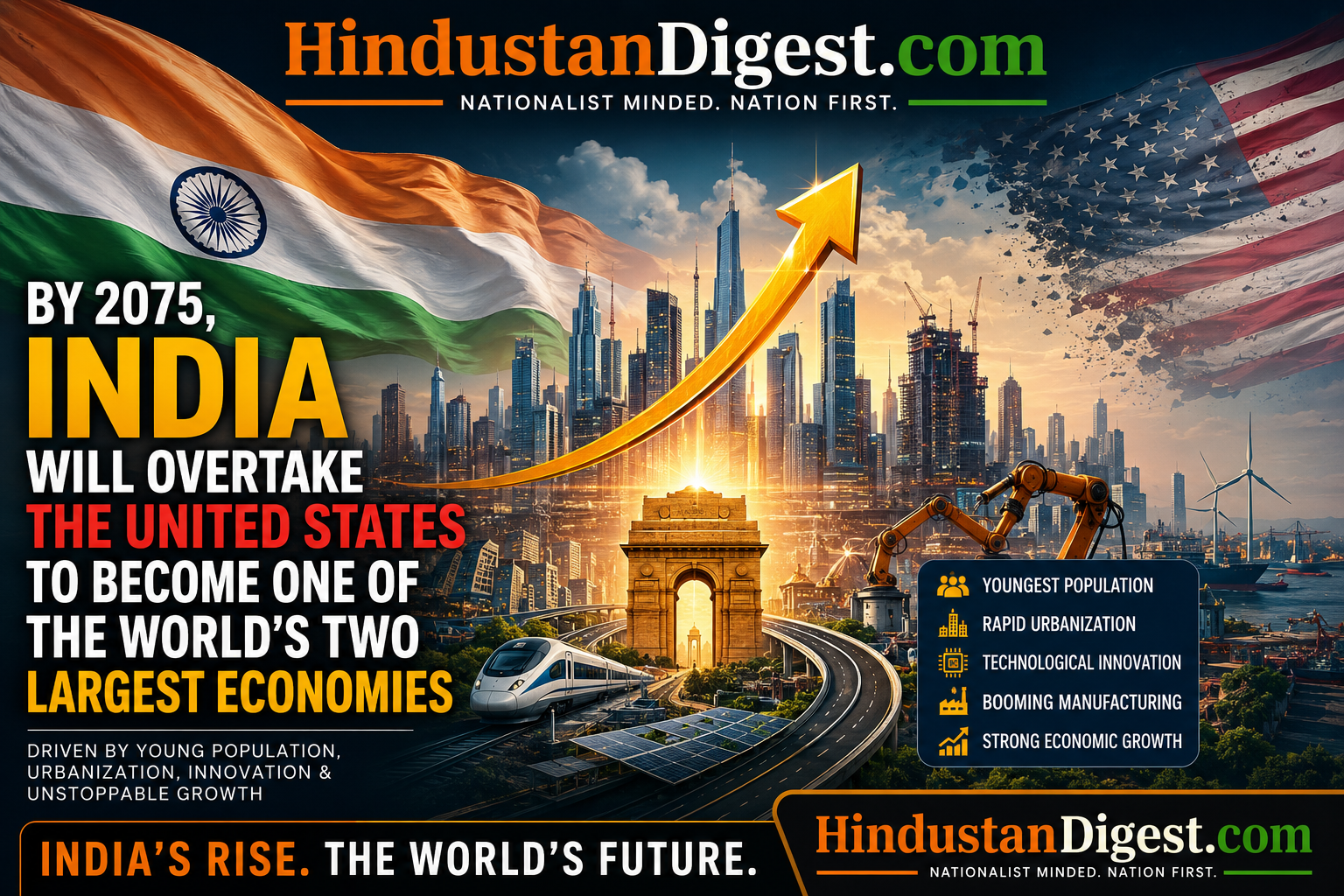
India’s Rise to Global Economic Superpower Status: Why Goldman Sachs Predicts India Could Overtake the United States by 2075.
Goldman Sachs forecasts that India could become the world’s second-largest economy by 2075, surpassing the United States. Explore the drivers behind India’s economic rise, demographic advantage, urbanization, technological transformation, and geopolitical influence.
India’s Rise to Global Economic Superpower Status: Why Goldman Sachs Predicts India Could Overtake the United States by 2075
Introduction
For decades, the global economic order has largely been dominated by Western powers, particularly the United States. However, the 21st century is increasingly becoming the century of Asia, and at the heart of this transformation stands India.
According to projections by Goldman Sachs, one of the world’s most influential investment banks, India could become the world’s second-largest economy by 2075, overtaking the United States and trailing only China in overall economic size. Such a development would represent one of the most significant shifts in global economic power since America emerged as the world’s dominant economy in the 20th century.
For Indians, this is more than just an economic forecast—it is validation of a historic civilizational resurgence that has been decades in the making.
Understanding Goldman Sachs’ Projection
Goldman Sachs estimates that India’s Gross Domestic Product (GDP) could grow to more than $50 trillion by 2075, placing it among the world’s largest economic powers.
The projection is based on several structural advantages:
- A young and growing workforce
- Rapid urbanization
- Rising productivity
- Expanding middle class
- Technological innovation
- Increasing global integration
Unlike many developed nations facing population decline and aging demographics, India continues to enjoy a demographic dividend that can fuel economic expansion for decades.
India’s Greatest Advantage: Demographics
One of the strongest reasons behind India’s projected rise is its population profile.
India recently became the world’s most populous nation, surpassing China. More importantly, India possesses one of the youngest populations among major economies.
Key Demographic Strengths
- Median age of approximately 28 years
- More than 65% of citizens below 35 years
- Large workforce entering productive age groups
- Growing consumer base
Compare this with:
- Japan’s aging population
- Europe’s demographic stagnation
- China’s shrinking workforce
- America’s slower population growth
A young workforce means higher productivity, greater consumption, stronger entrepreneurship, and increased innovation.
This demographic advantage may become India’s biggest economic weapon over the next five decades.
Urbanization: The Engine of Economic Growth
Goldman Sachs specifically highlights urbanization as a critical driver of India’s future success.
Historically, every major economic power experienced rapid urbanization before achieving developed-nation status.
India’s Urban Transformation
Today, around 36% of Indians live in urban areas.
By 2050, that number could exceed 50%.
This transition means:
- Better infrastructure
- Increased industrial productivity
- Higher incomes
- Improved logistics
- Stronger service sector growth
Mega economic corridors, smart cities, industrial zones, metro rail networks, airports, ports, and expressways are already reshaping India’s economic landscape.
Projects like:
- Delhi-Mumbai Industrial Corridor
- Dedicated Freight Corridors
- Bharatmala
- Sagarmala
- Smart Cities Mission
are laying foundations for long-term prosperity.
The Digital Revolution Driving India’s Growth
India’s digital transformation is arguably one of the greatest development stories of modern times.
Over the last decade, India has built a digital public infrastructure unmatched in scale.
Key Digital Achievements
Aadhaar
The world’s largest biometric identification system.
UPI (Unified Payments Interface)
India now leads the world in real-time digital payments.
Digital Governance
Government services are increasingly digitized, reducing corruption and improving efficiency.
Startup Ecosystem
India is now among the world’s largest startup ecosystems with hundreds of thousands of startups and numerous unicorns.
This digital foundation is expected to drive productivity gains across industries and contribute significantly to GDP growth.
Manufacturing: India’s Next Growth Frontier
For India to become a $50 trillion economy, manufacturing must expand substantially.
The government has introduced several initiatives aimed at transforming India into a global manufacturing hub.
Key Initiatives
Make in India
Encourages domestic production and foreign investment.
Production Linked Incentive (PLI) Scheme
Supports strategic sectors such as:
- Electronics
- Semiconductors
- Pharmaceuticals
- Renewable energy
- Automobile manufacturing
Supply Chain Diversification
As multinational corporations seek alternatives to China, India has emerged as a major beneficiary.
Global firms increasingly view India as both:
- A manufacturing base
- A large consumer market
This dual advantage could accelerate industrial growth dramatically.
The Rise of the Indian Middle Class
India’s middle class is expected to become one of the largest consumer groups in the world.
Over the coming decades:
- Household incomes will rise
- Consumer spending will increase
- Housing demand will expand
- Financial services penetration will deepen
- Travel and tourism will grow
A strong domestic consumption base makes India’s growth story more resilient than export-dependent economies.
The country’s vast internal market creates a self-sustaining growth engine.
India’s Growing Global Influence
Economic power inevitably translates into geopolitical influence.
As India’s economy expands, its role in global governance will become increasingly important.
India is already:
- A leading member of the G20
- A major voice in the Global South
- A strategic Indo-Pacific power
- An important technology and innovation partner for developed nations
The success of India’s G20 Presidency demonstrated its growing ability to shape international conversations on development, technology, climate, and global governance.
Challenges India Must Overcome
While the outlook is optimistic, India’s rise is not guaranteed.
Several challenges remain:
Employment Generation
Millions of quality jobs must be created annually.
Education and Skills
India needs continuous investment in:
- Education
- Vocational training
- Research and innovation
Infrastructure
Infrastructure development must keep pace with economic expansion.
Income Inequality
Growth must remain inclusive to ensure social stability.
Energy Security
India’s future growth requires reliable and sustainable energy supplies.
Addressing these challenges will determine whether India reaches its full potential.
The Vision of Viksit Bharat 2047
India’s aspiration to become a developed nation by 2047 aligns closely with long-term projections like Goldman Sachs’ 2075 forecast.
The vision of “Viksit Bharat” includes:
- High-income status
- World-class infrastructure
- Technological leadership
- Manufacturing excellence
- Strong defense capabilities
- Inclusive prosperity
If India successfully executes these goals, the country could emerge as one of the defining powers of the 21st century.
Why This Moment Matters for Every Indian
For centuries, India was among the world’s largest economies before colonial rule disrupted its trajectory.
Today, the nation is witnessing a remarkable economic resurgence.
The Goldman Sachs projection is not merely about GDP rankings.
It reflects:
- India’s entrepreneurial spirit
- The strength of its democracy
- The resilience of its people
- The ambition of its youth
- The confidence of a rising nation
The coming decades could see India move from being an emerging economy to becoming a leading architect of the global economic order.
Conclusion
Goldman Sachs’ prediction that India could overtake the United States and become the world’s second-largest economy by 2075 represents more than an economic forecast—it symbolizes a profound shift in global power.
Powered by a youthful population, rapid urbanization, technological innovation, manufacturing growth, and an increasingly influential global presence, India possesses many of the ingredients necessary for sustained long-term expansion.
The journey will not be without challenges. However, if India continues to invest in infrastructure, education, innovation, and economic reforms, the dream of becoming a global economic superpower may well become reality.
As the world watches the rise of the Asian century, India stands poised to become one of its greatest success stories—a modern economic giant rooted in an ancient civilization and driven by the aspirations of 1.4 billion people.
Published by HindustanDigest.com – Tracking India’s Rise in the Emerging Global Order.
More Featured Articles:
SME IPO in India: A Comprehensive Guide for Growing Businesses Looking to Go Public.
Venture Debt in India: The Complete 2026 Guide for Startups, Founders, CFOs & Growth Companies.


2 thoughts on “India’s Rise to Global Economic Superpower Status: Why Goldman Sachs Predicts India Could Overtake the United States by 2075.”