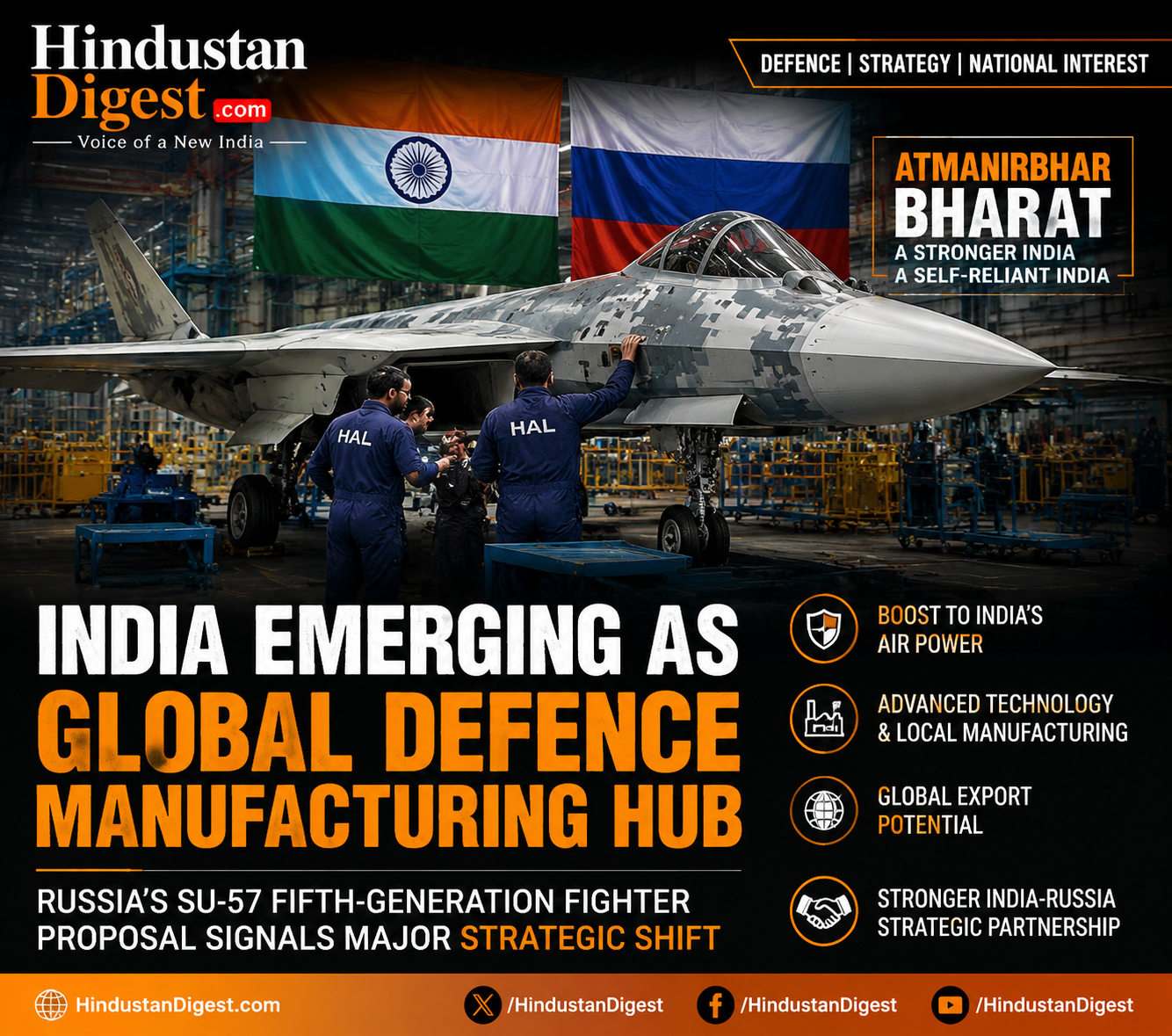
India Emerging as Global Defence Manufacturing Hub: Russia’s Su-57 Fifth-Generation Fighter Proposal Signals Major Strategic Shift.
Russia’s reported interest in manufacturing Su-57 fifth-generation stealth fighters in India highlights a potential game-changing moment for India’s defence sector. Explore the strategic, economic, and geopolitical implications of India becoming a global aerospace manufacturing hub under the “Make in India” initiative.
🇮🇳 India as a Global Defence Manufacturing Hub: Russia’s Su-57 Proposal and Its Strategic Implications
Introduction: A Potential Turning Point in India’s Defence Journey
India’s defence manufacturing ecosystem is undergoing a historic transformation. According to emerging reports from defence and strategic analysis platforms, Russia is exploring the possibility of positioning India as a global production hub for its Su-57 fifth-generation stealth fighter aircraft program.
If this development materializes, it could mark one of the most significant advancements in India’s journey toward self-reliance in defence production under the Atmanirbhar Bharat initiative.
While official confirmations remain limited, the strategic signals from Indo-Russian defence cooperation point toward a deeper industrial partnership that goes far beyond traditional buyer-seller relationships.
What the Su-57 Proposal Means for India
The Su-57 is Russia’s most advanced stealth multirole fighter aircraft, designed for air superiority, deep strike missions, and next-generation aerial combat.
A proposal to manufacture or assemble such a platform in India would imply:
- Transfer of advanced aerospace technology
- Local production and assembly capabilities
- Strengthening of India’s defence industrial base
- Potential export opportunities for India in the global fighter jet market
This aligns strongly with India’s long-term goal of becoming not just a defence importer, but a global defence exporter and production leader.
Strategic Importance for India’s National Interest
1. Strengthening Air Power Capabilities
India’s Air Force is currently undergoing a modernization phase. Integration of fifth-generation fighter technology would significantly enhance India’s air dominance in a rapidly evolving geopolitical environment.
2. Boost to Indigenous Manufacturing Ecosystem
If production is localized, companies like Hindustan Aeronautics Limited (HAL) and other Indian defence PSUs and private players could benefit from:
- Advanced manufacturing exposure
- Supply chain expansion
- High-value aerospace engineering skills development
3. Technology Transfer and Skill Development
One of India’s long-standing strategic goals has been deeper technology transfer (ToT) in defence deals. A Su-57 collaboration could accelerate:
- Jet engine integration knowledge
- Stealth airframe engineering capabilities
- Advanced avionics and radar systems expertise
4. Export Potential and Global Positioning
India could potentially evolve into a secondary production base for global defence exports, strengthening its position in international defence markets.
Russia–India Defence Relations: A Historical Backbone
India and Russia share a decades-long defence partnership that has included:
- Fighter aircraft programs (MiG series, Su-30 MKI)
- Missile systems (BrahMos collaboration)
- Submarine and naval technology transfers
- Joint development projects
The Su-57 discussion fits into this historical pattern of deep strategic defence cooperation, though with a more advanced technological dimension than previous collaborations.
Geopolitical Context: Why This Matters Now
The global defence landscape is undergoing rapid change due to:
- Rising Indo-Pacific security tensions
- Increasing demand for stealth and AI-enabled combat systems
- Shifting supply chains away from traditional Western dominance
In this environment, India’s role as a neutral yet strategically important defence manufacturing partner becomes highly significant.
For Russia, India offers:
- Stable industrial capacity
- Skilled engineering workforce
- Strategic geopolitical alignment in multiple forums
For India, Russia offers:
- Access to advanced military technology
- Faster capability development timelines
- Reduced dependence on Western supply chains
Challenges and Realities
While the proposal is strategically attractive, several challenges remain:
- Fifth-generation fighter technology is highly sensitive
- Full technology transfer is unlikely in initial phases
- Integration with Indian Air Force requirements would require customization
- Geopolitical pressures from competing global powers may influence timelines
Therefore, any final arrangement is expected to be phased, structured, and strategically negotiated.
Make in India: The Bigger Vision
This development, if it progresses strongly reinforces India’s Make in India and Atmanirbhar Bharat defence vision, which aims to:
- Reduce dependency on foreign defence imports
- Build domestic aerospace manufacturing ecosystems
- Position India as a global defence production hub
India has already made significant progress through:
- Indigenous fighter programs (Tejas)
- Defence corridors in Uttar Pradesh and Tamil Nadu
- Increasing private sector participation in aerospace manufacturing
The Su-57 proposal could act as a major catalyst in accelerating this transformation.
Conclusion: A Defining Moment for India’s Defence Future
The possibility of India becoming a manufacturing hub for a fifth-generation fighter program represents more than a defence deal—it represents a strategic evolution of India’s global role.
If successfully executed, it could:
- Elevate India’s aerospace capabilities
- Strengthen national security preparedness
- Boost economic and industrial growth
- Reinforce India’s position as a global defence manufacturing power
While discussions remain at a reported and exploratory stage, the implications are undeniably significant for India’s long-term national interest and strategic autonomy.
Intellex Strategic Consulting Pvt Ltd
More Featured Articles:
SME IPO in India: A Comprehensive Guide for Growing Businesses Looking to Go Public.
Venture Debt in India: The Complete 2026 Guide for Startups, Founders, CFOs & Growth Companies.


2 thoughts on “India Emerging as Global Defence Manufacturing Hub: Russia’s Su-57 Fifth-Generation Fighter Proposal Signals Major Strategic Shift.”