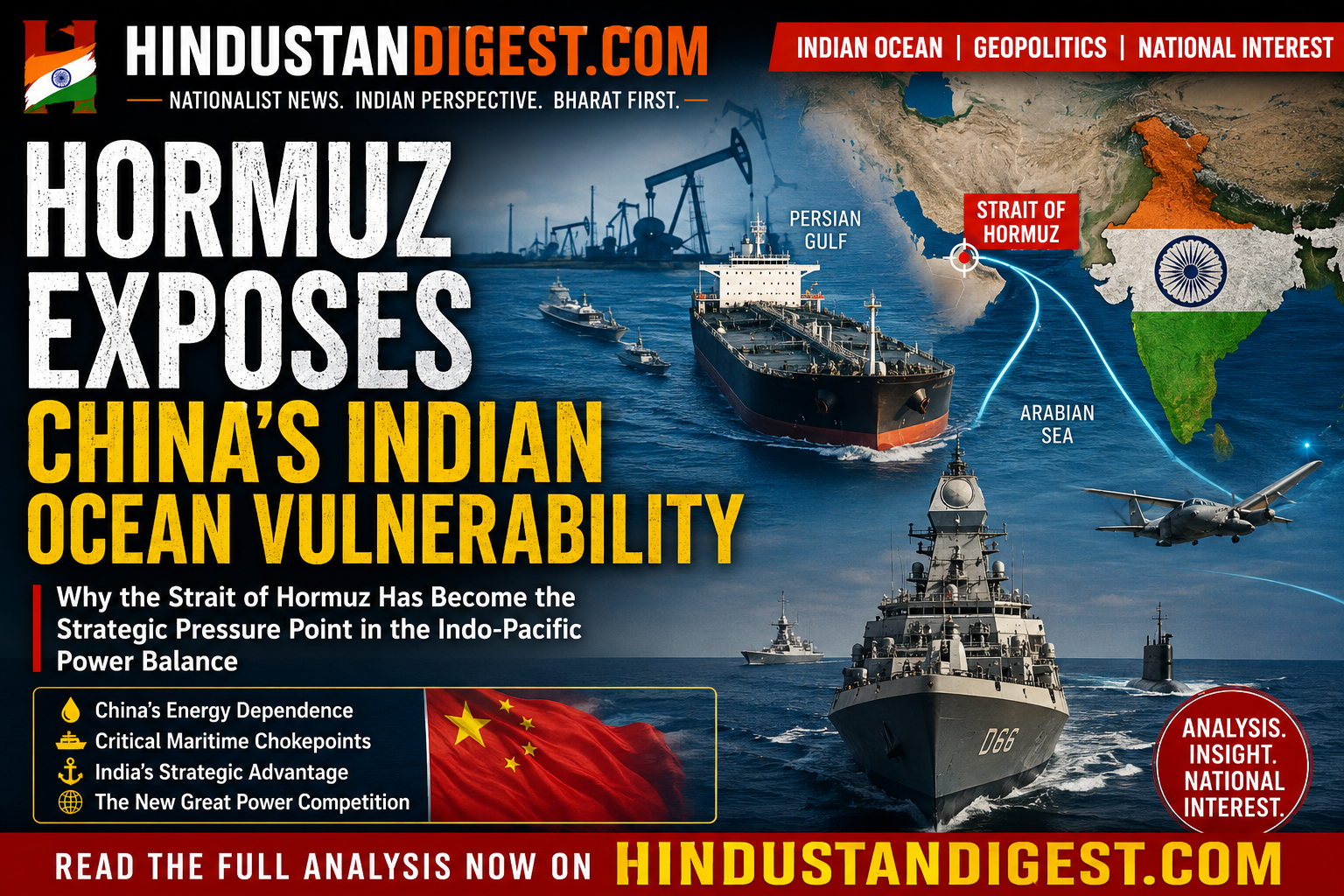
Hormuz Exposes China’s Indian Ocean Vulnerability: Why the Strait of Hormuz Has Become the Strategic Pressure Point in the Indo-Pacific Power Balance.
China’s growing dependence on the Strait of Hormuz highlights a major strategic vulnerability in the Indian Ocean Region. Explore how energy security, maritime chokepoints, India’s naval advantage, and evolving geopolitics are reshaping the Indo-Pacific balance of power.
Hormuz Exposes China’s Indian Ocean Vulnerability: Why the Indian Ocean is Emerging as the Defining Strategic Theatre of the 21st Century
The global strategic landscape is undergoing a profound transformation. While much of the world’s attention remains focused on trade wars, technological competition, and military tensions in the Western Pacific, a far more consequential geopolitical reality is steadily emerging in the Indian Ocean Region (IOR).
The Strait of Hormuz—one of the world’s most critical maritime chokepoints—has once again highlighted a significant strategic weakness in China’s rise as a global superpower. Despite possessing the world’s largest navy by vessel count and expanding its military footprint across continents, China remains heavily dependent on maritime energy routes that pass through regions where it enjoys limited strategic control.
For India, this development underscores the growing importance of the Indian Ocean as a theatre where New Delhi possesses inherent geographic and strategic advantages.
The Strategic Importance of the Strait of Hormuz
The Strait of Hormuz is a narrow waterway connecting the Persian Gulf to the Arabian Sea and the wider Indian Ocean.
Every day, approximately one-fifth of the world’s oil supplies transit through this corridor. Major energy exporters such as Saudi Arabia, the UAE, Kuwait, Iraq, and Qatar rely on this route to supply global markets.
Any disruption in Hormuz immediately impacts:
- Global oil prices
- International shipping
- Energy security
- Financial markets
- Industrial production worldwide
For energy-importing nations, the Strait represents both an economic lifeline and a strategic vulnerability.
No country illustrates this reality more clearly than China.
China’s Growing Energy Dependence
China’s spectacular economic rise over the past four decades has transformed it into the world’s largest manufacturing hub.
However, this economic success has created a critical dependency.
China imports nearly three-quarters of its crude oil requirements, with a substantial portion originating from the Middle East. These energy supplies travel thousands of kilometers through the Indian Ocean before reaching Chinese ports.
This dependence creates what strategic analysts often describe as China’s “Maritime Energy Dilemma.”
The route typically follows:
Persian Gulf → Strait of Hormuz → Arabian Sea → Indian Ocean → Strait of Malacca → South China Sea → Chinese Ports
Every segment of this journey contains potential vulnerabilities.
Unlike the United States, which maintains a vast network of military bases and alliances across maritime regions, China has limited capacity to secure these routes independently.
The Indian Ocean: India’s Natural Strategic Advantage
Geography remains one of the most enduring determinants of power.
India occupies a central position in the Indian Ocean, extending deep into the maritime space through the Indian peninsula.
This geographical reality provides India with several strategic advantages:
Control Over Critical Sea Lanes
The majority of China’s energy imports pass close to India’s maritime sphere of influence.
India’s location allows monitoring of major Sea Lines of Communication (SLOCs) connecting:
- Middle East
- East Africa
- Southeast Asia
- East Asia
Andaman & Nicobar Command
India’s Andaman and Nicobar Islands sit near the western entrance of the Strait of Malacca, another crucial maritime chokepoint.
These islands effectively provide India with strategic oversight over one of the world’s busiest shipping routes.
In any major conflict scenario, this geographic advantage could become a decisive factor.
China’s “Malacca Dilemma”
Former Chinese President Hu Jintao famously identified what came to be known as the “Malacca Dilemma.”
More than 60 percent of China’s maritime trade and energy imports pass through the Strait of Malacca.
Any disruption at this chokepoint could have severe consequences for China’s economy.
To address this vulnerability, Beijing has invested heavily in:
- Belt and Road Initiative projects
- Overseas port infrastructure
- Strategic partnerships
- Alternative energy corridors
However, despite billions of dollars in investment, geography continues to impose limitations.
The Belt and Road Initiative and the String of Pearls Strategy
China’s efforts to reduce vulnerability have led to extensive infrastructure development across the Indian Ocean.
Analysts often refer to this network as the “String of Pearls.”
Key nodes include:
- Gwadar Port
- Hambantota Port
- Djibouti Naval Base
- Various port investments in Africa and Southeast Asia
Officially, these projects are presented as commercial ventures.
However, strategic experts increasingly view them as components of a broader maritime strategy designed to secure China’s supply lines.
Yet these facilities do not eliminate China’s dependence on Hormuz and the Indian Ocean.
Instead, they merely seek to manage the associated risks.
Why the Indian Ocean Region is Re-Emerging as a Strategic Theatre
Following the end of the Cold War, geopolitical competition in the Indian Ocean experienced a period of relative calm.
That era is ending.
Several factors are driving renewed strategic competition:
Energy Security
The Middle East continues to supply a substantial portion of global energy requirements.
Any disruption in maritime transportation threatens global economic stability.
Great Power Competition
The rise of China, India’s growing influence, and continued American engagement have transformed the Indian Ocean into a focal point of strategic competition.
Maritime Trade
Nearly 90 percent of global trade by volume travels via sea routes.
Control and security of these routes have become critical national interests.
Emerging Naval Capabilities
Countries across the region are investing heavily in:
- Aircraft carriers
- Submarines
- Maritime surveillance systems
- Anti-access capabilities
The result is a more contested maritime environment.
India’s Expanding Maritime Vision
India’s strategic thinking has evolved considerably over the last decade.
New Delhi increasingly recognizes that national security extends beyond land borders.
Initiatives such as:
- SAGAR (Security and Growth for All in the Region)
- Indo-Pacific partnerships
- QUAD cooperation
- Maritime domain awareness programs
demonstrate India’s commitment to maintaining a free, open, and secure Indian Ocean.
India’s naval modernization efforts include:
- Indigenous aircraft carriers
- Nuclear submarines
- Long-range maritime patrol aircraft
- Enhanced island infrastructure
These capabilities strengthen India’s ability to protect critical sea lanes and safeguard national interests.
Lessons from Hormuz
The renewed focus on the Strait of Hormuz offers several important lessons.
Geography Still Matters
Technological advances cannot fully overcome geographic realities.
China’s dependence on distant energy sources remains a strategic vulnerability.
Energy Security Equals National Security
Modern economies depend upon uninterrupted access to energy.
Any disruption can have profound economic and political consequences.
The Indian Ocean Will Shape Future Geopolitics
The balance of power in the 21st century will not be determined solely in the Pacific or Atlantic.
The Indian Ocean is rapidly emerging as one of the world’s most consequential strategic theatres.
A National Perspective: India’s Moment in Maritime History
For centuries, India’s civilizational influence extended across the Indian Ocean through trade, culture, and diplomacy.
Today, as geopolitical competition intensifies, India finds itself uniquely positioned to play a stabilizing and leadership role in the region.
The vulnerability exposed by China’s dependence on the Strait of Hormuz serves as a reminder that strategic geography remains one of India’s greatest assets.
As global supply chains, energy routes, and security interests increasingly converge in the Indian Ocean, India’s maritime capabilities will become central not only to its own national security but also to regional and global stability.
The coming decades may well witness the Indian Ocean reclaiming its historical position as the centre of global commerce and strategic competition and India standing at its heart.
Published by HindustanDigest.com
National Interest • Strategic Affairs • Geopolitics • Maritime Security • Bharat First
More Featured Posts:
India-Israel Strategic Partnership: From Civilisational Bonds to a Modern Geopolitical Alliance.
Venture Debt in India: The Complete 2026 Guide for Startups, Founders, CFOs & Growth Companies.
Venture Debt in India: The Complete 2026 Guide for Startups, Founders, CFOs & Growth Companies.
Unlock Growth: How to Secure ₹1 Cr – ₹15 Cr Unsecured Funding for Your Business :
Strategic Finance Options for Medical and Hospital Businesses in India (2026)
Funding and Investment Options to Grow India’s Real Estate and Allied Businesses
SIDBI – Powering India’s MSME Growth: Funding, Schemes & Business Support.
CFO Services for Startups: Why Virtual CFOs Are Transforming Business Scalability in India

2 thoughts on “Hormuz Exposes China’s Indian Ocean Vulnerability: Why the Strait of Hormuz Has Become the Strategic Pressure Point in the Indo-Pacific Power Balance”