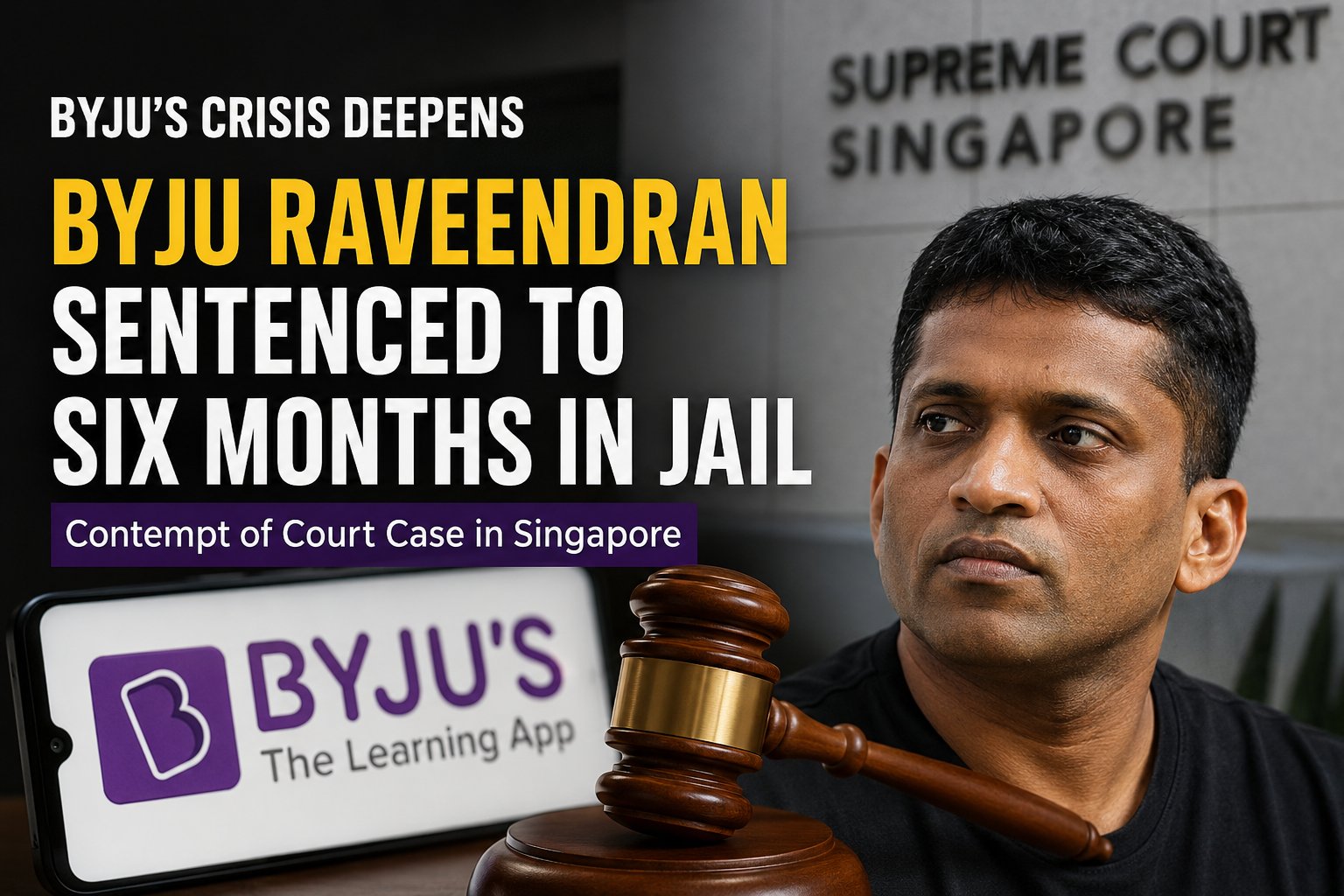
Byju’s Crisis Deepens: What Ravindran’s Jail Sentence Means for India’s Startup Ecosystem.
Byju’s founder Byju Raveendran has reportedly been sentenced to six months in jail for contempt of court in Singapore. Explore the legal, financial, and startup ecosystem implications of the latest development in India’s biggest edtech collapse.
Byju’s Founder Sentenced in Singapore: A Turning Point for India’s Startup Story
India’s startup ecosystem, once celebrated globally for producing unicorns at record speed, has received another major shock. In a dramatic development that has captured international attention, Byju Raveendran, founder of edtech giant Byju’s, has reportedly been sentenced to six months in jail by a Singapore court for contempt of court related to asset disclosure and compliance violations.
The news marks yet another setback for a company that was once valued at nearly $22 billion and regarded as India’s brightest edtech success story. What began as a revolutionary learning platform eventually spiraled into one of the most discussed corporate collapses in Indian startup history.
The latest legal action not only impacts the reputation of Byju’s and its founder but also raises larger questions about startup governance, investor accountability, aggressive expansion strategies, and financial transparency in India’s fast-growing entrepreneurial ecosystem.
The Rise and Fall of Byju’s
Founded by Byju Raveendran, a former teacher turned entrepreneur, Byju’s transformed online education in India. The platform gained massive popularity by offering interactive learning modules for school students and competitive exam aspirants.
During the pandemic, the company witnessed explosive growth as online learning became mainstream. International investors, including sovereign wealth funds, venture capital giants, and global institutional investors, poured billions into the company.
Byju’s aggressively expanded through acquisitions across the globe, purchasing educational platforms in the United States, Europe, and India. The company became a symbol of India’s startup ambitions and the booming edtech sector.
However, rapid growth also created mounting operational and financial pressures.
What Led to the Legal Crisis?
According to reports, the Singapore court found that Byju Raveendran failed to comply with multiple court directives concerning the disclosure and management of assets. The contempt ruling emerged amid ongoing disputes involving lenders and investors attempting to recover significant financial losses linked to the company’s debt obligations.
The legal proceedings reportedly intensified as global creditors pursued recovery actions across jurisdictions. The situation reflects the increasing willingness of international courts and investors to aggressively enforce compliance in cross-border financial disputes involving Indian startups.
While legal appeals and further proceedings may continue, the ruling has already sent shockwaves through the business community.
The Larger Financial Collapse
The downfall of Byju’s cannot be viewed merely as an isolated legal issue. It represents a combination of several structural weaknesses that eventually destabilized the company:
1. Over-Aggressive Expansion
Byju’s expanded rapidly through expensive acquisitions, many of which became difficult to integrate profitably.
2. Funding Dependency
The company relied heavily on continuous investor funding and debt financing to sustain operations and expansion.
3. Governance Concerns
Questions around auditing delays, financial reporting, cash flow management, and board-level governance gradually weakened investor confidence.
4. Market Correction
The global technology slowdown and post-pandemic normalization severely impacted edtech valuations worldwide.
5. Regulatory Scrutiny
Authorities, investors, and lenders intensified scrutiny regarding compliance practices and financial accountability.
Impact on India’s Startup Ecosystem
The Byju’s crisis has implications far beyond one company.
Investor Confidence May Tighten
Global investors are likely to become more cautious while evaluating Indian startups, especially companies pursuing rapid expansion without clear profitability.
Governance Will Become a Priority
Boards, auditors, and compliance frameworks will receive far greater attention from investors and regulators alike.
Shift from Growth to Sustainability
The “growth at all costs” model that dominated startup culture for years is increasingly being replaced by a focus on profitability, cash flow discipline, and operational efficiency.
Stronger Due Diligence
Investors may demand deeper financial transparency and stricter governance structures before committing capital.
Lessons for Entrepreneurs
The Byju’s episode offers important lessons for founders and emerging businesses across sectors.
Sustainable Growth Matters
Rapid valuation growth without operational stability can create long-term vulnerabilities.
Transparency Is Non-Negotiable
Timely disclosures, accurate financial reporting, and regulatory compliance are essential for maintaining investor trust.
Debt Must Be Managed Carefully
Excessive leverage can become dangerous when market conditions change.
Corporate Governance Is Critical
Independent oversight and strong internal controls are no longer optional for scaling businesses.
The Future of the Indian EdTech Sector
Despite the challenges surrounding Byju’s, the Indian edtech sector itself is unlikely to disappear. India continues to have one of the world’s largest student populations, growing internet penetration, and increasing digital adoption.
However, the sector may undergo significant transformation:
- Greater emphasis on profitability
- Consolidation among smaller players
- Hybrid online-offline learning models
- Improved regulatory oversight
- More disciplined funding environments
Investors are now expected to favor companies with strong fundamentals rather than merely high growth projections.
A Wake-Up Call for Corporate India
The Byju’s controversy serves as a cautionary tale not only for startups but for the broader corporate ecosystem. India’s entrepreneurial ambitions remain strong, but sustainable success requires governance, accountability, and responsible leadership.
The incident also highlights the increasing globalization of legal enforcement. As Indian startups expand internationally and raise capital from foreign investors, founders and executives will face higher compliance expectations across multiple jurisdictions.
For policymakers, investors, and entrepreneurs, the lessons from this crisis could shape the next phase of India’s startup evolution.
Conclusion
The sentencing of Byju Raveendran in Singapore represents a defining moment in India’s startup journey. It symbolizes the transition from an era driven primarily by rapid valuations and aggressive expansion to one where governance, transparency, and sustainable business models are becoming essential.
While Byju’s may remain one of India’s most dramatic startup collapses, it may also become a turning point that encourages stronger corporate discipline across the ecosystem.
India’s startup revolution is far from over—but the rules of the game are clearly changing.
HindustanDigest.com
More Featured Articles:
ED Raids Rock Kerala: Explosive CMRL Corruption Trail Reaches Former CM Pinarayi Vijayan’s Doorstep.
Why US Lawmakers Should Respect India’s Sovereignty and Independent Judiciary:
Trump, Nobel Peace Prize and the “Great India–Russia Bromance”:
Venture Debt in India: The Complete 2026 Guide for Startups, Founders, CFOs & Growth Companies.
Why Kjøller Is an Important Venture Capital Investor for Startups Globally.
Ultimate Guide to Early Stage Startup Funding in MENA (2026): Top Investors & Strategies
CFO Services for Startups: Why Virtual CFOs Are Transforming Business Scalability in India