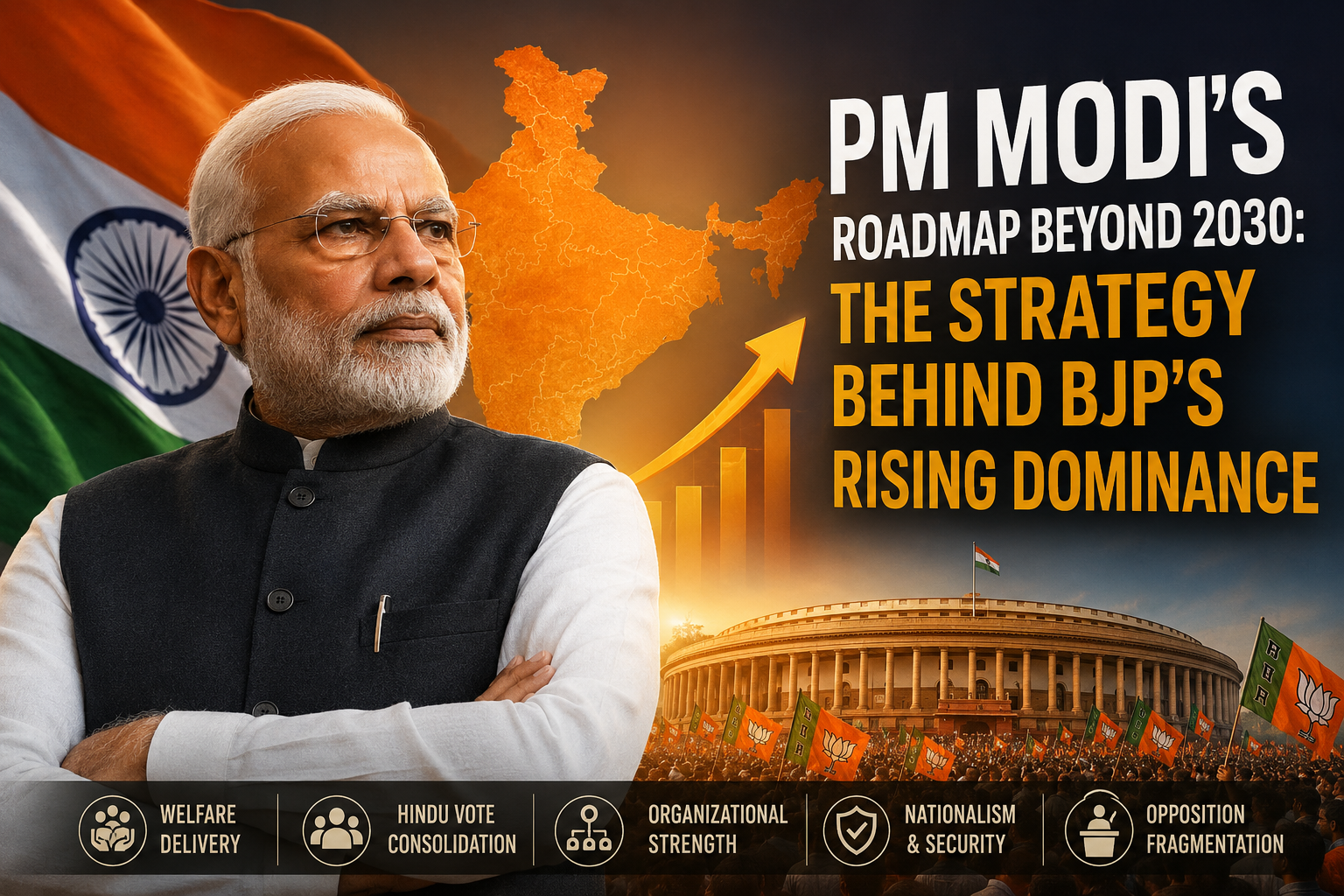
PM Modi’s Political Roadmap Beyond 2030: How Electoral Consolidation, Welfare Politics, and Opposition Fragmentation Are Reshaping India.
A detailed political analysis of how Prime Minister Narendra Modi and the BJP are positioning themselves for continued dominance beyond 2030 through welfare delivery, Hindu vote consolidation, organizational strength, economic nationalism, and opposition fragmentation.
PM Modi’s Political Roadmap Beyond 2030: A Critical Analysis of BJP’s Expanding Dominance in India
India’s political landscape is undergoing a historic transformation. Over the last decade, Prime Minister Narendra Modi has evolved from being a powerful electoral leader into the central axis around which national politics revolves. Recent political developments, particularly the BJP’s increasing penetration into traditionally difficult states such as West Bengal, Telangana, Odisha, Kerala, and parts of South India, indicate that the party’s ambitions extend far beyond the 2029 general elections.
The argument that PM Modi is “paving the way to keep power well beyond 2030” is no longer merely political rhetoric. It is increasingly becoming a strategic and structural possibility driven by electoral arithmetic, ideological consolidation, governance branding, welfare delivery systems, and the weakening of opposition unity.
This article critically examines the factors supporting this argument, the risks involved, and whether India is entering an era of prolonged single-party political dominance.
1. The Rise of Narendra Modi from Leader to Political Institution
One of the strongest arguments supporting long-term BJP dominance is the transformation of Narendra Modi into a political institution rather than merely a party leader.
Unlike previous Prime Ministers who relied heavily on coalition politics, Modi has built a centralized leadership model where elections increasingly become presidential-style contests centered around his personality, governance image, and nationalist narrative.
Key pillars of this transformation include:
- Strong personal branding
- Direct voter communication
- National security positioning
- Welfare-centric governance
- Digital political outreach
- Cultural nationalism
Even state elections increasingly revolve around Modi’s image rather than local leadership.
This creates a structural advantage for the BJP that many opposition parties struggle to counter.
2. Welfare Politics Has Changed Indian Elections
A major reason why the BJP may remain electorally dominant beyond 2030 is its successful combination of welfare politics with nationalism.
Schemes such as:
- PM Awas Yojana
- Jal Jeevan Mission
- Ujjwala Yojana
- Ayushman Bharat
- Free ration schemes
- Direct Benefit Transfers (DBT)
have created a direct connection between beneficiaries and the central government.
Unlike older welfare systems plagued by leakages, the BJP government has used Aadhaar-linked transfers, Jan Dhan accounts, and digitization to ensure visible delivery.
This creates political loyalty among lower-income voters across caste and regional lines.
The BJP’s political innovation lies in combining welfare benefits with aspirational nationalism rather than traditional caste-based coalition politics.
3. Hindu Vote Consolidation Is Reshaping Electoral Mathematics
The article highlighted in the image references West Bengal and Hindu vote consolidation. This is one of the most significant political developments in India over the past decade.
Historically, Indian elections were fragmented across:
- caste identities
- regional loyalties
- linguistic blocs
- community-specific voting patterns
The BJP has attempted to replace fragmented Hindu voting patterns with broader religious-cultural political unity.
This strategy has produced results in states where the BJP once had minimal presence.
Why West Bengal Matters
West Bengal has historically been dominated by:
- Left parties
- Regional identity politics
- Minority consolidation
- Anti-Hindutva narratives
However, BJP’s rapid rise in Bengal demonstrates:
- growing polarization
- dissatisfaction with regional governance
- successful grassroots expansion
- increasing acceptance of Hindutva politics among sections of voters
Even where the BJP does not win outright, increasing vote share changes long-term political equations.
This is politically significant because states once considered permanently inaccessible are now becoming competitive battlegrounds.
4. Weakness and Fragmentation of the Opposition
No long-term political dominance is possible without a weak opposition.
One of the biggest factors supporting BJP’s continued rise is the absence of a unified national alternative.
The opposition currently faces multiple challenges:
Leadership Vacuum
No opposition leader currently possesses:
- Modi’s national recognition
- communication skills
- campaign machinery
- centralized authority
Ideological Confusion
Opposition parties often struggle to balance:
- secular positioning
- caste coalitions
- soft Hindutva
- regional aspirations
This creates inconsistent messaging.
Regional Rivalries
Many opposition parties are direct competitors in state politics, making national alliances unstable.
Examples include:
- Congress vs AAP
- Congress vs TMC
- Congress vs Left
- SP vs Congress in some regions
This fragmentation indirectly benefits the BJP.
5. BJP’s Organizational Machinery Is Unmatched
Another major reason supporting long-term BJP dominance is its highly disciplined political organization.
The BJP-RSS ecosystem includes:
- booth-level workers
- ideological volunteers
- digital campaign teams
- social media networks
- fundraising systems
- grassroots mobilization
No other Indian political party currently possesses comparable nationwide organizational depth.
The BJP has also mastered:
- data-driven campaigning
- voter targeting
- narrative management
- digital influence operations
- micro-level constituency strategy
This creates sustained electoral efficiency beyond charismatic leadership alone.
6. Nationalism and Security Politics Continue to Benefit BJP
The BJP has successfully positioned itself as:
- strong on national security
- assertive internationally
- uncompromising on terrorism
- culturally nationalist
Events such as:
- Balakot airstrikes
- Article 370 abrogation
- Ram Mandir construction
- border posturing with China
- global diplomatic visibility
have strengthened the party’s nationalist credentials.
For many voters, political stability and strong leadership now outweigh traditional caste or regional considerations.
7. Economic Aspirations and the “New India” Narrative
Despite criticism around unemployment and inequality, the BJP continues to benefit from aspirational politics.
The “New India” narrative emphasizes:
- infrastructure growth
- manufacturing
- digital economy
- startup ecosystem
- global investment
- India’s geopolitical rise
Large infrastructure projects, expressways, airports, Vande Bharat trains, and digital payment expansion create visible symbols of development.
Even when economic pain exists, visible infrastructure often shapes public perception positively.
8. Can BJP Really Stay Dominant Beyond 2030?
While the argument supporting long-term BJP dominance is strong, several risks remain.
Economic Risks
- unemployment
- rural distress
- inflation
- inequality
could eventually weaken political support.
Anti-Incumbency
Long governments eventually face fatigue among voters.
Regional Pushback
South India still remains a major challenge for BJP expansion.
Leadership Transition
One of the biggest unanswered questions is succession planning after Modi.
The BJP’s long-term sustainability may depend on whether it can institutionalize leadership beyond one personality.
9. Is India Moving Toward a One-Party Dominant Democracy?
India is still a vibrant democracy with active elections and regional political competition.
However, political analysts increasingly debate whether India is entering a “one-party dominant system” similar to:
- Congress dominance in the early post-independence era
- Japan’s LDP model
- long-term ruling party systems seen in other democracies
The BJP’s current dominance stems from:
- ideology
- leadership
- organization
- welfare delivery
- nationalism
- opposition weakness
Whether this dominance continues beyond 2030 will depend on:
- economic performance
- leadership transition
- opposition restructuring
- voter fatigue
- regional political shifts
Final Analysis
The argument that PM Narendra Modi is paving the way for political influence beyond 2030 is supported by several structural realities:
- expanding BJP geography
- welfare-based voter loyalty
- Hindu vote consolidation
- organizational superiority
- centralized leadership
- weak opposition coordination
Unlike temporary political waves, the BJP’s dominance increasingly appears institutional and long-term.
However, democracies are dynamic systems. Economic disruption, leadership changes, or a revitalized opposition can rapidly alter political trajectories.
As India moves toward the next decade, the central political question may no longer be whether the BJP can win elections — but whether any opposition force can rebuild a credible national alternative strong enough to challenge it.
Published By: HindustanDigest.com
More Featured Articles:
China+1 Strategy: Is India Truly Gaining Ground or Missing a Historic Opportunity?
Manipal Hospitals IPO: India’s Healthcare Giant Prepares for a ₹11,000 Crore Market Debut.
From the Indus Valley to a Global Power: India’s 5000-Year Civilizational Journey to the Future.
Trump’s Alienation of India: Why Distancing New Delhi Could Be a Strategic Blunder for the West.
BSE Main Board Listed Company (Mumbai) Available for Strategic Acquisition.

2 thoughts on “PM Modi’s Political Roadmap Beyond 2030: How Electoral Consolidation, Welfare Politics, and Opposition Fragmentation Are Reshaping India.”