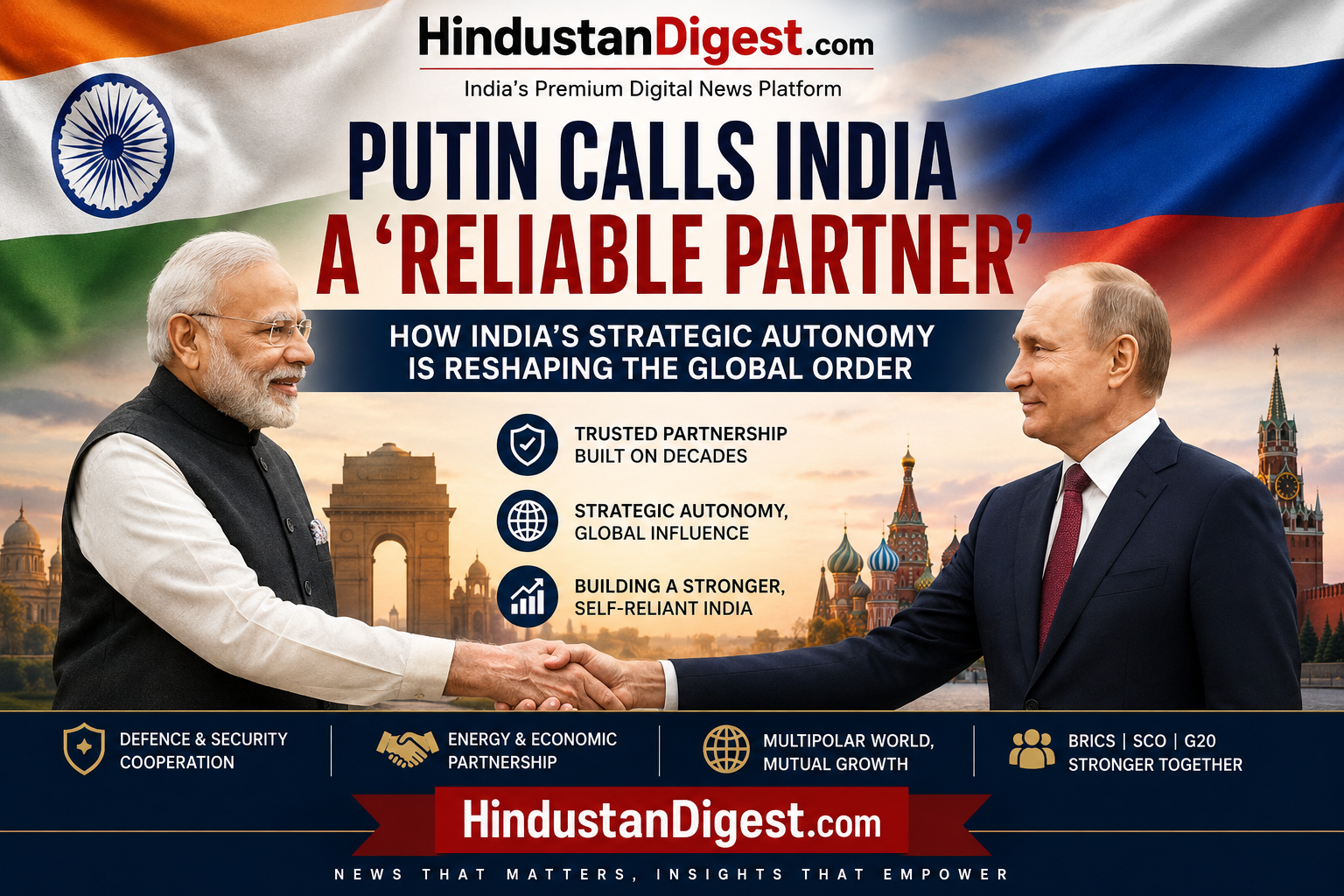
Putin Calls India a ‘Reliable Partner’: How India’s Strategic Autonomy Is Reshaping the Global Order.
Russian President Vladimir Putin has described India as a “reliable partner” and praised its strategic autonomy. Explore the history of India-Russia relations, New Delhi’s independent foreign policy, and India’s growing influence in a multipolar world.
Putin Calls India a ‘Reliable Partner’: How India’s Strategic Autonomy Is Reshaping the Global Order
Introduction
In a significant endorsement of India’s foreign policy approach, Russian President Vladimir Putin recently described India as a “reliable partner” and expressed support for New Delhi’s strategic autonomy. The remarks come at a time when the global geopolitical landscape is undergoing profound changes, with nations increasingly seeking balanced and independent foreign policies rather than aligning exclusively with competing power blocs.
For India, Putin’s statement is not merely diplomatic praise. It reflects the growing international recognition of India’s ability to pursue national interests independently while maintaining productive relationships with multiple global powers simultaneously.
Over the last decade, India has transformed itself from a regional power into a leading global stakeholder, capable of engaging with Russia, the United States, Europe, Japan, the Gulf nations, and the Global South without compromising its sovereign decision-making.
Understanding Strategic Autonomy: The Core of India’s Foreign Policy
Strategic autonomy has been the cornerstone of India’s foreign policy since independence.
The principle emerged from the vision of India’s early leadership, which sought to avoid becoming a pawn in Cold War rivalries. Rather than joining military alliances, India championed independent decision-making through the Non-Aligned Movement.
Today, strategic autonomy has evolved into a modern framework that allows India to:
- Protect national interests above ideological alignments
- Maintain relationships with competing global powers
- Ensure energy and economic security
- Preserve defense preparedness
- Expand diplomatic influence across regions
- Act as a bridge between developed and developing nations
Unlike traditional neutrality, strategic autonomy is proactive. India engages with all major powers while retaining complete freedom in its policy choices.
The Historical Foundation of India-Russia Relations
India and Russia share one of the most enduring strategic partnerships in modern international relations.
During the Cold War era, the former Soviet Union emerged as a trusted partner when many Western nations maintained distance from India on critical security issues.
Key milestones include:
1971 Indo-Soviet Treaty
The landmark treaty provided India with diplomatic and strategic support during the Bangladesh Liberation War, contributing significantly to regional stability.
Defense Cooperation
For decades, Russia has been India’s largest defense supplier, supporting the modernization of India’s armed forces through:
- Fighter aircraft
- Naval platforms
- Missile systems
- Submarine technology
- Joint defense manufacturing
Space and Nuclear Collaboration
Russia has played a major role in India’s scientific advancement through cooperation in:
- Space research
- Nuclear energy
- Advanced engineering
- Technology transfer
These foundations continue to shape contemporary bilateral relations.
India’s Balanced Approach in a Polarized World
One of the most remarkable aspects of India’s foreign policy is its ability to maintain strong ties with countries that often stand on opposite sides of geopolitical disputes.
India today enjoys robust relations with:
- Russia
- United States
- European Union
- Japan
- Australia
- France
- Israel
- Gulf Cooperation Council nations
This balanced diplomacy demonstrates New Delhi’s growing confidence and international credibility.
While maintaining historic ties with Russia, India has simultaneously strengthened partnerships through:
- The Quad framework
- Strategic defense agreements with Western nations
- Technology cooperation initiatives
- Semiconductor partnerships
- Supply chain resilience programs
This multidimensional engagement has made India one of the few nations capable of constructive dialogue across competing geopolitical camps.
Why Putin’s Remarks Matter
Putin’s characterization of India as a “reliable partner” carries strategic significance.
Recognition of Independent Decision-Making
Russia recognizes India’s refusal to succumb to external pressure when national interests are involved.
Energy Security
India’s approach to securing affordable energy supplies has prioritized the welfare of its citizens and economic growth.
Long-Term Partnership
Despite changing global circumstances, India and Russia continue to cooperate in areas of mutual benefit.
Growing International Influence
The remarks underscore India’s increasing importance in shaping emerging global power structures.
India’s Global Rise Under a Multipolar World Order
The world is gradually moving away from a unipolar framework toward a multipolar system where multiple centers of power influence global affairs.
India is emerging as one of the principal pillars of this new order.
Several factors support this rise:
Economic Strength
India is among the fastest-growing major economies globally and is projected to become one of the world’s largest economies in the coming decades.
Demographic Advantage
With the world’s largest population and a young workforce, India possesses unmatched human capital potential.
Technology Leadership
India has established itself as a leader in:
- Digital public infrastructure
- Fintech innovation
- Space technology
- Information technology services
- Artificial intelligence applications
Diplomatic Credibility
India enjoys trust among both developed and developing nations, allowing it to serve as a bridge-builder in international forums.
India’s Success During Global Crises
India’s strategic autonomy has been tested repeatedly during international crises.
Examples include:
COVID-19 Pandemic
India supplied vaccines and medical assistance to numerous countries under the Vaccine Maitri initiative.
Energy Market Disruptions
India pursued pragmatic policies to secure affordable energy supplies while protecting domestic economic stability.
Evacuation Operations
India has successfully evacuated citizens from conflict zones across the world, showcasing growing operational capabilities.
These actions have reinforced India’s reputation as a responsible and capable global actor.
The Future of India-Russia Relations
While the global geopolitical environment continues to evolve, India-Russia relations are expected to remain important in several areas:
Defense Manufacturing
Joint production initiatives are likely to deepen under India’s self-reliance agenda.
Energy Cooperation
Long-term energy partnerships will remain strategically valuable.
Arctic and Far East Opportunities
New avenues for economic cooperation are emerging in Russia’s Far East and Arctic regions.
Multilateral Institutions
Both countries continue to collaborate through platforms such as:
- BRICS
- Shanghai Cooperation Organisation
- G20
India’s Strategic Autonomy: A Model for the Developing World
Many nations in Asia, Africa, and Latin America increasingly view India’s foreign policy model as an example of how countries can preserve sovereignty while engaging globally.
India’s approach demonstrates that:
- National interests can remain paramount.
- Economic development and diplomatic flexibility can coexist.
- Partnerships need not come at the cost of independence.
- Emerging powers can shape global conversations without choosing sides.
This growing influence has strengthened India’s standing across the Global South.
Conclusion
President Vladimir Putin’s description of India as a “reliable partner” is more than a diplomatic courtesy. It reflects a broader international acknowledgment of India’s emergence as an independent, influential, and responsible global power.
India’s strategic autonomy has enabled it to navigate a complex geopolitical landscape while protecting national interests, expanding economic opportunities, and strengthening international partnerships.
As the world transitions toward a multipolar order, India’s ability to engage constructively with diverse powers without compromising its sovereignty is becoming one of its greatest strategic assets. The recognition from Russia is yet another indicator that India’s voice carries increasing weight on the global stage.
For New Delhi, the challenge ahead will be to continue balancing relationships, accelerating economic growth, and leveraging its diplomatic capital to shape the international order of the twenty-first century.
Suggested Featured Image Text
PUTIN PRAISES INDIA’S STRATEGIC AUTONOMY
“India Is A Reliable Partner”
India’s Rising Global Influence in a Multipolar World
HindustanDigest.com
More Featured Articles
India-Israel Strategic Partnership: From Civilisational Bonds to a Modern Geopolitical Alliance.
Unlock Growth: How to Secure ₹1 Cr – ₹15 Cr Unsecured Funding for Your Business :
Strategic Finance Options for Medical and Hospital Businesses in India (2026)
SIDBI – Powering India’s MSME Growth: Funding, Schemes & Business Support.
CFO Services for Startups: Why Virtual CFOs Are Transforming Business Scalability in India
One thought on “Putin Calls India a ‘Reliable Partner’: How India’s Strategic Autonomy Is Reshaping the Global Order.”