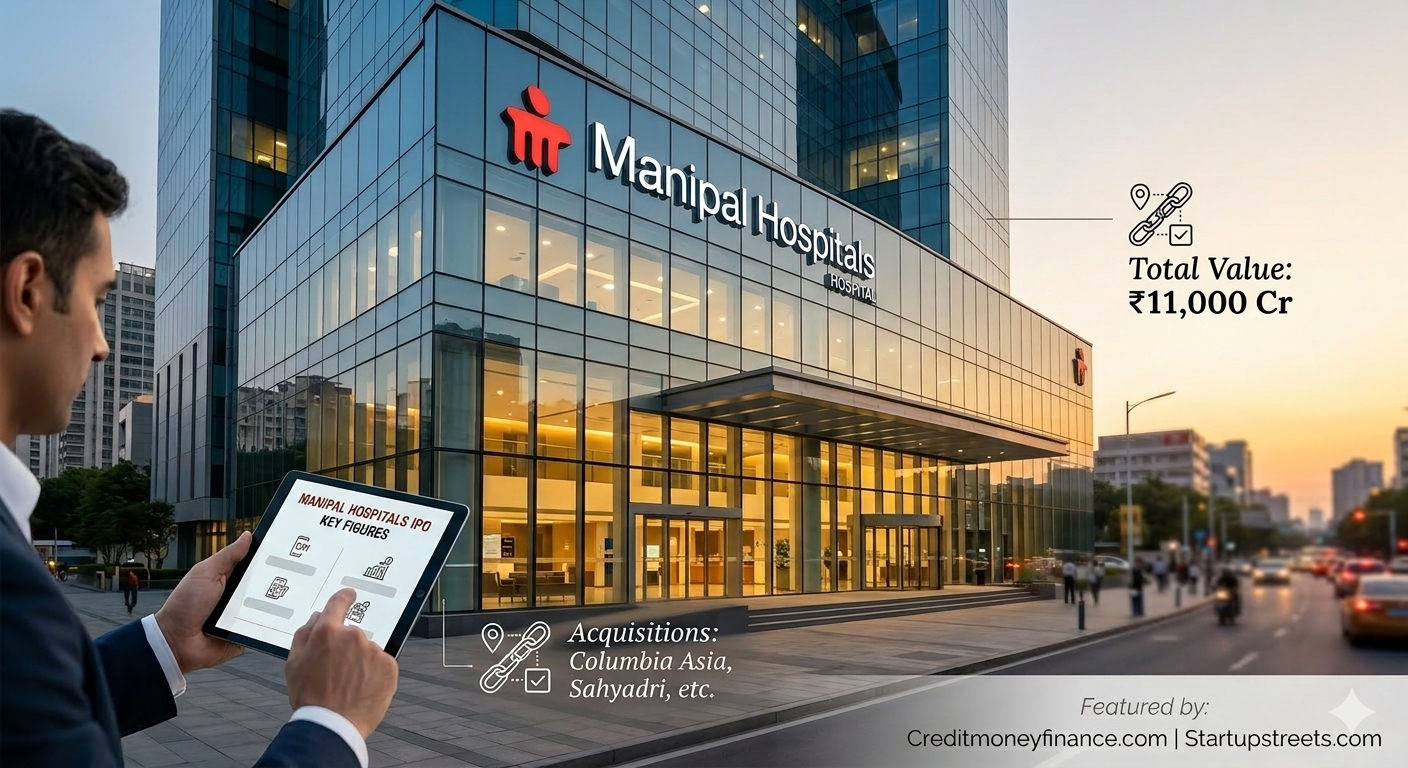
Manipal Hospitals IPO: India’s Healthcare Giant Prepares for a ₹11,000 Crore Market Debut.
Manipal Hospitals is set to file its DRHP for a massive ₹11,000 crore IPO. Discover the company’s history, aggressive growth via acquisitions, investor backing from Temasek, and future potential in India’s healthcare sector.
The Big Move: Manipal Hospitals Files for India’s Largest Healthcare IPO
The Indian healthcare landscape is bracing for a landmark event. Manipal Health Enterprises (Manipal Hospitals), the country’s second-largest hospital chain, is reportedly finalizing its Draft Red Herring Prospectus (DRHP) for an Initial Public Offering (IPO) that could raise between ₹10,500 crore and ₹11,000 crore.
This offering is poised to be the largest-ever public issue in India’s healthcare sector, dwarfing previous listings and signaling a new era of institutional scale in private medicine.
IPO Snapshot: Key Figures.
Feature | Details (Estimated) |
|---|---|
Issue Size | ₹10,500 – ₹11,000 Crore |
Target Valuation | ₹1.2 Lakh Crore ($13 Billion) |
Fresh Issue Component | ₹8,500 – ₹9,000 Crore |
Offer For Sale (OFS) | ₹2,000 Crore |
Primary Objective | Debt retirement (₹8,000 Cr) & Inorganic expansion |
Lead Banker | Kotak Mahindra Capital |
A Legacy of Care: The History and Founders
The roots of Manipal Hospitals trace back to 1953, when the visionary Dr. T.M.A. Pai founded the Kasturba Medical College in Manipal, Karnataka. What began as a philanthropic mission to provide quality medical education and affordable care evolved into the Manipal Education and Medical Group (MEMG).
The formal corporate entity for the hospital business was established in 1991 with the launch of its flagship 600-bed quaternary care facility in Bengaluru. Under the leadership of Dr. Ranjan Pai, the grandson of the founder, the group transitioned from a regional player into a professionally managed, pan-India healthcare behemoth.
The “String of Pearls” Growth Strategy
Manipal’s rise to the top hasn’t just been organic; it has been defined by a relentless and “aggressive” acquisition strategy often referred to as the “String of Pearls.” Over the last five years, the group has integrated several high-profile chains:
- Columbia Asia Hospitals (2021): Acquired for ₹2,100 crore, adding 11 hospitals.
- Vikram Hospital (2021): Strengthened its presence in the Bengaluru micro-market.
- AMRI Hospitals (2023): An 84% stake acquisition for ₹2,300 crore made Manipal the largest player in Eastern India.
- Sahyadri Hospitals (2024/25): A massive ~₹6,400 crore deal to dominate the Maharashtra and Western India markets.
- Medica Synergie: Recent moves to acquire a majority stake to further cement its leadership in the East.
Today, the network operates nearly 49 hospitals with over 12,000 beds, with plans to scale to 15,000 beds through greenfield projects in Mumbai and Raipur.
Investor Evolution: From TPG to Temasek
Manipal’s cap table reads like a “Who’s Who” of global private equity. The company’s ability to attract top-tier capital has been central to its valuation jump from $3 billion in 2021 to a staggering $13 billion today.
- Early Backers: Investors like TPG Capital and the National Investment and Infrastructure Fund (NIIF) provided the initial fuel for expansion.
- The Temasek Takeover (2023): Singapore’s sovereign wealth fund, Temasek Holdings, executed one of India’s largest healthcare deals by acquiring a controlling 59% stake for over $2 billion.
- Current Shareholding: Post-Temasek’s entry, the Pai Family (MEMG) retains approximately 30%, while TPG holds around 11%.
- The KKR Connection: In 2025, global giant KKR provided a $600 million financing package to further support the group’s inorganic ambitions.
Financial Health and IPO Objectives
According to recent filings and reports, Manipal Hospitals generated a consolidated revenue of ₹8,242 crore in FY25, reflecting a 34% year-on-year growth. Its EBITDA margins remain healthy at approximately 25-26%, despite the costs associated with integrating newly acquired units.
The IPO proceeds are strategically earmarked:
- Deleveraging: Around ₹8,000 crore will be used to retire debt, significantly strengthening the balance sheet and improving net margins.
- Future Acquisitions: The remaining capital will fund “inorganic expansion,” as the group continues to scout for distressed or high-potential hospital assets.
Future Potential: The Road to 15,000 Beds
The Indian healthcare sector is at an inflection point. With rising insurance penetration, an aging population, and an increasing preference for organized hospital chains over standalone clinics, Manipal is perfectly positioned.
Why Investors are Watching:
- Market Leadership: Post-listing, Manipal could become the most valuable healthcare operator in India, potentially surpassing Max Healthcare and Apollo Hospitals in market cap.
- Operational Synergy: As the company finishes integrating Sahyadri and Medica, “synergy benefits” are expected to drive margin expansion.
- Digital Health: The group is investing heavily in teleconsultation and health-tech to build a “phygital” ecosystem.
Conclusion
The Manipal Hospitals IPO is more than just a fund-raising exercise; it is a coming-of-age moment for the Indian healthcare industry. For investors, it offers a rare opportunity to own a piece of a high-moat, scaled, and professionally managed healthcare giant.
Team: HindustanDigest.com
More Featured Articles:
Strategic Finance Options for Medical and Hospital Businesses in India (2026)
Jio Finance Loan Against Property – Attractive Interest From 9.25%, High LTV & Fast Approvals
Trump’s Alienation of India: Why Distancing New Delhi Could Be a Strategic Blunder for the West.
Why Kjøller Is an Important Venture Capital Investor for Startups Globally.
BSE Main Board Listed Company (Mumbai) Available for Strategic Acquisition.
The Ultimate Guide to Burger Singh Franchise: How to Partner with India’s Fastest-Growing QSR Brand.
SIDBI – Powering India’s MSME Growth: Funding, Schemes & Business Support.