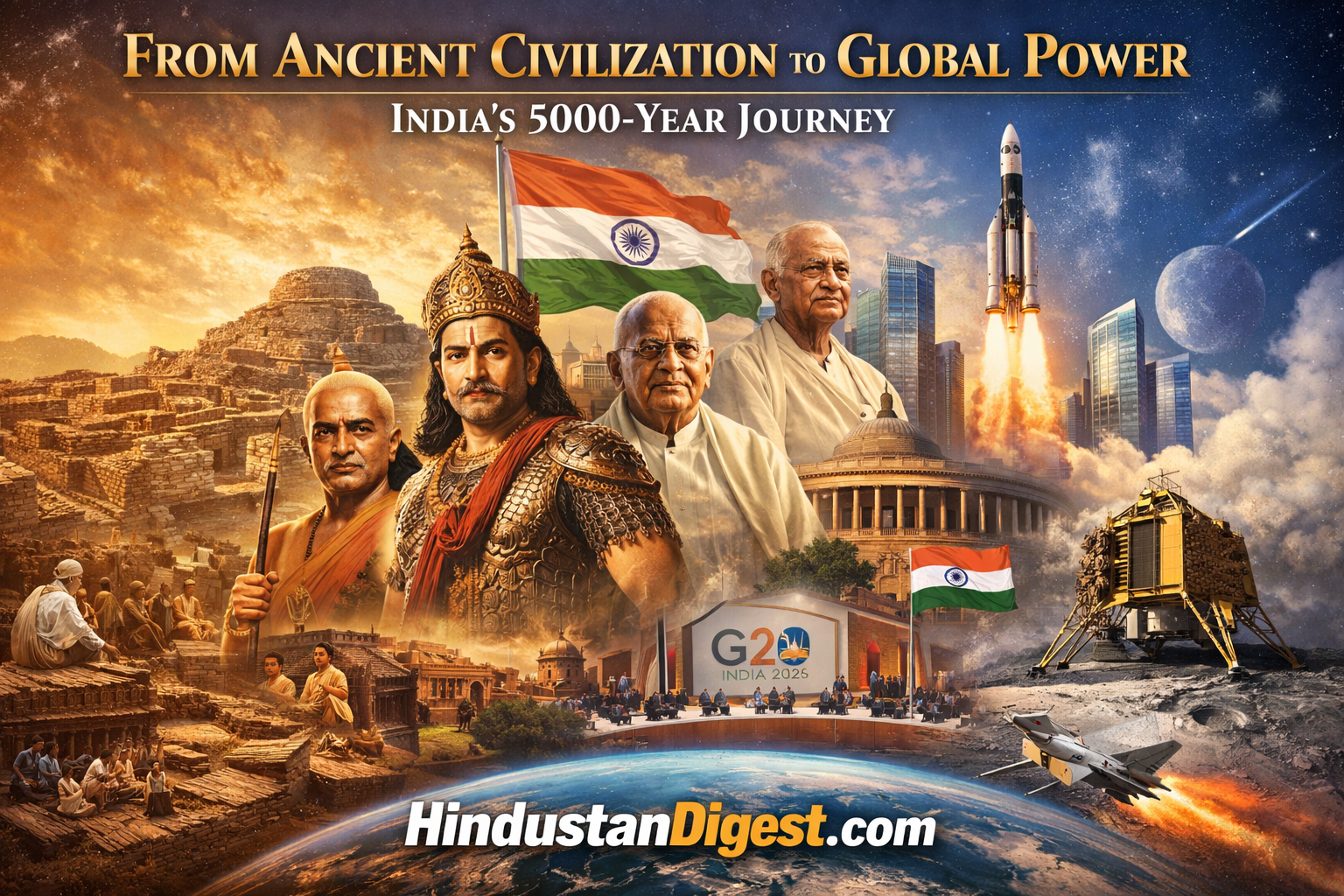
From the Indus Valley to a Global Power: India’s 5000-Year Civilizational Journey to the Future.
Discover the 5000-year journey of India from the Indus Valley Civilization to a rising global power. Explore India’s ancient knowledge systems, cultural continuity, democratic strength, and economic rise shaping the modern world.
From Ancient Civilization to Global Power: The 5000-Year Journey of India.
India is not merely a country created in the modern political era. It is a civilization that has flowed continuously for more than 5000 years, adapting, evolving, and influencing the world across centuries.
From the well-planned cities of the Indus Valley Civilization to the modern economic and technological achievements of the Republic of India, the story of India is one of resilience, knowledge, and cultural continuity unmatched in world history.
Today, India stands at a historic turning point reclaiming its role as a major global power, while remaining deeply rooted in its ancient civilizational values.
The Dawn of Civilization: The Indus Valley Legacy.
India’s story begins more than 5,000 years ago with the remarkable urban civilization that flourished along the Indus River basin.
The Indus Valley Civilization (c. 2600–1900 BCE) was one of the world’s earliest urban cultures, contemporary with Mesopotamia and Egypt.
Cities like Harappa and Mohenjo-daro revealed astonishing levels of sophistication:
Advanced urban planning with grid-pattern streets,
Drainage systems superior to many medieval cities,
Standardized weights and measures,
Extensive trade networks across Asia and the Middle East, and
Skilled craftsmanship in metallurgy, pottery, and jewelry.
These discoveries proved that India was among the earliest cradles of human civilization.
The Age of Knowledge: India’s Ancient Universities.
India’s civilizational strength has always rested on knowledge and education.
Long before Europe developed formal universities, India had thriving centers of higher learning that attracted students from across Asia.
Among the most famous were:
Takshashila,
Established around the 5th century BCE, Takshashila was one of the world’s earliest universities. Students studied subjects such as:
Medicine
Mathematics
Philosophy
Statecraft
Military science
The legendary strategist Chanakya, author of the Arthashastra, was associated with this institution.
Nalanda University
Founded in the 5th century CE during the Gupta period, Nalanda was one of the greatest centers of learning in the ancient world.
At its peak: Over 10,000 students studied there
More than 2,000 teachers taught philosophy, science, mathematics, astronomy, and medicine
Students came from China, Korea, Tibet, and Southeast Asia.
The Chinese scholar Xuanzang famously studied at Nalanda and documented the brilliance of India’s intellectual culture.
Civilizational Continuity: India’s Cultural Strength
Many ancient civilizations vanished with time.
But India’s greatest strength lies in its extraordinary continuity of culture.
For thousands of years, Indian civilization has preserved traditions that still shape daily life:
Yoga and meditation traditions rooted in ancient philosophy,
Spiritual texts like the Vedas and Bhagavad Gita,
Festivals celebrated across centuries,
Classical languages such as Sanskrit,
Family and community-based social structures etc
This cultural continuity has allowed India to absorb external influences while retaining its core identity.
Few civilizations in the world have maintained such unbroken cultural evolution over millennia.
Resilience Through Centuries of Challenges.
India’s civilizational journey has not been without challenges.
Over centuries, the subcontinent experienced invasions, political upheavals, and colonial rule. Yet the civilizational core survived.
The defining moment of modern India’s rebirth came through the freedom movement led by visionary leaders such as:
Mahatma Gandhi,
Sardar Vallabhbhai Patel,
Subhas Chandra Bose, etc
Their efforts culminated in India gaining independence in 1947 and the creation of the modern Republic.
The World’s Largest Democracy.
India today is not just an ancient civilization , it is also the world’s largest democracy.
The Constitution of India created a political system that combines:
Universal adult voting rights,
Independent judiciary,
Federal governance, and
Strong democratic institutions.
With over 900 million eligible voters, Indian elections are the largest democratic exercise on the planet.
This democratic stability has been a key pillar of India’s long-term development.
India’s Economic Rise in the 21st Century
In recent decades, India has emerged as one of the fastest-growing major economies in the world.
Key milestones include:
Becoming the world’s fifth-largest economy,
Rapid growth in technology, digital payments, and startups,
Expanding manufacturing and infrastructure,
A thriving space and scientific ecosystem,
India’s technological success is symbolized by organizations like the Indian Space Research Organisation, which successfully landed the Chandrayaan-3 near the Moon’s south pole.
Such achievements demonstrate how ancient knowledge traditions now combine with modern innovation.
India’s Global Influence Today.
India’s voice is increasingly influential on the global stage.
Whether through diplomacy, technology, or culture, India plays a critical role in shaping the future.
Examples include:
Leadership during the G20 Summit 2023,
Expanding global influence of Indian technology talent,
Worldwide adoption of practices like Yoga recognized through the International Day of Yoga,
India today represents a unique model: a modern economic power rooted in ancient civilizational values.
A Civilization Looking Toward the Future
India’s journey from the Indus Valley to the digital age is more than a historical narrative. It is the story of a civilization that has survived, evolved, and risen repeatedly through time.
With a young population, a dynamic economy, and a deep cultural foundation, India is positioned to play a decisive role in shaping the 21st century global order.
From the wisdom of the Vedas to the power of modern technology, India’s civilizational journey reflects a timeless truth:
A nation rooted in its heritage can rise to lead the future.
India’s 5000-year story is not merely about the past.
It is about the future of a civilization that continues to inspire the world.
Team: HindustanDigest.com
Featured Articles:
Trump’s Alienation of India: Why Distancing New Delhi Could Be a Strategic Blunder for the West.
BSE Main Board Listed Company (Mumbai) Available for Strategic Acquisition.
SME IPOs in India: Insights from Regulators, Bankers & Advisors

2 thoughts on “From the Indus Valley to a Global Power: India’s 5000-Year Civilizational Journey to the Future.”