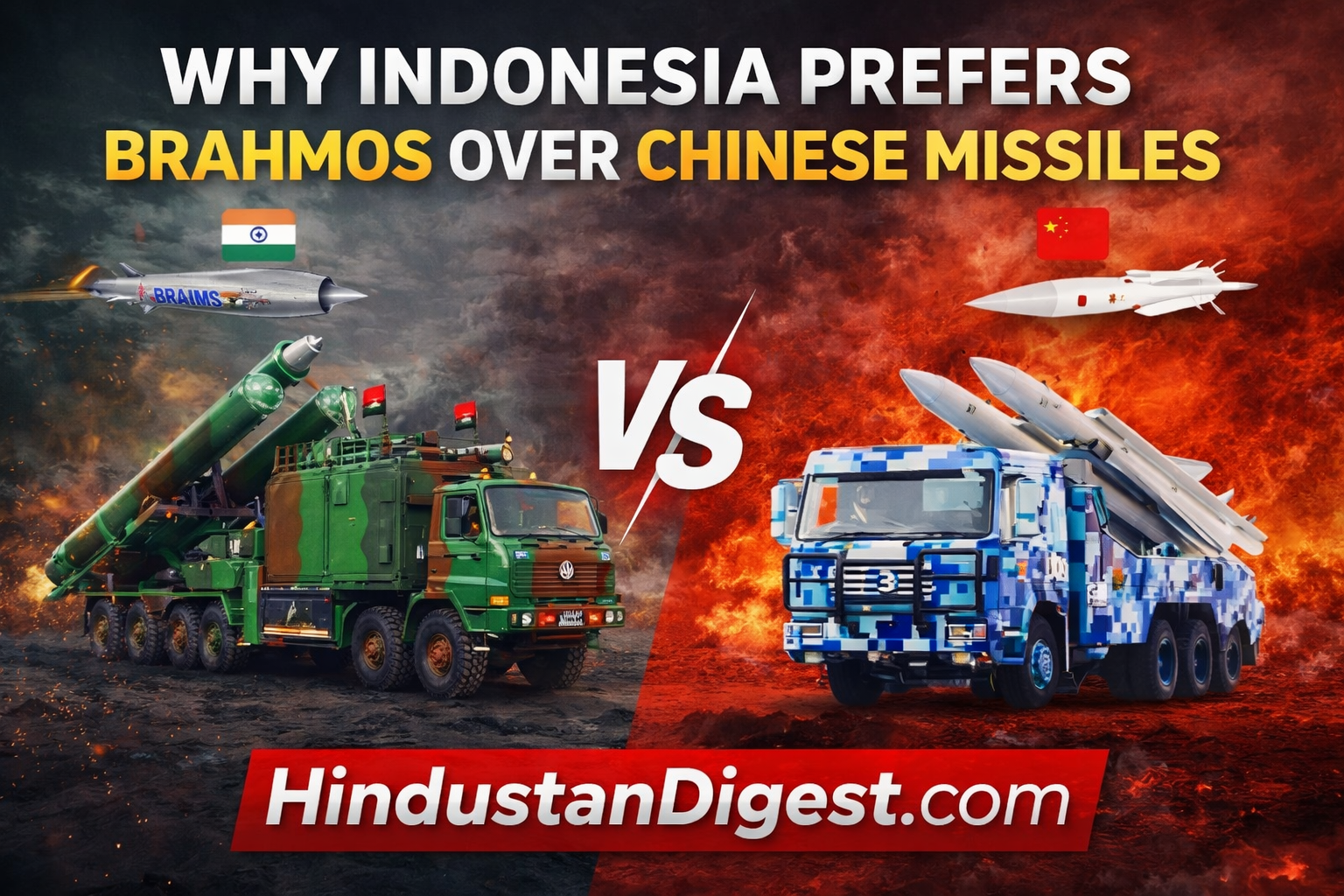
Why Indonesia’s Defence Community Prefers the BrahMos Missile: A Strategic Shift Away from Chinese Systems.
Indonesia’s defence experts increasingly support acquiring the BrahMos supersonic cruise missile over Chinese alternatives like the YJ-12. Explore why the India-Russia BrahMos system is seen as more reliable, accurate, and strategically valuable for regional security.
Indonesia’s Defence Community Applauds BrahMos Acquisition:
Why the Supersonic Missile Is Seen as Safer Than Chinese Alternatives
The decision by Indonesia to move forward with the acquisition of the BrahMos Missile marks a significant shift in the security architecture of Southeast Asia.
Defence analysts, military planners, and strategic experts within Indonesia have increasingly expressed confidence in the capabilities of the missile system, which is jointly developed by BrahMos Aerospace, a collaboration between Defence Research and Development Organisation of India and Russia’s NPO Mashinostroyenia.
In contrast, Chinese systems such as the YJ-12 Missile have faced growing skepticism in several regional defence circles due to concerns related to reliability, operational transparency, and geopolitical dependency.
Indonesia’s interest in BrahMos reflects not just a technological preference but also a strategic calculation that prioritizes reliability, deterrence capability, and diversified defence partnerships.
The Strategic Importance of Missile Deterrence for Indonesia.
Indonesia is the world’s largest archipelagic state, stretching across thousands of islands and controlling key maritime choke points. These include vital shipping lanes that connect the Indian Ocean with the Pacific Ocean.
Protecting these waters requires sophisticated anti-ship and land-attack capabilities capable of deterring hostile naval forces. For this reason, Indonesia has been aggressively modernizing its armed forces under its Minimum Essential Force program.
Acquiring the BrahMos missile provides Indonesia with one of the fastest and most lethal cruise missile systems currently available for export. With speeds reaching Mach 2.8 to Mach 3, BrahMos is nearly three times faster than most subsonic cruise missiles.
This speed significantly reduces reaction time for enemy ships and missile defense systems.
BrahMos: A Proven and Combat-Ready System.
Unlike many emerging missile systems that remain largely theoretical or lightly tested, BrahMos has undergone extensive testing and operational deployment.
It is currently deployed by the Indian Armed Forces, including the Indian Navy, Indian Air Force, and Indian Army.
The missile has been successfully integrated across multiple platforms:
• Land-based mobile launchers
• Naval warships
• Submarines (planned variants)
• Fighter aircraft such as the Sukhoi Su‑30MKI
This multi-platform capability dramatically enhances operational flexibility for militaries deploying the system.
For Indonesia, this means BrahMos could eventually be integrated with coastal defence systems, naval assets, and potentially future aircraft platforms.
Superior Speed and Precision.
One of BrahMos’s biggest advantages is its supersonic speed, which makes interception extremely difficult.
While many cruise missiles travel at subsonic speeds of around Mach 0.8, BrahMos travels at nearly three times the speed of sound.
This speed offers several operational advantages:
• Reduced interception probability
• Shorter enemy reaction time
• Greater kinetic impact upon strike
• Higher probability of target destruction
The missile also uses advanced fire-and-forget guidance systems, combining inertial navigation with satellite guidance and terminal radar homing.
This allows it to strike targets with extreme precision, even in contested electronic warfare environments.
BrahMos vs Chinese YJ-12: A Strategic Comparison.
The YJ-12 Missile developed by China is also a supersonic anti-ship missile. However, several factors distinguish BrahMos from its Chinese counterpart.
1. Operational Transparency: BrahMos has been widely tested and demonstrated in public trials. Its performance metrics and capabilities are better documented compared to Chinese systems whose real-world performance data remains limited.
2. Reliability Record: BrahMos has built a reputation through years of operational use by India’s armed forces. Continuous upgrades and real-world deployments have strengthened confidence in its reliability.
3. Technology Partnership Model: The BrahMos program represents collaboration between India and Russia, two countries with long histories in missile technology development. This partnership has produced a highly mature and refined weapon system.
4. Strategic Independence: Indonesia, like many Southeast Asian countries, prefers to avoid excessive dependence on a single geopolitical supplier.
Purchasing BrahMos allows Indonesia to diversify its defence procurement away from Chinese platforms while strengthening ties with India.
India’s Emergence as a Major Defence Exporter.
The export of BrahMos is also a milestone in India’s rise as a global defence manufacturing power.
Under initiatives promoted by the Government of India, defence exports have grown significantly over the past decade.
Countries across Southeast Asia and the Indo-Pacific have expressed interest in the BrahMos system due to its reputation for performance and reliability.
Indonesia joins the Philippines, which earlier signed a landmark BrahMos coastal defence deal worth hundreds of millions of dollars.
These deals are positioning India as a credible alternative supplier in the global defence market.
Strengthening Indo-Pacific Security.
The acquisition of BrahMos by Indonesia also aligns with broader efforts to maintain stability across the Indo‑Pacific region.
The area has become increasingly strategic due to rising maritime tensions and competition among major powers.
By deploying advanced deterrence systems like BrahMos, countries in the region can better protect their sovereignty, shipping routes, and exclusive economic zones.
For Indonesia, BrahMos enhances its ability to safeguard crucial waters such as the South China Sea, where territorial disputes and military activity have grown significantly in recent years.
Technological Evolution of BrahMos.
The BrahMos program continues to evolve with newer variants under development.
Future versions include:
• BrahMos‑NG, a lighter and faster next-generation missile
• Extended-range variants exceeding 800 km
• Enhanced stealth features
• Improved targeting algorithms
These upgrades ensure that BrahMos remains one of the most advanced cruise missile systems available globally.
A Symbol of Strategic Trust.
For Indonesia, acquiring BrahMos is not merely about buying a missile system. It represents a deeper strategic partnership with India.
India has increasingly positioned itself as a security partner in Southeast Asia through defence cooperation, naval exercises, and technology sharing.
The BrahMos deal strengthens these ties while giving Indonesia a credible deterrence capability against potential maritime threats.
Conclusion.
Indonesia’s defence community views the BrahMos missile as a powerful, reliable, and strategically sound choice for strengthening national security.
Its unmatched speed, proven operational track record, and multi-platform deployment capability make it one of the most formidable cruise missile systems in the world today.
Compared with alternatives such as China’s YJ-12, BrahMos offers a combination of transparency, reliability, and technological maturity that appeals strongly to defence planners.
As Southeast Asia navigates a complex geopolitical landscape, systems like BrahMos will play a crucial role in ensuring deterrence, protecting maritime sovereignty, and maintaining stability across the Indo-Pacific region.
Team: Hindustan Digest
More Featured Articles
From the Indus Valley to a Global Power: India’s 5000-Year Civilizational Journey to the Future.
SME IPOs in India: Insights from Regulators, Bankers & Advisors
CFO Services for Startups: Why Virtual CFOs Are Transforming Business Scalability in India
SIDBI – Powering India’s MSME Growth: Funding, Schemes & Business Support.
The Ultimate Guide to Burger Singh Franchise: How to Partner with India’s Fastest-Growing QSR Brand.
Venture Capital and Private Equity Funding in India: A Complete Founder’s Guide (2025)


One thought on “Why Indonesia’s Defence Community Prefers the BrahMos Missile: A Strategic Shift Away from Chinese Systems.”