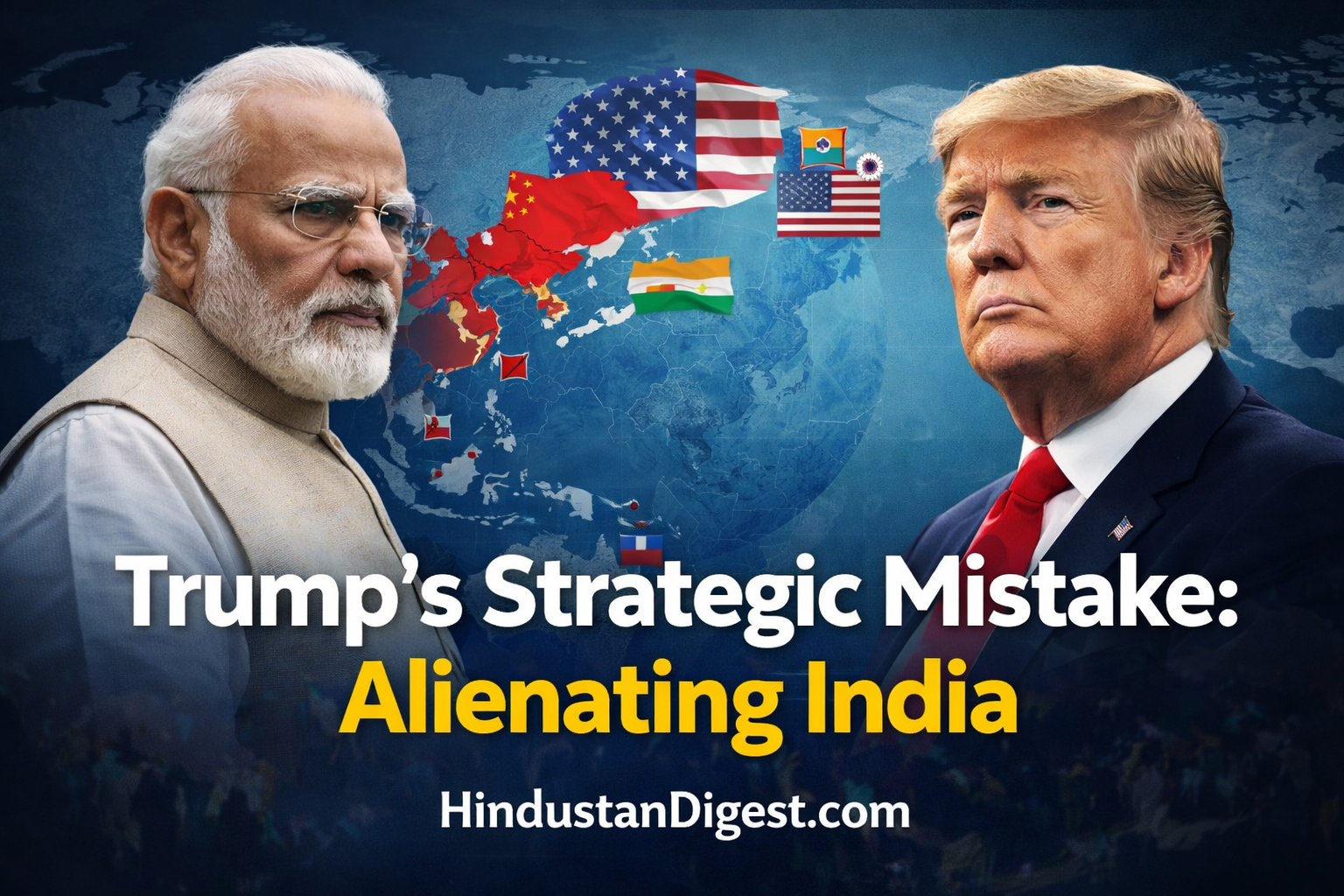
Trump’s Alienation of India: Why Distancing New Delhi Could Be a Strategic Blunder for the West.
A detailed analysis of criticism surrounding Donald Trump and his policies toward India, including comments from former Australian Prime Minister Tony Abbott and global strategic experts.
Explore why strong India–West relations are vital for geopolitical stability.
Trump’s Alienation of India: Why Distancing New Delhi Could Be a Strategic Blunder for the West.
In the evolving landscape of global geopolitics, relationships between major democratic powers are increasingly important. Recently, comments by former Australian Prime Minister Tony Abbott reignited debate about the diplomatic approach of Donald Trump toward India. Abbott suggested that alienating India could be one of the biggest strategic mistakes made by Western leadership.
India today is not merely another emerging economy; it is a geopolitical pivot in the Indo-Pacific region and one of the most influential democratic powers in the world. Any strain in relations between Washington and New Delhi has broader implications for global alliances, economic partnerships, and regional security.
We will examine the context of these criticisms, the strategic importance of India, and why maintaining strong ties with New Delhi is widely considered essential for global stability.
India’s Rising Strategic Importance.
Over the last two decades, India has rapidly transformed into a global economic and political power.
With a population exceeding 1.4 billion and one of the fastest-growing major economies, India plays a critical role in global supply chains, technology innovation, and international diplomacy.
Under the leadership of Prime Minister Narendra Modi, India has expanded its global presence through initiatives such as:
Strategic partnerships with the United States, Japan, and Australia,
Participation in the Indo-Pacific security architecture,
Expansion of defense manufacturing and technology sectors, and
Increasing influence in global organizations such as the G20.
India is also viewed as a key democratic counterbalance in Asia, particularly amid the growing influence of Xi Jinping and China’s geopolitical ambitions.
Given this strategic position, many analysts argue that alienating India would undermine Western efforts to maintain a stable balance of power in the Indo-Pacific.
Tony Abbott’s Criticism of Trump’s Approach.
Former Australian Prime Minister Tony Abbott publicly expressed concern that certain policies associated with Donald Trump risked unnecessarily alienating India.
Abbott stated that while he did not oppose every element of Trump’s foreign policy, he believed some actions had “gratuitously alienated” New Delhi. According to Abbott, maintaining strong relations with India should be a priority for any Western strategic framework in Asia.
His remarks reflect a broader sentiment among many geopolitical observers who view India as an indispensable partner for democratic alliances.
The Russia Oil Controversy.
One of the key issues that created diplomatic friction was India’s purchase of discounted oil from Russia following the Russian invasion of Ukraine.
Several Western nations criticized India for continuing energy trade with Moscow. However, Indian policymakers defended the decision as a pragmatic move driven by national economic interests and energy security.
India’s position was supported by several analysts who argued that:
Energy security is essential for a developing nation of India’s scale,
Western countries themselves continued various forms of trade with Russia in the early stages of the conflict,
India maintained a balanced diplomatic approach rather than aligning exclusively with any bloc,
Many Indian commentators viewed Western criticism as an example of geopolitical double standards..
Why India’s Strategic Autonomy Matters.
India has traditionally pursued a policy of strategic autonomy. Unlike many Cold War alliances, India prefers to maintain flexibility in international relations.
This approach allows India to:
Maintain partnerships with Western democracies,
Continue diplomatic and economic ties with Russia,
Strengthen regional partnerships in Asia and the Global South,
India’s balanced approach reflects its long-standing foreign policy philosophy that national interest should guide diplomacy rather than rigid ideological alliances.
Even leaders such as Emmanuel Macron and Joe Biden have increasingly acknowledged the importance of respecting India’s strategic independence while building stronger partnerships.
The Indo-Pacific and the Importance of India.
The Indo-Pacific region has become the central theatre of global geopolitics. In this environment, India’s role is indispensable.
India is a founding member of the Quad alliance alongside the United States, Japan, and Australia. The group focuses on promoting a free and open Indo-Pacific and balancing regional power dynamics.
Analysts widely believe that without India’s participation, efforts to maintain regional stability would be significantly weakened.
India also commands one of the world’s largest armed forces and has rapidly expanded its naval presence across the Indian Ocean — a critical corridor for global trade.
Indian Public Sentiment and National Pride
In India, foreign policy is closely linked with national pride and sovereignty. Many citizens expect global powers to treat India as an equal partner rather than a subordinate ally.
Policies perceived as pressuring India often trigger strong public reactions. This sentiment has become more pronounced as India’s economic and diplomatic influence has grown.
For nationalist-minded observers in India, the expectation is clear: global partnerships should be based on mutual respect and recognition of India’s independent decision-making.
Economic Partnerships Between India and the United States.
Despite occasional diplomatic disagreements, economic ties between India and the United States remain strong.
Key areas of cooperation include:
Technology and semiconductor manufacturing,
Defense cooperation and joint military exercises,
Renewable energy and climate initiatives,
Startup and venture capital ecosystems,
Bilateral trade between the two countries has crossed hundreds of billions of dollars annually, making the United States one of India’s largest economic partners.
The Broader Geopolitical Lesson.
The central lesson highlighted by critics such as Tony Abbott is that the West cannot afford to mismanage its relationship with India.
India represents:
The world’s largest democracy,
A rapidly growing economic powerhouse,
A critical strategic partner in the Indo-Pacific,
Alienating such a nation could weaken broader geopolitical alliances at a time when global stability is increasingly dependent on cooperation between democratic powers.
Conclusion:
India’s rise as a global power has reshaped the geopolitical landscape of the 21st century. Any attempt to pressure or marginalize New Delhi risks undermining strategic partnerships that are essential for regional stability.
While foreign policy debates will continue across political administrations, many global observers agree on one point: strong and respectful relations with India are indispensable for the future of international diplomacy.
As India continues to expand its influence across economic, technological, and strategic domains, the world’s major powers must adapt to a new reality , one in which New Delhi is not just a partner, but a central pillar of the global order.
Team: HindustanDigest.com
More Featured Articles:
Strategic Finance Options for Medical and Hospital Businesses in India (2026)
Funding and Investment Options to Grow India’s Real Estate and Allied Businesses
China Growth Weakens as Retail Sales and Investment Miss Forecasts, Raising Stimulus Expectations
Why Kjøller Is an Important Venture Capital Investor for Startups Globally.
2 thoughts on “Trump’s Alienation of India: Why Distancing New Delhi Could Be a Strategic Blunder for the West.”