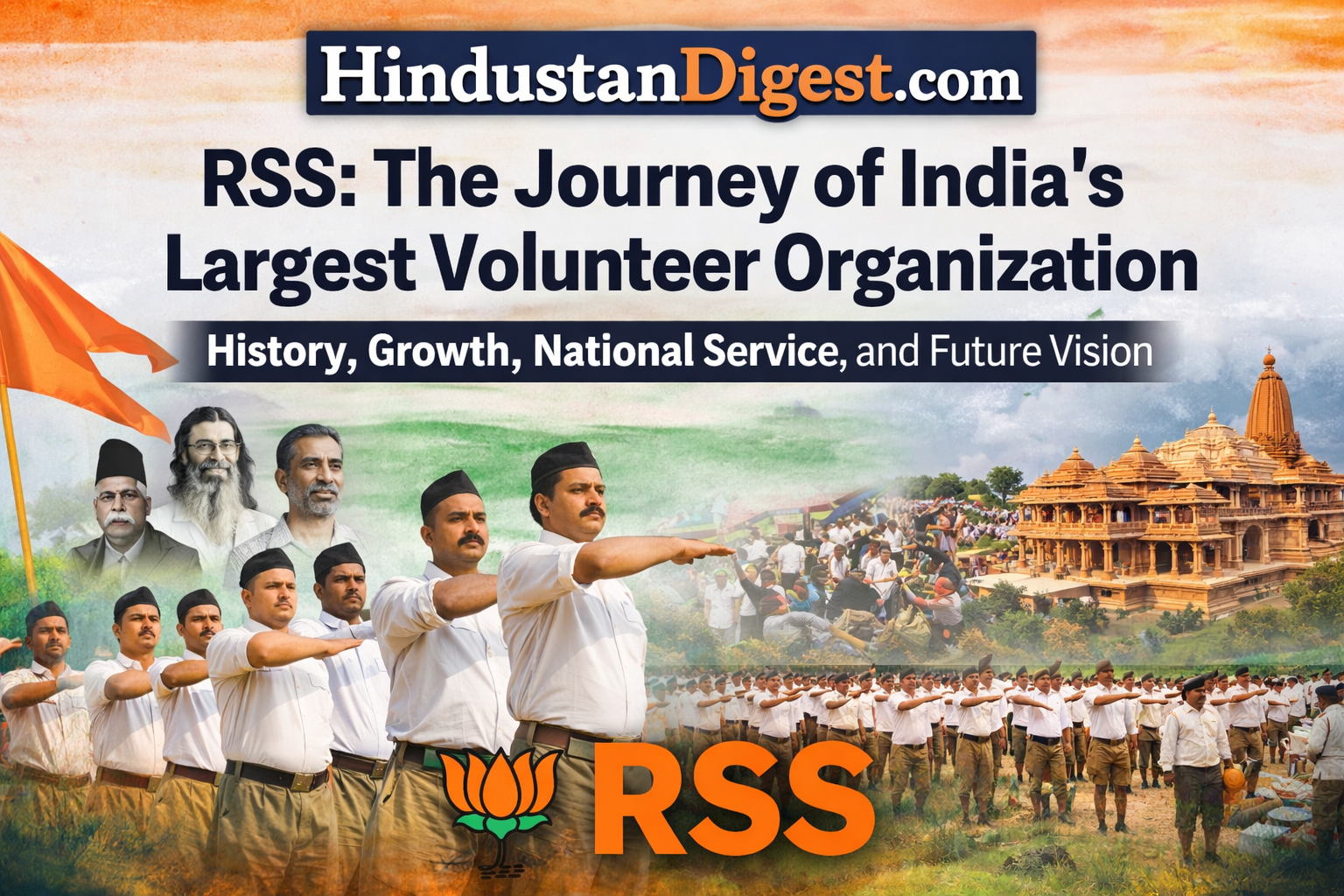
RSS: The Journey of India’s Largest Volunteer Organization – History, Growth, National Service, and Future Vision.
Explore the inspiring journey of the Rashtriya Swayamsevak Sangh (RSS) from its founding in 1925 to becoming the world’s largest volunteer organization.
Discover its role in nation building, social service, cultural revival, and India’s future.
Introduction: Understanding the Rashtriya Swayamsevak Sangh.
The Rashtriya Swayamsevak Sangh (RSS) stands today as one of the most influential socio-cultural organizations in India and arguably the largest volunteer organization in the world. Founded in 1925, RSS has grown from a small group of patriotic volunteers into a nationwide movement focused on nation building, cultural preservation, social service, and character development.
With millions of volunteers, known as Swayamsevaks, the organization operates thousands of daily gatherings called Shakhas across India and in many countries worldwide. Its guiding philosophy centers on strengthening society through discipline, service, unity, and pride in India’s civilizational heritage.
Over the past century, RSS has evolved into a powerful social force that has influenced education, rural development, disaster relief, cultural revival, and national consciousness.
The Founding Vision: Birth of RSS in 1925.
RSS was founded on 27 September 1925 in Nagpur by Keshav Baliram Hedgewar, a physician and freedom fighter deeply concerned about the social fragmentation he observed in Indian society during the colonial era.
Dr. Hedgewar believed that India’s strength lies in a united and culturally confident society. He felt that political independence alone would not be sufficient; society needed discipline, unity, and a strong national character.
To address this, he created a volunteer-based organization focused on:
- Character building
- Social unity beyond caste divisions
- Cultural awareness
- National pride
The early RSS activities centered around daily physical training, discussions, patriotic education, and community service conducted in local parks or open spaces.
What began with a few volunteers in Nagpur soon started spreading to other parts of India.
Expansion and Consolidation: Leadership of Guruji Golwalkar.
After the passing of Dr. Hedgewar in 1940, leadership passed to Madhav Sadashiv Golwalkar, popularly known as Guruji.
Under Golwalkar’s leadership, RSS expanded rapidly across India. He focused on:
- Organizational discipline
- Ideological clarity
- Nationwide expansion of Shakhas
- Development of affiliated organizations
During this period, RSS developed a strong grassroots structure that helped it grow steadily across urban and rural India.
RSS and National Service After Independence.
After India gained independence in 1947, RSS volunteers became involved in relief work during the partition crisis, helping refugees who had migrated from Pakistan.
Thousands of swayamsevaks participated in:
- Refugee camps
- Food distribution
- Medical assistance
- Rehabilitation efforts
Historical records indicate that thousands of relief camps were organized to assist displaced families, demonstrating RSS’s capacity for large-scale volunteer mobilization.
This marked the beginning of RSS’s long tradition of disaster relief and humanitarian work.
Associated Organizations and Social Outreach.
Over the decades, RSS inspired the creation of numerous social, educational, and cultural organizations working in various sectors of society.
These include:
- Bharatiya Janata Party – political platform inspired by nationalist ideology
- Vishva Hindu Parishad – religious and cultural organization
- Akhil Bharatiya Vidyarthi Parishad – student organization
- Bharatiya Mazdoor Sangh – one of India’s largest labor unions
- Vidya Bharati – network of educational institutions.
These organizations collectively work in areas such as:
- Education
- Tribal welfare
- Rural development
- Labor rights
- Women empowerment
- Cultural preservation
Through this ecosystem of organizations, RSS has built what many observers describe as one of the most extensive grassroots social networks in India.
Role During National Challenges.
Throughout its history, RSS volunteers have been active during times of national crisis.
Swayamsevaks have participated in relief operations during:
- The 2004 Indian Ocean tsunami
- Earthquakes in Gujarat and Nepal
- Floods in Kerala and Assam
- Cyclones along India’s eastern coast
They have provided food, shelter, rescue assistance, and rehabilitation support.
Pandemic Relief
During the COVID-19 pandemic, RSS volunteers organized one of the largest civil society relief efforts in India.
Activities included:
Distribution of food to millions,
Supplying masks and medicines,
Helping migrant workers return home, and
Supporting vaccination drives.
These initiatives demonstrated the organization’s ability to mobilize large numbers of volunteers quickly during national emergencies.
Leadership in the Modern Era.
In 2009, Mohan Bhagwat became the sixth Sarsanghchalak (chief) of RSS.
Under his leadership, the organization has focused on:
Expanding social outreach,
Increasing dialogue with different communities
Promoting environmental awareness,
Encouraging youth participation, and
Strengthening India’s cultural identity.
RSS has also expanded its global presence, with affiliated groups operating in more than 40 countries, engaging the Indian diaspora.
RSS and Cultural Revival.
One of the core goals of RSS has been the revival of India’s civilizational heritage and cultural confidence.
The organization emphasizes:
- Preservation of traditional values
- Promotion of Indian languages
- Yoga and physical discipline
- Respect for family and community structures.
The construction of the Ram Temple in Ayodhya has been seen by many supporters as a major cultural milestone linked to long-standing social movements involving RSS volunteers.
Current Reach and Influence
Today RSS has:
Millions of volunteers,
Tens of thousands of daily shakhas,
Thousands of service projects across India.
Its activities include:
- Rural education programs
- Healthcare camps
- Tribal development initiatives
- Skill development for youth
- Environmental campaigns
- Social harmony initiatives
In many villages and towns, RSS-inspired organizations run schools, hostels, health centers, and community service programs.
RSS and India’s Youth.
One of the reasons for RSS’s longevity is its ability to connect with younger generations.
Through its training programs, camps, and student organizations, it encourages youth to develop:
- Leadership skills
- Discipline
- National responsibility
- Community service values
Many prominent leaders in politics, academia, social service, and business have had some form of association with RSS activities during their youth.
Future Potential: The Next Century of RSS.
As RSS approaches its centenary milestone, its future potential remains significant.
Key areas where RSS may play an increasing role include:
1. Social Development
Expanding rural development and poverty alleviation initiatives.
2. Cultural Preservation
Promoting India’s civilizational heritage globally.
3. Youth Leadership
Developing future leaders committed to national development.
4. Environmental Awareness
Supporting sustainability, organic farming, and ecological protection.
5. Global Hindu Community
Connecting the Indian diaspora and promoting cultural understanding worldwide.
With India emerging as a major global power, organizations that emphasize social cohesion, volunteerism, and national identity may continue to shape the country’s social landscape.
Conclusion.
From its modest beginning in Nagpur in 1925 to becoming the world’s largest volunteer organization, the Rashtriya Swayamsevak Sangh has had a remarkable journey.
Its focus on discipline, service, and national unity has enabled it to build a vast network of volunteers dedicated to social work and cultural awareness.
As India enters a new era of global prominence, RSS supporters believe the organization will continue contributing to nation building, social harmony, and cultural revival in the decades ahead.
Team: HindustanDigest.com
More Featured Articles:
SME IPOs in India: Insights from Regulators, Bankers & Advisors
From the Indus Valley to a Global Power: India’s 5000-Year Civilizational Journey to the Future.
The Ultimate Guide to Burger Singh Franchise: How to Partner with India’s Fastest-Growing QSR Brand.
Ultimate Guide to Early Stage Startup Funding in MENA (2026): Top Investors & Strategies