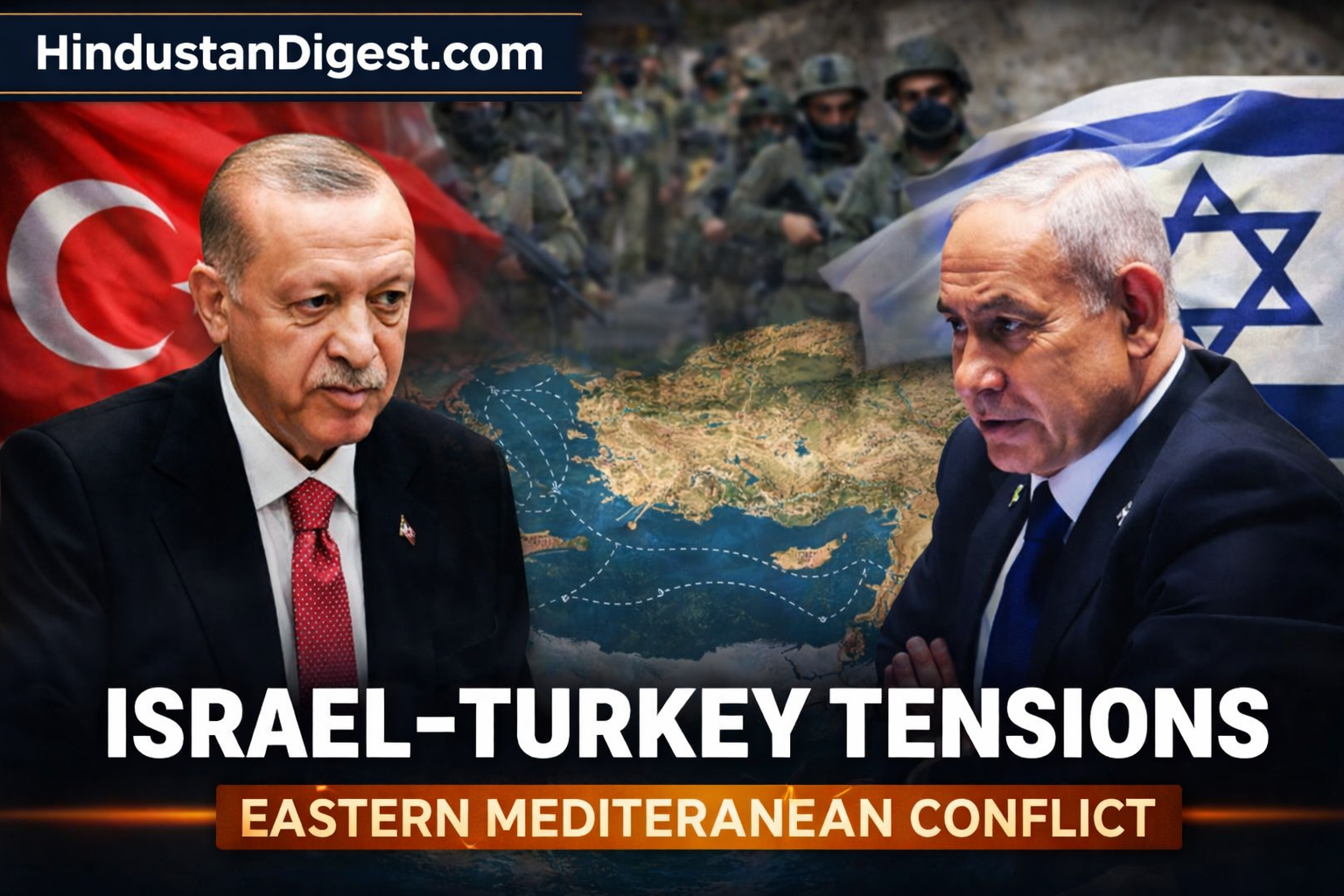
Israel-Turkey Tensions in the Eastern Mediterranean: Netanyahu’s Warning to Erdoğan and the Emerging Geopolitical Fault Lines.
Rising tensions between Israel and Turkey in the Eastern Mediterranean highlight shifting alliances, energy politics, and regional security concerns involving Greece and Cyprus.
The Eastern Mediterranean has once again emerged as a geopolitical flashpoint as reports circulate about Israeli Prime Minister Benjamin Netanyahu issuing a sharp warning to Turkish President Recep Tayyip Erdoğan regarding Turkey’s ambitions in the region. The warning, allegedly delivered in the context of trilateral coordination between Israel, Greece, and Cyprus, reflects deeper strategic anxieties over security, energy resources, and regional influence.
The underlying dynamics point to a broader realignment of power in the Eastern Mediterranean, where energy exploration, military posturing, and historical rivalries intersect.
Background: Israel–Turkey Relations Over Time.
Israel and Turkey once enjoyed close strategic ties, particularly during the 1990s, when military cooperation and intelligence sharing flourished. However, relations deteriorated significantly after:.
The 2009 Gaza conflict.
The 2010 Mavi Marmara incident, where Israeli commandos killed Turkish activists aboard a Gaza-bound flotilla
Erdoğan’s increasingly vocal criticism of Israeli policies toward Palestinians.
Although diplomatic relations were partially restored in recent years, mutual distrust remains deeply entrenched, particularly as Turkey pursues a more assertive regional policy.
The Eastern Mediterranean: Why It Matters.
1. Energy Discoveries:
The discovery of large offshore natural gas fields such as Israel’s Leviathan and Tamar fields has transformed the Eastern Mediterranean into a strategic energy corridor.
Greece, Cyprus, and Israel have sought to cooperate on:
Joint exploration projects
Energy pipelines to Europe
Reducing European dependence on Russian gas
Turkey, which disputes maritime boundaries with Greece and Cyprus, views these developments as excluding Ankara from regional energy frameworks.
2. Competing Maritime Claims:
Turkey rejects the maritime boundaries claimed by Greece and Cyprus, arguing that they unfairly limit Turkey’s access to energy resources. Ankara has deployed naval vessels and drilling ships to contested waters, escalating tensions.
Israel, by contrast, has aligned itself with Greece and Cyprus, supporting internationally recognized maritime frameworks.
3. Security and Military Cooperation
Israel, Greece, and Cyprus have expanded defense cooperation, including:
Joint military exercises
Intelligence sharing
Air and naval coordination.
From Ankara’s perspective, this trilateral cooperation appears designed to contain Turkish influence in the Mediterranean.
Also Read: Can India Catch Up with the US, Taiwan and China in the Global Chip Race?
Netanyahu’s Reported Warning: Strategic Messaging.
According to reports, Netanyahu warned Erdoğan not to pursue what Turkish leaders sometimes frame as a revival of Ottoman-era influence in the Mediterranean. The phrase “Don’t even think about it,” while dramatic, should be understood as strategic signaling rather than a declaration of military intent.
The message serves multiple purposes:
Reassuring Greece and Cyprus of Israel’s commitment
Deterring Turkish unilateral actions
Demonstrating Israel’s growing role as a Mediterranean security actor.
Turkey’s Perspective: Regional Power Assertion.
Turkey under Erdoğan has pursued an assertive foreign policy doctrine often described as “strategic autonomy.” This includes:
Expanding naval capabilities
Projecting influence in Libya, Syria, and the Eastern Mediterranean
Challenging Western-dominated security arrangements.
From Ankara’s viewpoint, Israeli-Greek-Cypriot cooperation risks marginalizing Turkey in a region it considers vital to its national security and economic future.
NATO, Alliances, and Diplomatic Complexity.
The situation is further complicated by NATO dynamics:
Turkey and Greece are both NATO members despite longstanding disputes
Israel is a close U.S. partner but not a NATO member
The United States and European Union have attempted to prevent escalation while balancing competing interests
This creates a fragile equilibrium, where diplomacy, deterrence, and energy politics coexist uneasily.
Is Turkey Really an “Emerging Threat” to Israel?
While Turkey is not an immediate military threat to Israel, strategic concerns include:
Turkey’s support for Hamas
Its expanding naval presence
Its opposition to Israeli-backed energy initiatives
For Israel, the concern is less about direct confrontation and more about regional balance of power and safeguarding economic and security interests.
Conclusion:
The reported warning from Netanyahu to Erdoğan underscores the deepening strategic rivalry in the Eastern Mediterranean, driven by energy resources, shifting alliances, and competing visions of regional order.
Rather than signaling imminent conflict, the episode highlights a new phase of geopolitical competition, where diplomacy, deterrence, and strategic partnerships will shape the future of the Mediterranean basin.
As long as energy interests remain unresolved and regional ambitions clash, tensions between Israel and Turkey are likely to persist, making the Eastern Mediterranean one of the most closely watched regions in global geopolitics.
Team: HindustanDigest.com
More Featured Articles:
Angel Investing in India: The New Wave of Micro-Angels
SME IPOs in India: Insights from Regulators, Bankers & Advisors
Funding and Investment Options to Grow India’s Real Estate and Allied Businesses
SIDBI – Powering India’s MSME Growth: Funding, Schemes & Business Support.
Venture Capital and Private Equity Funding in India: A Complete Founder’s Guide (2025)
Why MSMEs Trust Us With Their Most Critical Financial Decisions

One thought on “Israel–Turkey Tensions in the Eastern Mediterranean: Netanyahu’s Warning to Erdoğan and the Emerging Geopolitical Fault Lines.”