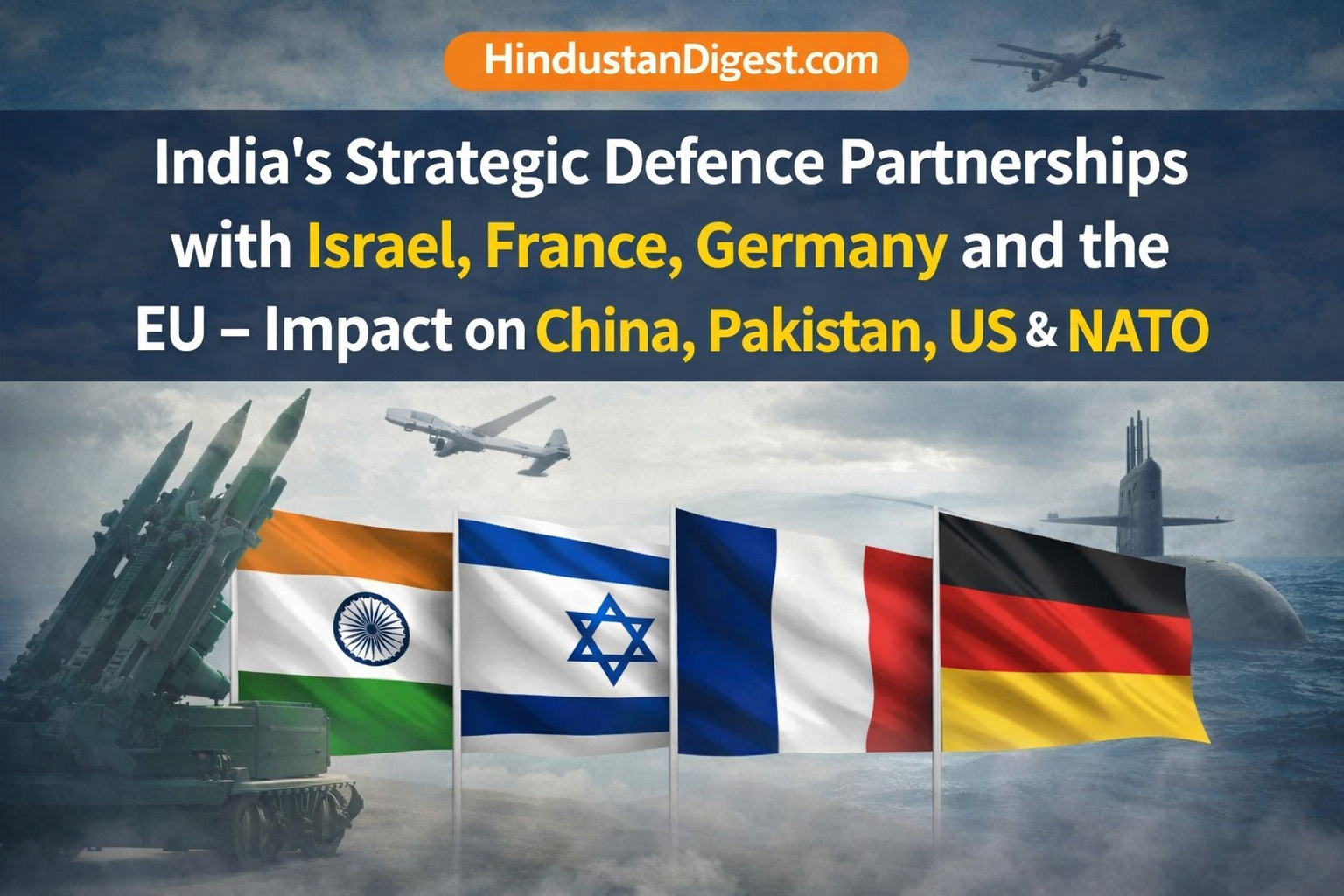
India’s Defence Diplomacy 2026: What Strategic Ties with Israel, France, Germany and the EU Mean for China, Pakistan, the US and NATO.
India’s expanding defence partnerships with Israel, France, Germany and the European Union mark a strategic shift in global geopolitics. Here’s what it means for China, Pakistan, the United States and NATO in 2026.
India’s Strategic Defence Reset: A Multi-Alignment Era.
India’s defence diplomacy is undergoing a decisive transformation. Over the past few years, New Delhi has moved beyond traditional procurement relationships and is now building deep, technology-driven strategic partnerships with major global powers including Israel, France, Germany and the European Union.
Rather than aligning exclusively with any single bloc, India is strengthening its position through calibrated multi-alignment reinforcing its strategic autonomy while expanding military capability, technological access, and industrial self-reliance.
This shift is not merely transactional. It signals India’s emergence as a central pillar in the evolving global security architecture.
Strengthening Ties with Israel: Technology, Intelligence and Missile Defence.
India’s defence partnership with Israel has matured into one of its most trusted strategic relationships. Cooperation spans:
Advanced missile systems,
Drone and UAV technologies,
Cyber warfare capabilities,
Border surveillance systems, and
Air defence platforms.
Israel’s strength lies in combat-proven, innovation-driven defence technology. For India, such partnerships accelerate indigenous manufacturing under the “Make in India” and “Atmanirbhar Bharat” frameworks through joint development and technology transfer.
The growing collaboration enhances India’s ability to counter asymmetric threats and modernize its armed forces rapidly.
France: A Long-Term Strategic Defence Partner.
France has emerged as one of India’s most reliable Western defence allies. The Indo-French defence relationship now includes:
Advanced fighter aircraft cooperation,
Naval platform collaboration,
Submarine technologies, and
Space and maritime domain awareness.
Unlike many Western nations, France has historically supported India’s strategic independence. Defence cooperation increasingly includes joint production and industrial collaboration rather than simple import-based acquisition.
For India, France offers both advanced military platforms and diplomatic flexibility in global forums.
Germany and the European Union: Industrial Power Meets Strategic Convergence.
Germany and the European Union represent industrial depth and regulatory stability. India’s engagement with Europe reflects:
Naval propulsion and submarine discussions,
Aerospace engineering cooperation,
Defence manufacturing partnerships, and
Cyber and AI-driven military technologies.
The European Union views India as a critical Indo-Pacific partner. For India, Europe offers diversification reducing overdependence on any single supplier while strengthening technology inflows.
This convergence aligns economic partnership with defence strategy, strengthening supply chain resilience.
What This Means for China.
China remains India’s primary long-term strategic competitor. India’s deepening defence ties with Israel and Europe send a clear message:
India is strengthening technological parity.
India is expanding maritime cooperation in the Indo-Pacific.
India is reinforcing its air and missile defence capabilities.
China may interpret these partnerships as part of a broader balancing coalition, especially as Europe shows greater Indo-Pacific engagement.
India, however, continues to frame its diplomacy as strategic autonomy rather than alliance politics.
Implications for Pakistan.
Pakistan’s defence ecosystem has traditionally relied heavily on China. India’s diversification and technological upgrades shift the conventional balance.
Enhanced surveillance, precision strike capabilities, and missile defence systems raise deterrence thresholds.
The signalling effect is significant: India is building layered defence capabilities with global partners, strengthening its conventional superiority.
Where Does the United States Stand?
The United States remains a key defence partner through intelligence cooperation, joint exercises, and Indo-Pacific security dialogues.
However, India’s outreach to Europe and Israel reinforces its non-aligned strategic doctrine. Rather than joining a NATO-style alliance, India prefers issue-based coalitions such as maritime security, technology partnerships, and regional deterrence cooperation.
Washington may view India’s European deepening positively, as it broadens the democratic security architecture in Asia.
NATO and the Indo-Pacific Dimension
NATO’s growing interest in the Indo-Pacific reflects recognition that European and Asian security are interconnected.
India is unlikely to formally align with NATO, but expanded interoperability, technology exchanges, and joint exercises are increasingly plausible.
India’s defence diplomacy strengthens its leverage without binding commitments a hallmark of its strategic culture.
Strategic Autonomy: India’s Core Doctrine.
At the heart of India’s defence diplomacy lies one principle strategic autonomy.
India seeks:
Multiple partnerships,
Technology transfer and local manufacturing,
Long-term industrial cooperation,
Supply chain diversification, and
Independent geopolitical decision-making
By engaging Israel, France, Germany and the EU simultaneously, India reduces vulnerability while maximizing capability gains.
The Bigger Picture: India as a Defence Manufacturing Hub
Beyond geopolitics, the deeper transformation lies in defence industrialization.
India aims to become:
A global defence production hub,
A technology co-development partner,
An exporter of military platforms, and
A key node in Indo-Pacific security.
If executed successfully, this model could redefine India’s global standing from arms importer to strategic manufacturer.
Conclusion: A New Chapter in Global Security Architecture.
India’s expanding defence diplomacy is not about choosing sides ,it is about expanding leverage.
Engagement with Israel, France, Germany and the European Union signals:
A maturing foreign policy,
A push for technological sovereignty,
A strategic counterweight in Asia, and
A diversified global partnership framework.
For China, it is a signal of strengthening deterrence.
For Pakistan, it raises the strategic threshold.
For the United States and NATO, it reinforces India’s centrality in Indo-Pacific stability.
India is no longer just balancing , it is shaping the emerging global order.
Team: HindustanDigest.com
More Featured Articles:
India Halts Water Flow of Ravi River to Pakistan: Understanding the Shahpur Kandi Project.
The Ultimate Guide to Burger Singh Franchise: How to Partner with India’s Fastest-Growing QSR Brand.
Strategic Finance Options for Medical and Hospital Businesses in India (2026)

3 thoughts on “India’s Defence Diplomacy 2026: What Strategic Ties with Israel, France, Germany and the EU Mean for China, Pakistan, the US and NATO.”