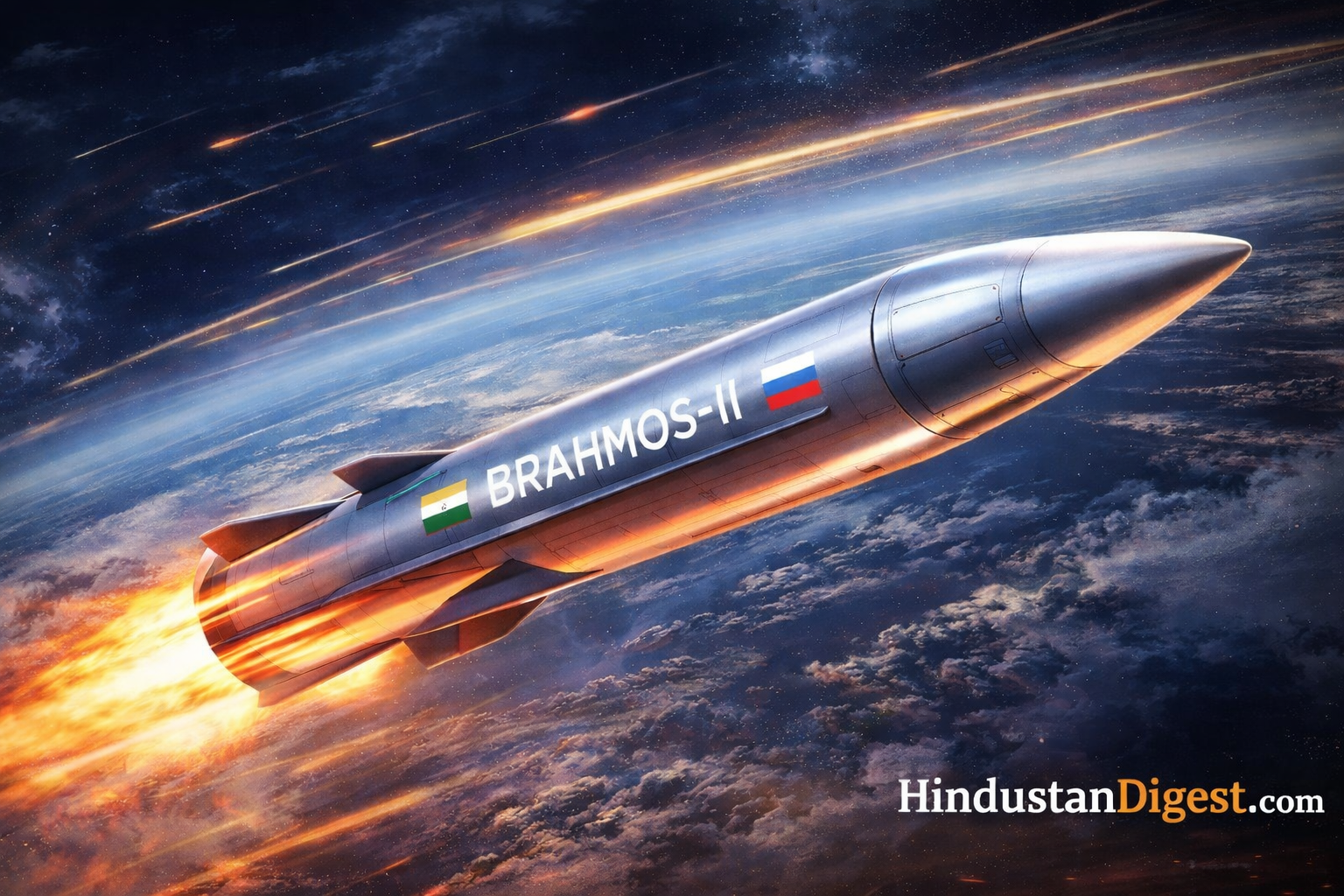
BrahMos-II Hypersonic Missile: How India’s Next-Generation Weapon Is Redefining Speed, Range, and Strategic Deterrence:
India is fast-tracking the BrahMos-II hypersonic missile, a next-generation weapon jointly developed with Russia. Learn how its Mach 7+ speed, extended range, and hypersonic cruise capability could reshape regional deterrence and global missile warfare.
BrahMos-II Hypersonic Missile: India’s Leap into the Future of Missile Warfare:
India is rapidly advancing into the elite global club of hypersonic weapon powers with the BrahMos-II hypersonic cruise missile, a next-generation system designed to dramatically enhance speed, range, precision, and survivability.
Jointly developed by India and Russia, BrahMos-II represents a major technological leap beyond the already-combat-proven BrahMos supersonic missile, positioning India at the forefront of future warfare.
As global militaries race to master hypersonic technologies, BrahMos-II is increasingly viewed as a strategic game-changer in the Indo-Pacific and South Asian security landscape.
Also Read:
Angel Investing in India: The New Wave of Micro-Angels
What Is BrahMos-II?
BrahMos-II (also referred to as BrahMos-IIK or BrahMos-II Hypersonic Cruise Missile) is a hypersonic cruise missile under advanced development, intended to operate at speeds exceeding Mach 7-more than seven times the speed of sound.
Unlike traditional ballistic missiles that follow predictable arcs, BrahMos-II is designed to:
Fly at extreme hypersonic speeds,
Maintain sustained atmospheric cruise,
Execute high-maneuverability trajectories, and
Evade modern missile defence systems.
This places it in a fundamentally different class of weaponry compared to conventional cruise or ballistic missiles.
Key Technological Advancements of BrahMos-II.
1. Hypersonic Speed (Mach 7+) : The most defining feature of BrahMos-II is its hypersonic velocity, enabling it to strike targets within minutes of launch.
At such speeds:
Reaction time for adversaries is drastically reduced,
Interception becomes extremely difficult,
Target engagement windows shrink to seconds,
This speed alone gives BrahMos-II a decisive edge over existing air defence systems.
2. Scramjet Propulsion Technology: BrahMos-II is expected to use an advanced scramjet (supersonic combustion ramjet) engine, allowing sustained hypersonic flight within the atmosphere.
Benefits of scramjet propulsion include:
Higher fuel efficiency at extreme speeds
Longer ranges compared to boost-glide systems
Enhanced mid-course maneuverability
India’s progress in scramjet testing and hypersonic flight demonstrators directly supports BrahMos-II’s development.
3. Extended Range: While the original BrahMos operates in the supersonic regime with a limited range, BrahMos-II is expected to feature:
Significantly enhanced strike radius,
Deep precision-strike capability, and
Flexibility across multiple theatres of operation
This expanded range increases India’s stand-off strike capability, reducing exposure of launch platforms.
4. Precision and Survivability: BrahMos-II is being designed with:
Advanced guidance and navigation systems,
High accuracy against hardened and high-value targets,
Low detectability due to speed, altitude variation, and maneuvering,
Combined, these factors make the missile exceptionally difficult to track, target, and intercept, even by next-generation air defence networks.
Why BrahMos-II Is Hard to Intercept:
Modern missile defence systems are optimized for:
Ballistic missiles with predictable trajectories,
Subsonic or low-supersonic cruise missiles,
BrahMos-II challenges these systems by:
Flying unpredictably at hypersonic speeds,
Maneuvering throughout its flight path, and
Compressing detection-to-interception timelines
For adversaries, this creates a defence saturation problem, where interception becomes technologically and economically impractical.
Also Read:
Venture Capital and Private Equity Funding in India: A Complete Founder’s Guide (2025)
Strategic Implications for India:
1. Strengthening Deterrence: BrahMos-II significantly enhances India’s credible deterrence posture by ensuring the ability to conduct rapid, precise, and survivable strikes against high-value targets.
2. Regional Power Balance: The missile alters the strategic calculus in Asia by:
Countering advances in missile defence systems,
Offsetting numerical disadvantages with technological superiority,
Enhancing second-strike and conventional deterrence options
3. Technological Sovereignty: The program reflects India’s growing capability in:
Indigenous missile design,
Hypersonic research,
Advanced materials and propulsion systems,
This aligns with India’s broader push toward defence self-reliance and high-technology weapon development.
India–Russia Defence Collaboration:
BrahMos-II continues the long-standing India–Russia defence partnership, combining:
Russian experience in hypersonic research,
Indian expertise in missile integration, software, and systems engineering,
This collaboration accelerates development timelines while ensuring operational relevance for Indian defence requirements.
Also Read:
Comparison with Global Hypersonic Programs:
Globally, only a handful of countries are actively developing hypersonic weapons. BrahMos-II places India among:
The world’s leading hypersonic research powers,
Nations shaping the future of missile warfare,
States capable of deploying next-generation precision strike systems.
Unlike experimental platforms, BrahMos-II is being developed with operational deployment in mind, making it particularly significant.
Future Deployment Possibilities:
While official details remain classified, BrahMos-II is expected to be adaptable across:
Land-based mobile launchers,
Naval platforms, and
Potential future air-launch configurations.
Such multi-platform compatibility would maximize flexibility and survivability.
Conclusion:
The BrahMos-II hypersonic missile is far more than an incremental upgrade, it represents a paradigm shift in India’s military capabilities. By combining extreme speed, extended range, advanced propulsion, and precision strike capability, BrahMos-II positions India at the cutting edge of modern warfare.
As hypersonic weapons increasingly define global military power, BrahMos-II underscores India’s emergence as a technologically advanced strategic force, capable of shaping deterrence dynamics well into the next decade and beyond.
Team: HindustanDigest.com
More Featured Articles:
Funding and Investment Options to Grow India’s Real Estate and Allied Businesses
CFO Services for Startups: Why Virtual CFOs Are Transforming Business Scalability in India
SIDBI – Powering India’s MSME Growth: Funding, Schemes & Business Support.
Why MSMEs Trust Us With Their Most Critical Financial Decisions


3 thoughts on “BrahMos-II Hypersonic Missile: How India’s Next-Generation Weapon Is Redefining Speed, Range, and Strategic Deterrence”