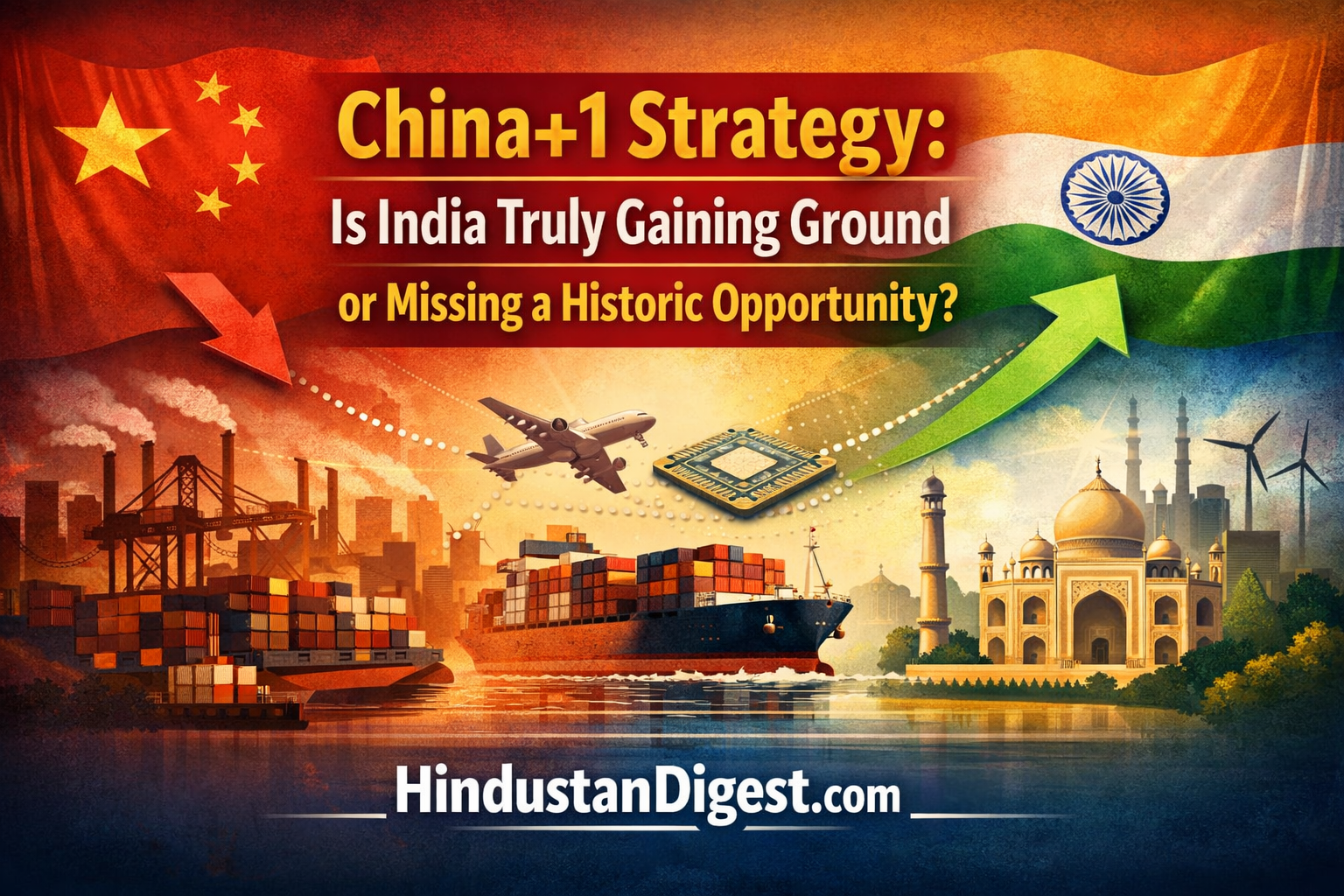
China+1 Strategy: Is India Truly Gaining Ground or Missing a Historic Opportunity?
Is India capitalizing on the China+1 strategy? Explore opportunities, challenges, FDI trends, manufacturing growth, and whether India is emerging as a global supply chain leader.
Introduction
The global economic landscape is undergoing a structural transformation. Rising geopolitical tensions, supply chain disruptions, and lessons learned from the COVID-19 pandemic have compelled multinational corporations to rethink their dependence on China. This has given rise to the widely discussed China+1 strategy, a diversification approach where companies maintain operations in China while expanding manufacturing into alternative countries.
India, with its vast labor force, growing domestic market, and policy push, is often seen as a natural beneficiary. But the critical question remains:
Is India truly capitalizing on this once-in-a-generation opportunity, or is it falling short while competitors surge ahead?
Understanding the China+1 Strategy
The China+1 strategy is not about abandoning China it is about risk mitigation. Global firms are looking to:
- Reduce overdependence on a single geography
- Hedge against geopolitical risks
- Optimize cost structures
- Build resilient supply chains
Countries like Vietnam, Indonesia, Thailand, and Mexico have aggressively positioned themselves as alternative manufacturing hubs.
Why India Should Be a Natural Winner
India possesses several structural advantages:
1. Demographic Dividend
With one of the world’s youngest populations, India offers a large, cost-effective workforce.
2. Large Domestic Market
A growing middle class makes India not just a manufacturing base, but also a consumption powerhouse.
3. Policy Push
Government initiatives such as:
- Make in India
- Production Linked Incentive (PLI) Scheme
- National Logistics Policy
have aimed to boost manufacturing competitiveness.
4. Geopolitical Alignment
India is seen as a stable and strategic partner by Western economies seeking to reduce reliance on China.
Signs That India Is Benefiting
India has made notable progress in certain sectors:
1. Electronics Manufacturing Boom
India has emerged as a major assembly hub for smartphones, with global giants expanding operations. Exports of mobile phones have surged significantly in recent years.
2. Rising Foreign Direct Investment (FDI)
India continues to attract strong FDI inflows, particularly in:
- Electronics
- Renewable energy
- Automotive components
3. Growth in Export-Oriented Sectors
Sectors such as:
- Pharmaceuticals
- Chemicals
- Textiles
have seen increased global demand diversification.
4. Semiconductor Ambitions
India has announced plans and incentives to enter the semiconductor manufacturing space, critical for long-term strategic positioning.
Where India Is Falling Behind
Despite progress, several challenges are preventing India from fully capitalizing:
1. Infrastructure Gaps
While improving, India’s logistics and infrastructure still lag behind competitors like Vietnam and China in terms of efficiency and cost.
2. Complex Regulatory Environment
Businesses often face:
- Lengthy approval processes
- Compliance burdens
- Policy unpredictability
3. Land and Labor Issues
- Land acquisition remains cumbersome
- Labor laws, though reformed, still present execution challenges
4. Supply Chain Ecosystem Weakness
Unlike China, India lacks deeply integrated supplier ecosystems, making it harder for companies to scale rapidly.
5. Execution vs Policy Gap
India excels in announcing reforms, but implementation speed remains inconsistent.
How Competitors Are Outpacing India
Vietnam
- Faster approvals
- Strong trade agreements
- Export-oriented policies
Mexico
- Proximity to the U.S. market
- Beneficiary of nearshoring trends
Indonesia & Thailand
- Focused industrial policies
- Better ease of doing business in manufacturing clusters
These countries have been quicker in translating policy into on-ground execution, attracting large-scale manufacturing shifts.
Sector-Wise Reality Check
Electronics
India is gaining traction, but still heavily dependent on imports for components.
Textiles
Opportunity exists due to China’s declining dominance, but Bangladesh and Vietnam remain strong competitors.
Automobiles & EVs
India is well-positioned, especially in EV components, but needs stronger supply chain integration.
Renewable Energy
India is a global leader in solar capacity addition but still imports a significant portion of equipment.
What India Must Do to Win
To fully leverage the China+1 shift, India must focus on:
1. Infrastructure Acceleration
- Faster development of industrial corridors
- Port modernization
- Logistics cost reduction
2. Policy Stability & Simplification
- Single-window clearances
- Predictable tax regime
- Reduced compliance burden
3. Strengthening Supply Chains
- Incentivizing component manufacturing
- Developing industrial clusters
4. Skilling the Workforce
- Industry-aligned vocational training
- Focus on advanced manufacturing skills
5. Faster Execution
Speed is critical. Countries that act faster will lock in long-term investments.
The Verdict: Opportunity Still Open, But Not Forever
India is partially benefiting from the China+1 strategy—but not to the extent its potential suggests.
The window of opportunity is still open, but it is narrowing.
If India can:
- Bridge execution gaps
- Strengthen infrastructure
- Simplify regulations
it could emerge as a global manufacturing powerhouse.
However, failure to act decisively could result in India missing one of the biggest economic opportunities of this decade, while smaller, more agile economies take the lead.
Conclusion
The China+1 strategy represents a historic realignment of global supply chains. India stands at a crossroads:
- Accelerate reforms and capture the moment, or
- Move incrementally and lose ground to faster competitors
The coming decade will determine whether India becomes the next factory of the world or remains a promising but under-realized contender.
Team: Hindustan Digest
More Featured Articles:
Satellite Deception and Nuclear Mobility: China’s Use of Civilian Disguise for ICBM Launchers
Can India Catch Up with the US, Taiwan and China in the Global Chip Race?
How Did China’s Trade Surplus Hit $1 Trillion? Key Drivers Behind the Historic Surge
Ultimate Guide to Early Stage Startup Funding in MENA (2026): Top Investors & Strategies
Why Kjøller Is an Important Venture Capital Investor for Startups Globally.
Ultimate Guide to Early Stage Startup Funding in MENA (2026): Top Investors & Strategies

One thought on “China+1 Strategy: Is India Truly Gaining Ground or Missing a Historic Opportunity?”