Ideological Shielding: Congress Distances from Jamaat-e-Islami Over ‘Islamic Republic’ Row
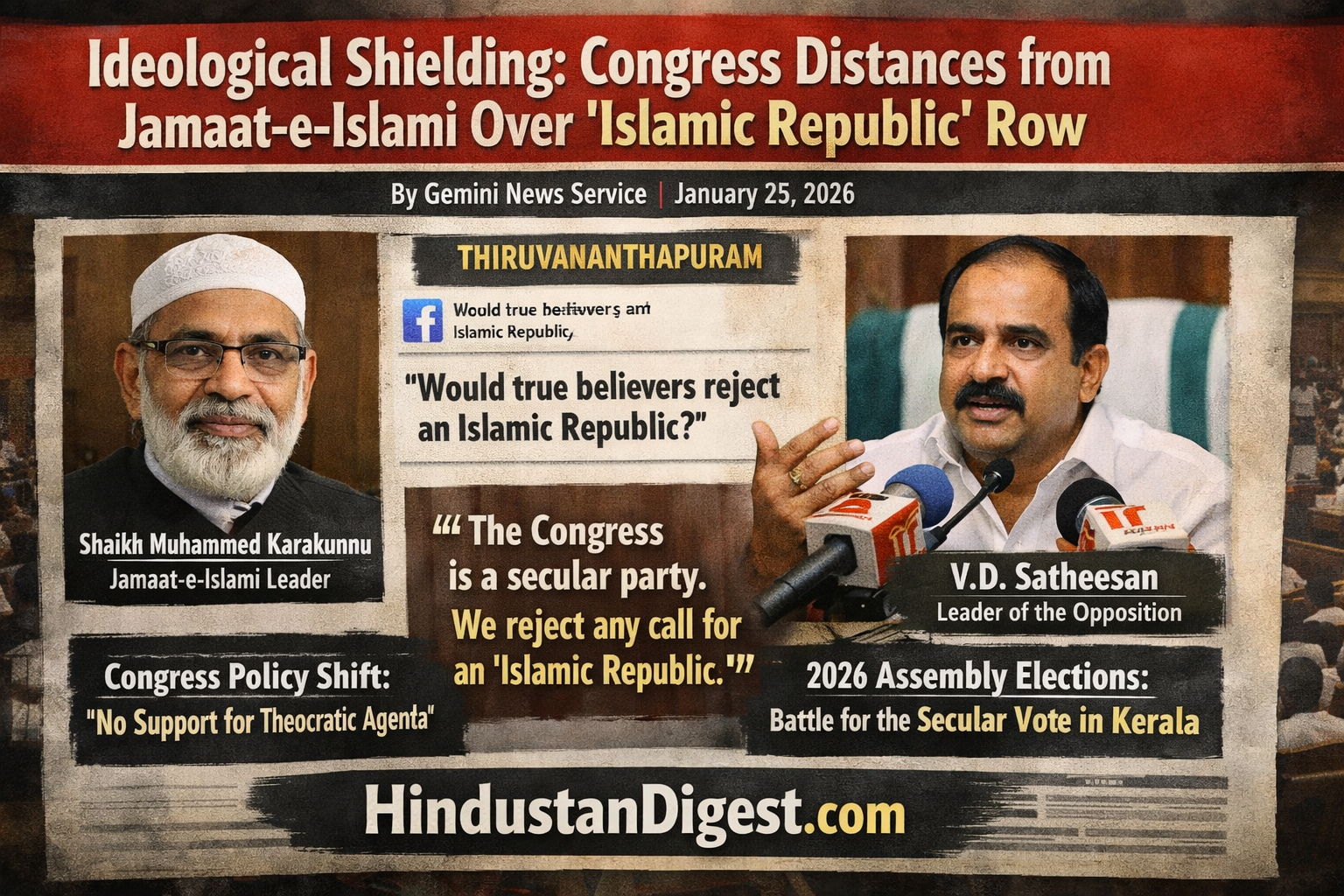
Congress in Kerala distances itself from Jamaat-e-Islami after a senior leader’s call for an “Islamic Republic,” as V.D. Satheesan reaffirms the party’s commitment to secularism ahead of the 2026 Assembly elections.
THIRUVANANTHAPURAM – The Congress-led United Democratic Front (UDF) in Kerala has signaled a strategic retreat from its perceived association with the Jamaat-e-Islami Hind (JIH), following a controversial social media post by a senior leader of the Islamist organization advocating for the establishment of an “Islamic Republic.”
The controversy erupted after Shaikh Muhammed Karakunnu, a prominent state leader and secretary of the Jamaat-e-Islami, published a Facebook post titled “Would true believers reject an Islamic Republic?”
In the post, Karakunnu argued that the concept of an Islamic Republic, modeled after the early administration in Medina, remains a core ideal for believers.
Congress Policy Shift
Leader of the Opposition V.D. Satheesan moved quickly to mitigate the political fallout. Speaking to reporters on Saturday, Satheesan stated that the Congress would categorically reject electoral support from any organization that maintains an agenda for a theocratic state.
”The Congress is a secular party. If any organization believes in an ‘Islamic Republic’ or any form of religious statehood, we do not want their support,” Satheesan said. This marks a significant pivot, as the Congress has previously been accused by rivals of maintaining a “soft” stance toward the Jamaat’s political wing, the Welfare Party of India, to consolidate minority votes.
Political Context: The Battle for the Secular High Ground
The timing of this distancing is critical, as Kerala prepares for the 2026 Assembly Elections. The state’s unique demographic where minorities constitute nearly 45% of the population makes the “secular” tag a vital political currency.
Party/Front | Current Stance | Allegation |
|---|---|---|
Congress (UDF) | Rejects support if radical goals persist. | Accused of “opportunistic” ties for vote-bank politics. |
CPI(M) (LDF) | Direct attack on Jamaat as “anti-social.” | Accused of stoking “Islamophobia” to woo majority votes. |
BJP (NDA) | Labels the UDF-Jamaat link a threat to national security. | Accused of communal polarization. |
- Also Read: Why Some Critics Compare Rahul Gandhi’s Leadership to Historical Invaders – A Political Opinion
Ramifications: A Triple-Edged Sword
1. The “Majoritarian” Trap The CPI(M) has been relentless in its attack. State Secretary M.V. Govindan recently mocked the Congress, noting that while Satheesan previously claimed the Jamaat had “moderated,” the group’s own leaders have now proven otherwise. By forcing the Congress to distance itself, the Left aims to paint the UDF as ideologically hollow.
2. The Minority Vote Bank The Congress faces a delicate balancing act. By distancing itself from the Jamaat, it risks alienating a section of the conservative Muslim vote. However, failing to do so allows the BJP and the Left to alienate the Christian and Hindu communities from the UDF by branding the front as “pro-extremist.”
3. BJP’s “National Security” Narrative The BJP has leveraged the row to connect Kerala’s local politics to broader regional concerns. BJP spokespersons have highlighted the recent rise of Jamaat-e-Islami in neighboring Bangladesh to argue that the organization’s ideology is inherently “anti-national,” putting further pressure on the Congress to define its boundaries.
The Road Ahead
The “Islamic Republic” remark has effectively shut the door on any formal or “under-the-table” alliance between the UDF and the Jamaat for the upcoming polls. For V.D. Satheesan and the Congress, the challenge now is to convince the electorate that their secularism is not just a matter of political convenience, but a core ideological commitment.
As the rhetoric sharpens, the 2026 election is increasingly looking like a referendum on how Kerala defines its secular identity in an era of growing religious polarization.
Team: HindustanDigest.com
More Featured Articles:
Trump Planning New “Superclub” With India? Inside the Buzz Around a Potential Core-5 Power Grouping.
Strategic Finance Options for Medical and Hospital Businesses in India (2026)
SME IPOs in India: Insights from Regulators, Bankers & Advisors
Unlock Growth: How to Secure ₹1 Cr – ₹15 Cr Unsecured Funding for Your Business :
One thought on “Ideological Shielding: Congress Distances from Jamaat-e-Islami Over ‘Islamic Republic’ Row.”