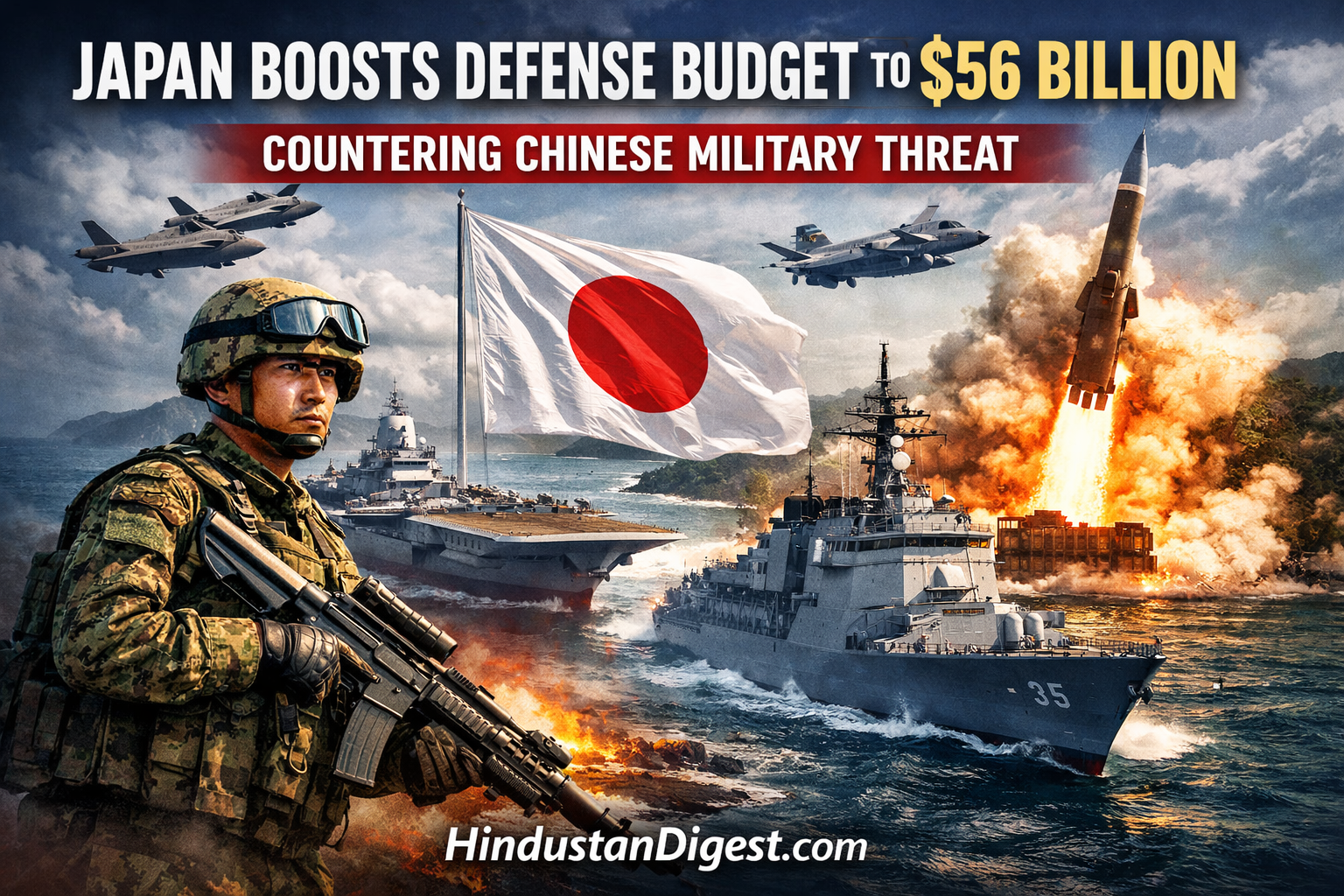
Japan Raises Defense Budget to $56 Billion Amid Escalating Chinese Military Pressure in the Indo-Pacific.
Japan has increased its defense budget to $56 billion as part of a historic military buildup aimed at countering China’s expanding naval, air, and missile capabilities in the Indo-Pacific region.
Japan Raises Defense Budget to $56 Billion Amid Escalating Chinese Military Pressure in the Indo-Pacific.
Japan has taken a decisive step in reshaping its post-war security posture by raising its defense budget to approximately $56 billion, marking one of the most significant military expansions in the country’s modern history.
The move comes amid growing concerns over China’s rapidly expanding military capabilities and increasingly assertive behavior in the Indo-Pacific, particularly around the East China Sea and Taiwan Strait.
This budget increase reflects Tokyo’s strategic assessment that the regional security environment has entered what Japanese officials describe as “the most severe and complex phase since World War II.”
Also Read:
Trump Planning New “Superclub” With India? Inside the Buzz Around a Potential Core-5 Power Grouping.
Strategic Drivers Behind the Budget Increase.
The primary catalyst for Japan’s defense spending surge is China’s sustained military modernization. The People’s Liberation Army (PLA) has dramatically expanded its naval fleet, long-range missile forces, air power, and cyber capabilities, enabling Beijing to project power far beyond its shores.
Of particular concern to Japan are:
Frequent PLA naval and air operations near the Senkaku Islands (administered by Japan, claimed by China),
China’s expanding aircraft carrier program,
Ballistic and hypersonic missile developments capable of striking Japanese territory,
Joint Chinese-Russian military patrols near Japan’s airspace and waters,
These developments have prompted Tokyo to reassess its traditionally restrained defense policy..
Key Areas of Defense Spending.
The $56 billion allocation focuses on strengthening Japan’s deterrence and response capabilities across multiple domains:
Missile Defense and Counter-Strike Capabilities:
Japan is investing heavily in long-range precision strike systems, including the acquisition and domestic production of extended-range missiles. This marks a historic shift toward possessing counter-strike capabilities designed to deter missile attacks before launch.
Naval and Air Power Enhancement
Funding will support new Aegis-equipped destroyers, next-generation submarines, and upgrades to the Japan Air Self-Defense Force, including enhanced interoperability of F-35 fighter aircraft with allied forces.
Cyber, Space, and Electronic Warfare
Recognizing modern warfare’s evolving nature, Japan is expanding its cyber defense units, space surveillance programs, and electronic warfare capabilities to counter grey-zone and hybrid threats.
Defense Industrial Base Strengthening
The budget also aims to revitalize Japan’s domestic defense industry, ensuring supply chain resilience and faster production of critical military hardware.
Also Read:
Can India Catch Up with the US, Taiwan and China in the Global Chip Race?
Implications for Regional Security:
Japan’s defense expansion sends a strong strategic signal across the Indo-Pacific. While Tokyo maintains that its policies remain defensive in nature, Beijing has criticized the move as destabilizing.
However, regional partners view Japan’s actions as a necessary counterbalance to China’s growing military dominance.
The budget increase also reinforces the US-Japan security alliance, enhancing joint deterrence capabilities and operational integration. It aligns closely with broader efforts by democratic Indo-Pacific nations to maintain freedom of navigation, territorial integrity, and rules-based order.
Domestic Debate and Constitutional Constraints.
Despite strong government backing, Japan’s defense buildup remains a topic of domestic debate. Critics argue that rising military spending could strain public finances and challenge the pacifist spirit of Japan’s constitution. Supporters counter that evolving threats demand pragmatic adaptation to ensure national survival and regional stability.
The government has emphasized that all measures remain within constitutional bounds, focusing on deterrence rather than aggression.
Conclusion.
Japan’s decision to raise its defense budget to $56 billion represents a watershed moment in its national security strategy. As China continues to expand its military footprint, Tokyo is signaling its resolve to defend its sovereignty, protect vital sea lanes, and contribute more actively to regional stability.
In an increasingly contested Indo-Pacific, Japan’s military modernization is likely to play a central role in shaping the balance of power for years to come.
Team: HindustanDigest.com
More Featured Articles:
Funding and Investment Options to Grow India’s Real Estate and Allied Businesses
SIDBI – Powering India’s MSME Growth: Funding, Schemes & Business Support.
Why MSMEs Trust Us With Their Most Critical Financial Decisions
Venture Capital and Private Equity Funding in India: A Complete Founder’s Guide (2025)


One thought on “Japan Raises Defense Budget to $56 Billion Amid Escalating Chinese Military Pressure in the Indo-Pacific”