Satellite Deception and Nuclear Mobility: China’s Use of Civilian Disguise for ICBM Launchers.
Open-source imagery suggests China is disguising Dongfeng ICBM launchers as construction cranes, highlighting advanced satellite deception tactics and the evolving survivability of PLA Rocket Force nuclear assets.
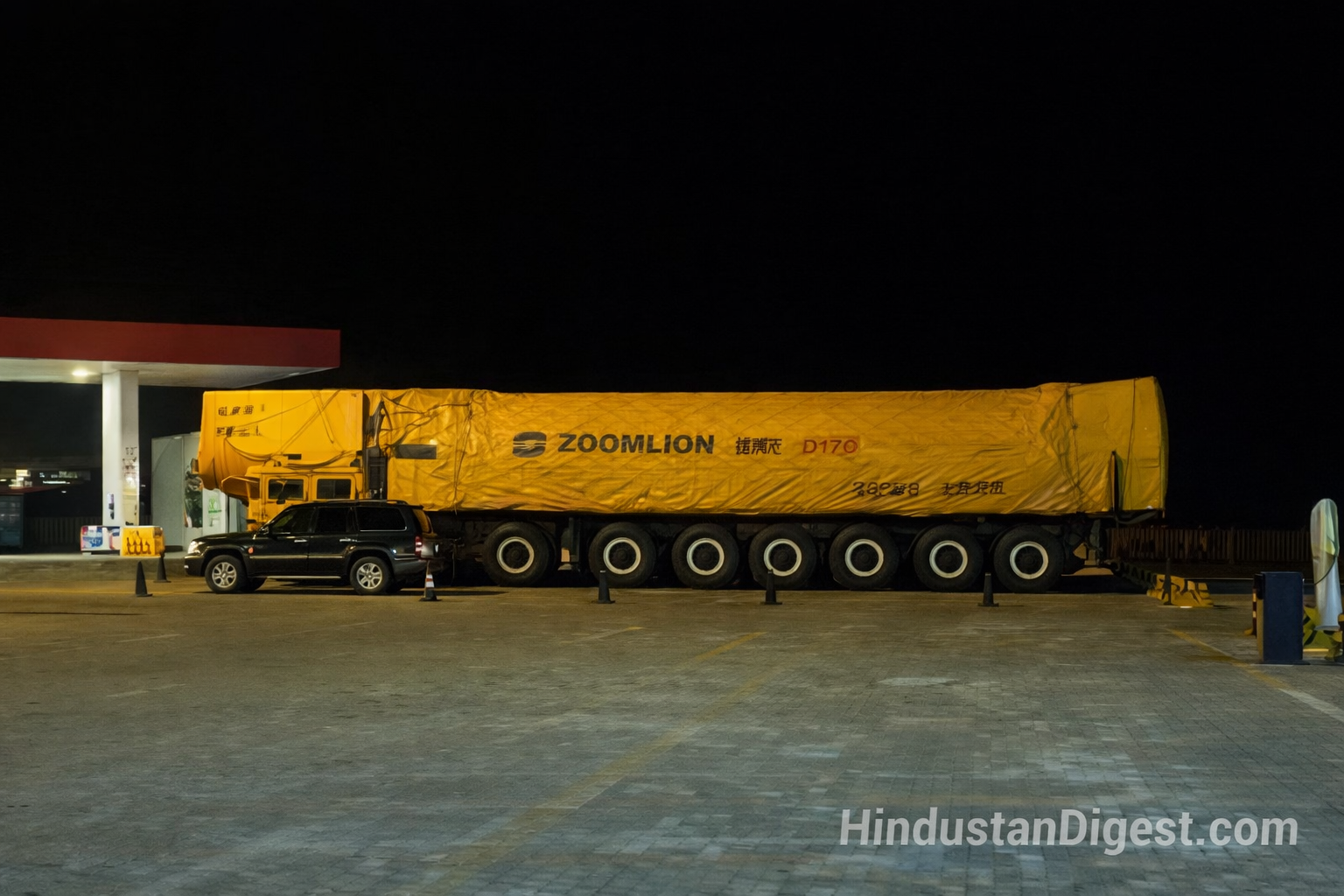
Recent imagery circulating in open-source intelligence (OSINT) and defence analysis circles indicates that China may be disguising road-mobile intercontinental ballistic missile (ICBM) launchers as civilian construction equipment, specifically large industrial cranes.
If accurate, this represents a notable evolution in the People’s Liberation Army Rocket Force (PLARF) approach to camouflage, concealment, and deception (CCD), particularly against space-based surveillance.
The tactic appears designed to complicate foreign intelligence efforts to track, count, and assess the readiness of China’s nuclear forces.
Also Read:
What the Image Suggests.
The vehicle shown in the image presents several features inconsistent with genuine civilian construction cranes:
Unusually high axle count, typical of heavy missile TELs
Long cylindrical covered structure, matching known Dongfeng missile canister dimensions
Lack of functional crane components, such as booms or counterweights
Operational context, including nighttime movement and refuelling at roadside facilities.
These characteristics strongly resemble Dongfeng-series ICBM transporter-erector-launchers, repainted and branded to resemble commercial heavy equipment.
China’s Mobile Nuclear Deterrent.
China’s land-based nuclear deterrent relies heavily on road-mobile missile systems, including:
DF-31 / DF-31A
DF-41, believed capable of carrying MIRVs
Mobility enhances survivability by:
Reducing vulnerability to pre-emptive strikes
Allowing dispersal across vast road networks
Enabling rapid repositioning during crises
Disguising TELs as civilian vehicles further strengthens this survivability by obscuring movements in peacetime and crisis conditions alike.
Why Civilian Disguise Matters.
1. Countering Satellite Intelligence
Modern ISR relies not only on imagery but also on pattern-of-life analysis and AI-driven object recognition. Civilian camouflage increases false positives and forces analysts to rely on additional intelligence layers, slowing assessments.
2. Strategic Ambiguity
By blending nuclear assets into civilian traffic flows, China introduces uncertainty regarding:
Missile numbers
Deployment locations
Alert status
This ambiguity enhances deterrence by complicating adversary targeting and planning.
3. Integrated CCD Doctrine
China has long emphasized deception in military thought. This approach suggests an integrated CCD strategy, combining:
Visual camouflage,
Civilian branding,
Operational timing,
Infrastructure masking,
It reflects a mature understanding of how Western intelligence systems function.
Also Read:
Risks and Implications.
While effective from a survivability standpoint, this tactic carries risks:
Crisis instability: Civilian-looking vehicles may be misidentified or targeted during heightened tensions
Escalation concerns: Blurring civilian–military boundaries complicates rules of engagement.
Arms control verification challenges: Mobile, disguised systems are harder to monitor under any future agreements.
For rival powers, this underscores the growing importance of multi-sensor intelligence fusion, including SAR, SIGINT, and persistent surveillance rather than reliance on optical imagery alone.
Broader Nuclear Modernization Trends.
This apparent deception effort aligns with wider indicators of China’s nuclear expansion, including:
New missile silo fields,
Growth in mobile launcher numbers,
Improved command, control, and survivability measures,
Integration of space and electronic warfare into strategic planning,
Together, these trends suggest a shift toward a more robust and flexible nuclear posture.
Conclusion:
If confirmed, the use of construction-crane disguise for ICBM launchers highlights how modern nuclear deterrence increasingly depends on deception as much as firepower. As surveillance capabilities improve, so too do methods to defeat them.
For defence analysts and intelligence planners, the key takeaway is clear: civilian appearance can no longer be taken at face value in strategic contexts. The battlespace now extends well beyond weapons themselves to how they are seen, classified, and misunderstood from orbit.
Team: HindustanDigest.com
More Featured Articles:
Funding and Investment Options to Grow India’s Real Estate and Allied Businesses
Can India Catch Up with the US, Taiwan and China in the Global Chip Race?
Trump Planning New “Superclub” With India? Inside the Buzz Around a Potential Core-5 Power Grouping.
SIDBI – Powering India’s MSME Growth: Funding, Schemes & Business Support.
Venture Capital and Private Equity Funding in India: A Complete Founder’s Guide (2025)


One thought on “Satellite Deception and Nuclear Mobility: China’s Use of Civilian Disguise for ICBM Launchers”