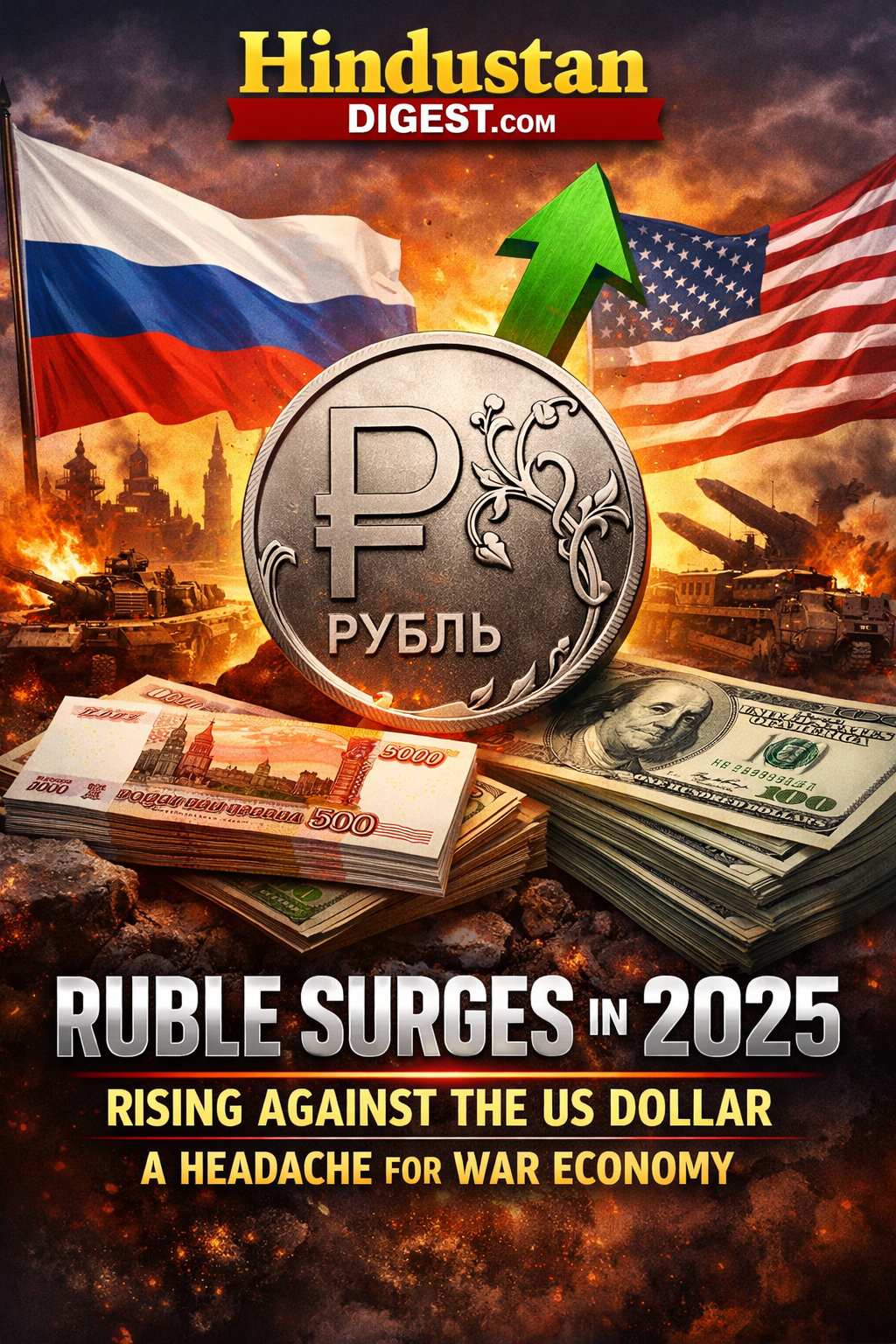
Ruble Surges in 2025: Russian Currency Emerges as Top Performer Against the US Dollar – Why It’s a Headache for Russia’s War Economy.
The Russian ruble has emerged as one of the world’s top-performing currencies against the US dollar in 2025. But behind the ruble’s strength lies a troubling paradox for Russia’s war-driven economy.
Ruble Surges in 2025: A Surprising Currency Winner.
In a surprising twist for global financial markets, the Russian ruble has emerged as one of the strongest-performing currencies against the US dollar in 2025. Despite ongoing Western sanctions, geopolitical isolation, and the prolonged war in Ukraine, the ruble has not only stabilized but surged, outperforming many major and emerging market currencies.
At first glance, the ruble’s rally in 2025 appears to signal economic resilience. However, for Russia’s war-dependent economy, a strong ruble is proving to be a double-edged sword and increasingly a liability.
Also Read: Can India Catch Up with the US, Taiwan and China in the Global Chip Race?
Why Is the Russian Ruble Rising in 2025?.
The ruble’s strength against the US dollar is not the result of traditional market confidence. Instead, it reflects a mix of state controls, forced demand, and structural distortions within Russia’s economy.
1. Strict Capital Controls
The Russian government continues to enforce tight capital controls, limiting how much foreign currency individuals and businesses can move abroad. This artificially suppresses demand for dollars and euros while propping up the ruble.
2. Mandatory FX Conversion for Exporters
Russian exporters especially in oil, gas, and commodities are required to convert a large share of their foreign currency earnings into rubles. This creates constant artificial demand for the ruble, strengthening its exchange rate.
3. High Interest Rates
The Central Bank of Russia has maintained elevated interest rates to curb inflation and stabilize the currency. High yields make holding rubles attractive domestically, even as foreign investment remains minimal..
4. Reduced Imports
Sanctions and supply chain disruptions have drastically reduced imports. With less demand for foreign goods, there is less need for foreign currency, further supporting the ruble.
The Ruble’s Strength Masks Economic Weakness.
While the ruble’s surge in 2025 looks impressive on currency charts, it does not reflect genuine economic health.
Russia’s economy has become increasingly militarized, with growth driven by defense spending, arms production, and state subsidies. This model benefits from a weaker currency, not a stronger one.
Why a Strong Ruble Hurts Russia’s War Economy.
1. Lower Export Revenues
Russia’s budget relies heavily on oil, gas, and commodity exports, which are priced in US dollars. A stronger ruble means fewer rubles per dollar earned, reducing government revenue at a time when war spending is soaring.
2. Budget Pressure
With military expenditures consuming a growing share of public spending, a strong ruble widens fiscal deficits. The Kremlin must either cut spending elsewhere, raise taxes, or draw down reserves.
3. Reduced Inflation Cushion
A weaker ruble historically helped Russia inflate away some costs. A strong ruble limits this mechanism, making it harder to manage war-driven inflation and rising wages.
4. Manufacturing Competitiveness Declines
Russian manufacturers, already struggling with technology shortages due to sanctions, face higher relative costs when the ruble strengthens, making domestic production less competitive.
Please Read:
A Currency Propped Up, Not Trusted.
Crucially, the ruble’s rise in 2025 is not driven by global investor confidence. Russia remains largely cut off from international capital markets, and the ruble is not freely traded in global forex markets.
Instead, analysts describe the ruble as a “managed currency”, whose value reflects policy decisions rather than market fundamentals. This makes the ruble’s strength fragile and reversible.
Geopolitics and the Illusion of Strength.
The ruble’s performance is also shaped by geopolitics. As Russia pivots trade toward China, India, and non-Western partners, settlements increasingly occur in rubles, yuan, or local currencies. While this reduces dollar dependence, it also locks Russia into less favorable trade terms.
What Happens Next for the Ruble in 2025?
Most economists believe the ruble’s surge will be difficult to sustain. Any of the following could weaken the currency sharply:
Falling global oil prices
Rising military expenditures
Relaxation of capital controls
Increased imports through sanction workarounds
Pressure on foreign exchange reserves.
In short, the ruble’s strength is policy-driven, not productivity-driven.
Conclusion: A Strong Ruble, A Weak Signal
The Russian ruble’s rise in 2025 may headline as a financial success, but beneath the surface it highlights the contradictions of Russia’s war economy. A currency that looks strong on paper is undermining export earnings, straining the budget, and complicating wartime economic management.
For Russia, the ruble’s rally is not a victory, it is a headache, revealing how deeply distorted the economy has become under sanctions and war.
Team: Hindustan Digest
More Featured Articles:
China Growth Weakens as Retail Sales and Investment Miss Forecasts, Raising Stimulus Expectations
Funding and Investment Options to Grow India’s Real Estate and Allied Businesses
SIDBI – Powering India’s MSME Growth: Funding, Schemes & Business Support.
Jio Finance Loan Against Property – Attractive Interest From 9.25%, High LTV & Fast Approvals
Why MSMEs Trust Us With Their Most Critical Financial Decisions
Venture Capital and Private Equity Funding in India: A Complete Founder’s Guide (2025)